1 Department of Interventional Radiology, The Seventh Affiliated Hospital, Sun Yat-sen University, Shenzhen, People's Republic of China.
2 Department of Interventional Oncology, The First Affiliated Hospital, Sun Yat-sen University, Guangzhou, People's Republic of China.
Cancer Control. 2019 Jan-Dec;26(1):1073274819872216. doi: 10.1177/1073274819872216.
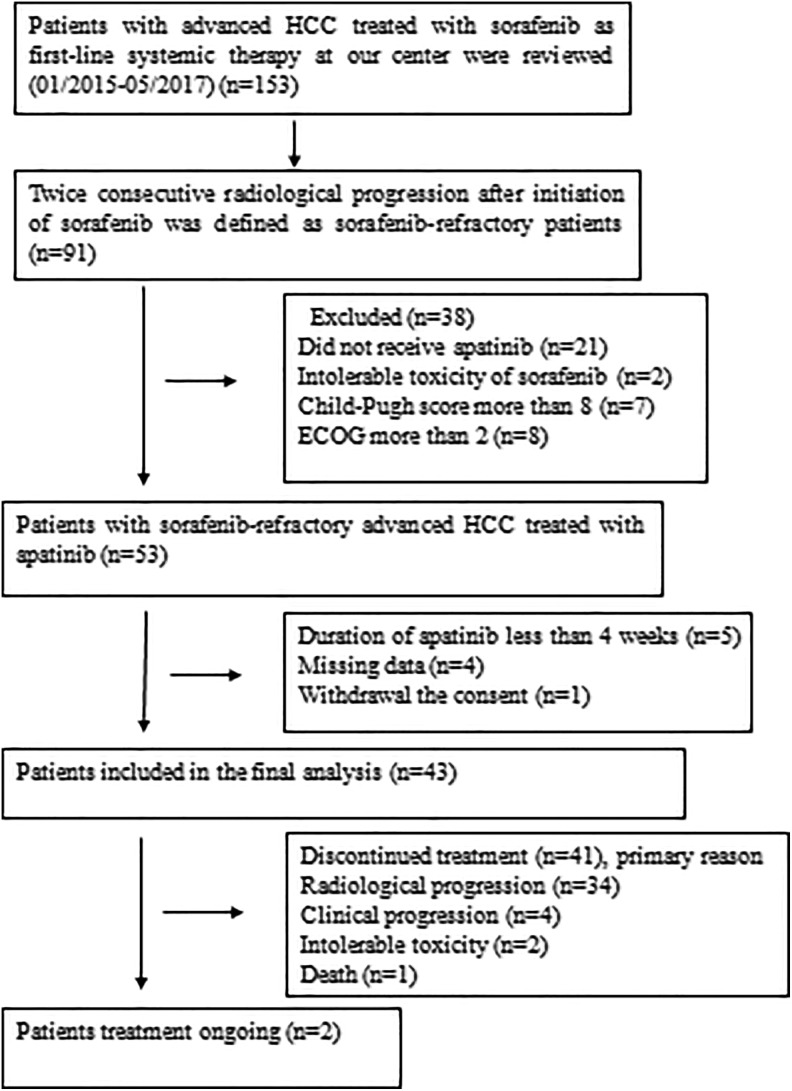
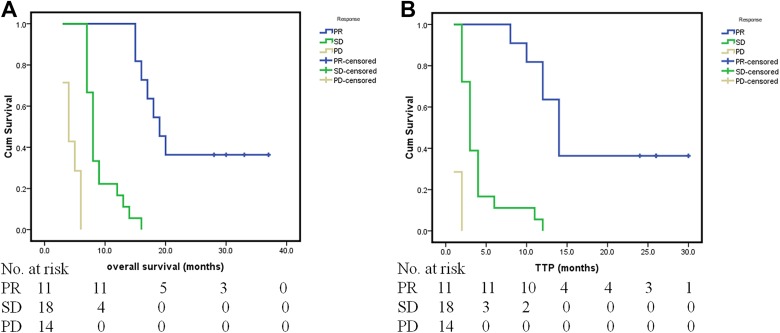
More than half of the patients with advanced hepatocellular carcinoma (HCC) do not respond to primary treatment with sorafenib. Currently, there are no universally accepted methods for further treatment. This pilot study was performed to assess the safety and effectiveness of apatinib as an optional treatment for patients with sorafenib-refractory HCC. Between January 2015 and May 2017, 43 consecutive patients with sorafenib-refractory advanced HCC who received apatinib were reviewed. The objective response rate (ORR) and disease control rate (DCR) were assessed using modified response evaluation criteria in solid tumors. The time to progression (TTP) and overall survival (OS) were determined using the Kaplan-Meier method. Toxicities associated with apatinib were assessed. All patients had hepatitis B virus (HBV) related HCC. The mean follow-up time was 11 months (range: 3-37) and the mean duration of apatinib was 7.6 months (range: 1-32). After treatment, 11 patients had partial response (PR), 18 had stable disease (SD), and 14 had progressive disease (PD); accordingly, the ORR and DCR were 25.6% and 67.4%, respectively. The median TTP and OS were 3 months (95% confidence interval [CI]: 1.9-4.1) and 8 months (95% CI: 6.9-9.0), respectively. The median OS times for PR, SD, and PD were 19 months (95% CI: 15.8-22.2), 8 months (95% CI: 7.3-8.7), and 4 months (95% CI: 3.1-4.9), respectively ( < .001). The median TTP for PR, SD, and PD was 14 months (95% CI: 11.9-16.1), 3 months (95% CI: 2.3-3.7) and 1 month, respectively ( < .001). No patients experienced toxicity-related death. The most common toxicities were weight loss, hand-foot skin reaction, and hypertension. Twelve adverse events of grade 3 or higher were observed. Based on our findings, apatinib is a promising treatment for patients with sorafenib-refractory advanced HBV-related HCC.
超过一半的晚期肝细胞癌 (HCC) 患者对索拉非尼的初始治疗无反应。目前,尚无普遍接受的进一步治疗方法。本研究旨在评估阿帕替尼作为索拉非尼耐药 HCC 患者的可选治疗方法的安全性和有效性。2015 年 1 月至 2017 年 5 月,对 43 例接受阿帕替尼治疗的索拉非尼耐药晚期 HCC 患者进行了回顾性分析。采用实体瘤反应评价标准(mRECIST)评估客观缓解率(ORR)和疾病控制率(DCR)。采用 Kaplan-Meier 法计算无进展生存期(TTP)和总生存期(OS)。评估与阿帕替尼相关的毒性。所有患者均为乙型肝炎病毒(HBV)相关 HCC。中位随访时间为 11 个月(范围:3-37),阿帕替尼中位治疗时间为 7.6 个月(范围:1-32)。治疗后,11 例患者部分缓解(PR),18 例患者疾病稳定(SD),14 例患者疾病进展(PD);ORR 和 DCR 分别为 25.6%和 67.4%。中位 TTP 和 OS 分别为 3 个月(95%CI:1.9-4.1)和 8 个月(95%CI:6.9-9.0)。PR、SD 和 PD 的中位 OS 时间分别为 19 个月(95%CI:15.8-22.2)、8 个月(95%CI:7.3-8.7)和 4 个月(95%CI:3.1-4.9),差异有统计学意义(P<0.001)。PR、SD 和 PD 的中位 TTP 分别为 14 个月(95%CI:11.9-16.1)、3 个月(95%CI:2.3-3.7)和 1 个月,差异有统计学意义(P<0.001)。无患者因毒性相关死亡。最常见的毒性是体重减轻、手足皮肤反应和高血压。观察到 12 例 3 级或以上的不良事件。根据我们的研究结果,阿帕替尼是索拉非尼耐药晚期 HBV 相关 HCC 患者有前途的治疗方法。