Tiffe Theresa, Morbach Caroline, Rücker Viktoria, Gelbrich Götz, Wagner Martin, Faller Hermann, Störk Stefan, Heuschmann Peter U
Institute of Clinical Epidemiology and Biometry, University of Würzburg, Germany.
Comprehensive Heart Failure Center, University of Würzburg, Germany.
Int J Hypertens. 2019 Jul 28;2019:9385397. doi: 10.1155/2019/9385397. eCollection 2019.
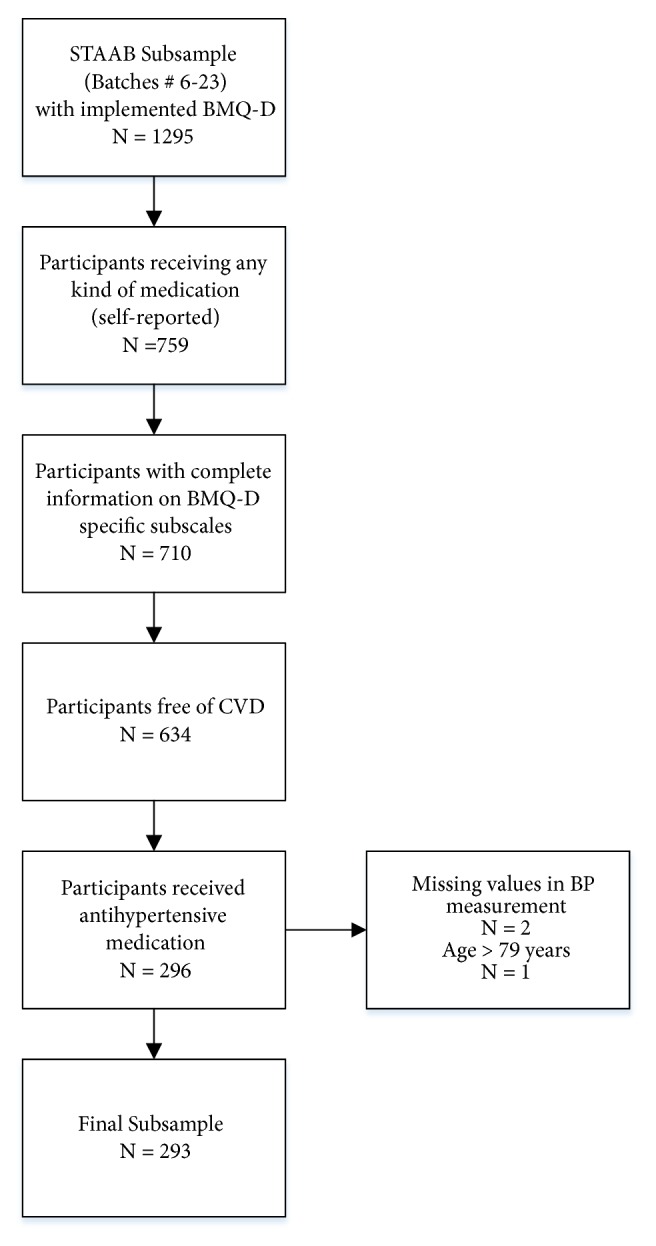
Effective antihypertensive treatment depends on patient compliance regarding prescribed medications. We assessed the impact of beliefs related towards antihypertensive medication on blood pressure control in a population-based sample treated for hypertension. We used data from the Characteristics and Course of Heart Failure Stages A-B and Determinants of Progression (STAAB) study investigating 5000 inhabitants aged 30 to 79 years from the general population of Würzburg, Germany. The was provided in a subsample without established cardiovascular diseases (CVD) treated for hypertension. We evaluated the association between inadequately controlled hypertension (systolic RR >140/90 mmHg; >140/85 mmHg in diabetics) and reported concerns about and necessity of antihypertensive medication. Data from 293 participants (49.5% women, median age 64 years [quartiles 56.0; 69.0]) entered the analysis. Despite medication, half of the participants (49.8%) were above the recommended blood pressure target. Stratified for sex, inadequately controlled hypertension was less frequent in women reporting higher levels of concerns (OR 0.36; 95%CI 0.17-0.74), whereas no such association was apparent in men. We found no association for specific-necessity in any model. Beliefs regarding the necessity of prescribed medication did not affect hypertension control. An inverse association between concerns about medication and inappropriately controlled hypertension was found for women only. Our findings highlight that medication-related beliefs constitute a serious barrier of successful implementation of treatment guidelines and underline the role of educational interventions taking into account sex-related differences.
有效的降压治疗取决于患者对处方药物的依从性。我们在一个基于人群的高血压治疗样本中,评估了与抗高血压药物相关的信念对血压控制的影响。我们使用了心力衰竭A - B期特征与病程及进展决定因素(STAAB)研究的数据,该研究调查了德国维尔茨堡普通人群中5000名年龄在30至79岁之间的居民。数据来自一个未患既定心血管疾病(CVD)且接受高血压治疗的子样本。我们评估了血压控制不佳(收缩压RR>140/90 mmHg;糖尿病患者>140/85 mmHg)与报告的对抗高血压药物的担忧及必要性之间的关联。293名参与者(49.5%为女性,年龄中位数64岁[四分位数间距56.0;69.0])的数据进入了分析。尽管服用了药物,但一半的参与者(49.8%)血压高于推荐目标。按性别分层后,报告担忧程度较高的女性中血压控制不佳的情况较少(OR 0.36;95%CI 0.17 - 0.74),而在男性中未发现这种关联。在任何模型中,我们都未发现与特定必要性之间的关联。关于处方药物必要性的信念并未影响高血压控制。仅在女性中发现了对药物的担忧与血压控制不佳之间的负相关。我们的研究结果强调,与药物相关的信念是成功实施治疗指南的严重障碍,并强调了考虑性别差异的教育干预措施的作用。