Department of Urology, Fudan University Shanghai Cancer Center, Shanghai, China (mainland).
Department of Oncology, Shanghai Medical College, Fudan University, Shanghai, China (mainland).
Med Sci Monit. 2019 Aug 30;25:6518-6522. doi: 10.12659/MSM.916984.
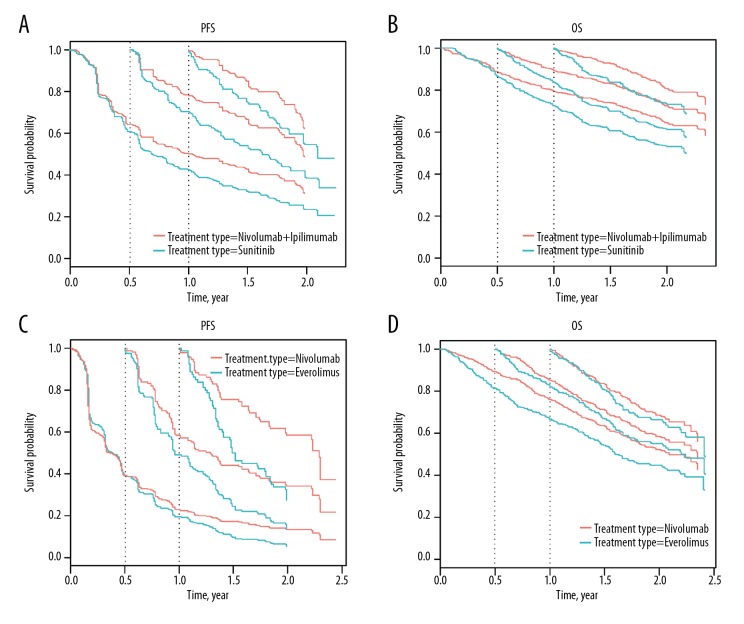
BACKGROUND Nivolumab is approved for the treatment of advanced renal cell carcinoma (RCC). However, traditional overall survival (OS) or progression-free survival (PFS) do not reflect patient prognosis after initial management. Therefore, this study aimed to evaluate conditional overall survival (COS) and conditional progression-free survival (CPFS) in patients with advanced RCC treated with nivolumab. MATERIAL AND METHODS There were 847 patients with advanced RCC treated with first-line nivolumab plus ipilimumab (n=425) and sunitinib (n=422), and 821 patients were treated with second-line nivolumab (n=410) and everolimus (n=411). Primary endpoints were COS and CPFS. Individual patient data of PFS and OS were digitally reconstructed from two large randomized controlled trials (CheckMate 025 and CheckMate 214). RESULTS In first-line treatment, compared with sunitinib, improvement of one-year CPFS for the nivolumab plus ipilimumab group after living for 0.5 and 0.75 years were 14% (from 53.0% to 67.0%) and 16% (from 57.0% to 73.0%) higher than the one-year PFS of 6.5% (from 42.9% to 49.4%), with similar results for one-year COS following first-line treatment. For second-line treatment, compared with everolimus, the improvement of one-year CPFS for the nivolumab group after living for 0.5 and 0.75 years were 19% (from 25.0% to 44.0%) and 19% (from 27.0% to 46.0%) and significantly higher than the one-year PFS of 4.5% (from 18.5% to 23.0%). CONCLUSIONS Survival benefit for patients with advanced RCC from nivolumab (plus ipilimumab) compared with sunitinib was more evident from conditional survival (CS) analysis of first-line treatment.
纳武利尤单抗获批用于治疗晚期肾细胞癌(RCC)。然而,传统的总生存期(OS)或无进展生存期(PFS)并不能反映初始治疗后患者的预后。因此,本研究旨在评估纳武利尤单抗治疗晚期 RCC 患者的条件总生存期(COS)和条件无进展生存期(CPFS)。
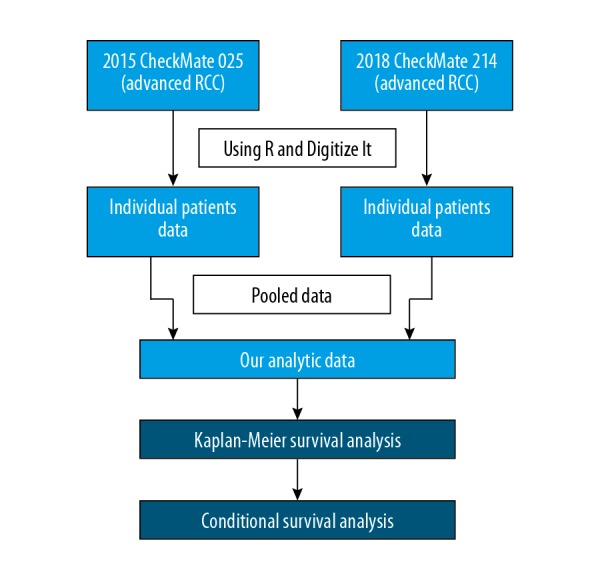
共有 847 例接受一线纳武利尤单抗联合伊匹单抗(n=425)和舒尼替尼(n=422)治疗的晚期 RCC 患者,821 例接受二线纳武利尤单抗(n=410)和依维莫司(n=411)治疗。主要终点为 COS 和 CPFS。两项大型随机对照试验(CheckMate 025 和 CheckMate 214)的 PFS 和 OS 个体患者数据经数字重建。
一线治疗中,与舒尼替尼相比,纳武利尤单抗联合伊匹单抗组在生存 0.5 年和 0.75 年时,CPFS 改善 1 年的比例分别为 14%(从 53.0%增加到 67.0%)和 16%(从 57.0%增加到 73.0%),高于一线治疗时的 1 年 PFS 为 6.5%(从 42.9%增加到 49.4%),一线治疗后,1 年 COS 也有类似的结果。二线治疗中,与依维莫司相比,纳武利尤单抗组在生存 0.5 年和 0.75 年时,CPFS 改善 1 年的比例分别为 19%(从 25.0%增加到 44.0%)和 19%(从 27.0%增加到 46.0%),明显高于二线治疗时的 1 年 PFS 为 4.5%(从 18.5%增加到 23.0%)。
与舒尼替尼相比,纳武利尤单抗(联合伊匹单抗)治疗晚期 RCC 患者的生存获益在一线治疗时通过条件生存(CS)分析更为明显。