Department of Trauma Surgery, Regensburg University Medical Center, 93042, Regensburg, Germany.
Department of Orthopaedics, UCMS and GTB Hospital, Delhi, 110095, India.
BMC Musculoskelet Disord. 2019 Aug 31;20(1):391. doi: 10.1186/s12891-019-2775-x.
Subtrochanteric femur fractures (SFF) are uncommon, but have a high complication rate concerning non-union and mechanical complications. There is ongoing discussion about risk factors for delayed fracture healing after SFF. The purpose of this study was to evaluate potential risk factors for delayed fracture healing after SFF.
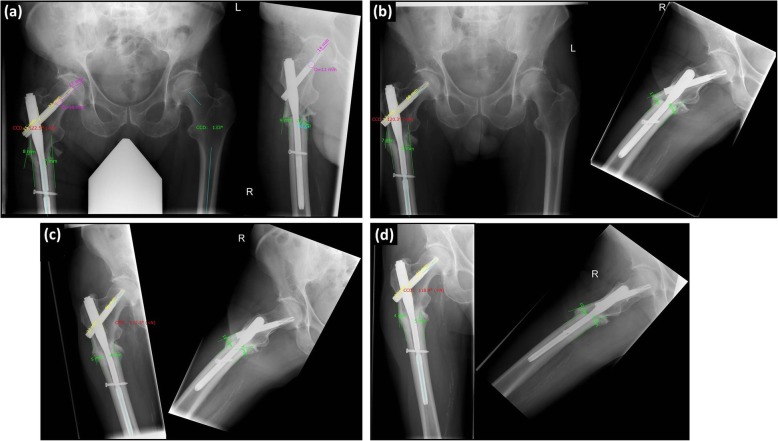
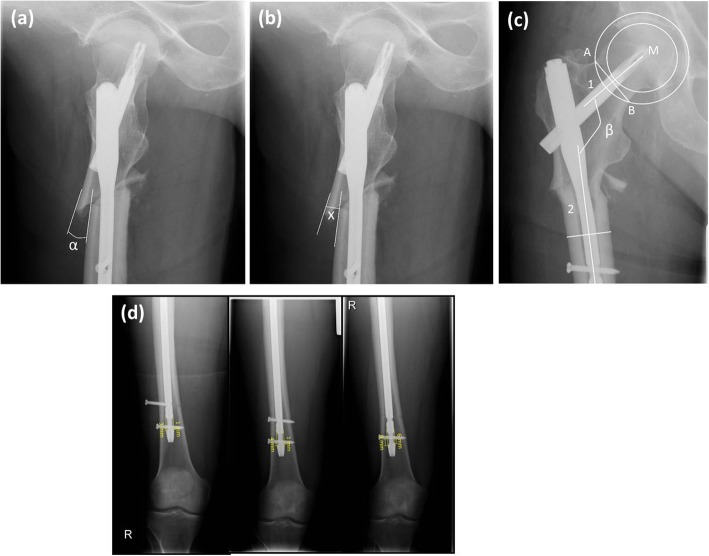
This retrospective radio-morphometric case control study compares 61 patients after SFF in two groups (uncomplicated healing within 6 months postoperatively vs. delayed union) concerning radiographical properties. The patients were analyzed concerning the following parameter: Quality of the reduction according to Baumgaertner, CCD-angle, Tip-Apex Distance, leg-length shortening and fracture healing according to the RUSH Score.
The mean RUSH-Score at 6 months postoperatively was 21.32(±4.57). At that point of time, only 29/61 fractures were radiographically fully consolidated (timely fracture healing) and 32 patients were rated as delayed union. The total revision rate was 9/61 (14.7%), whereof four patients required revision for symptomatic non-union of the SFF. The results of the radio-morphometric measurement showed a significant difference between both groups concerning the degree of reduction measured according to Baumgaertner (p = 0.022). The postoperative ipsilateral CCD-angle was different between the two groups (p = 0.019). After 12 months postoperatively, 48/61 (78.6%) of fractures were rated healed without any further intervention.
Delayed union after SFF occurs frequently. In our patient population, the quality of reduction and the postoperative CCD-angle were the key factors to avoid delayed union.
Level III, Therapeutic study.
Clinical Trial Registry University of Regensburg Z-2018-1074-1. Registered 04. Aug 2018. https://studienanmeldung.zks-regensburg.de.
股骨转子下骨折(SFF)并不常见,但在非愈合和机械并发症方面的并发症发生率较高。关于 SFF 后骨折愈合延迟的危险因素,目前仍存在争议。本研究旨在评估 SFF 后骨折愈合延迟的潜在危险因素。
本回顾性放射形态计量学病例对照研究比较了 61 例 SFF 患者的两组(术后 6 个月内无并发症愈合与延迟愈合)的影像学特征。分析患者以下参数:根据 Baumgaertner 评估的复位质量、CCD 角、尖端 - 顶点距离、下肢长度缩短和 Rush 评分评估的骨折愈合情况。
术后 6 个月的平均 Rush 评分为 21.32(±4.57)。此时,只有 29/61 例骨折在影像学上完全愈合(及时骨折愈合),32 例患者被评为延迟愈合。总翻修率为 9/61(14.7%),其中 4 例因 SFF 症状性不愈合而需要翻修。放射形态计量测量结果显示,两组间根据 Baumgaertner 测量的复位程度存在显著差异(p=0.022)。两组术后同侧 CCD 角也存在差异(p=0.019)。术后 12 个月,61 例骨折中有 48/61(78.6%)无需进一步干预即可愈合。
SFF 后延迟愈合较为常见。在我们的患者人群中,复位质量和术后 CCD 角是避免延迟愈合的关键因素。
III 级,治疗研究。
雷根斯堡大学 Z-2018-1074-1。注册于 2018 年 8 月 4 日。https://studienanmeldung.zks-regensburg.de。