Department of Health Management and Economics, School of Public Health, Tehran University of Medical Sciences, Tehran, Iran.
School of Public Health, College of Health Sciences, Mekelle University, Mekelle, Ethiopia.
BMC Health Serv Res. 2019 Aug 30;19(1):614. doi: 10.1186/s12913-019-4443-0.
This study aims to assess geographical distribution of hospitals and extent of inequalities in hospital beds against socioeconomic status (SES) of residents of five metropolitan cities in Iran.
A cross-sectional analysis was conducted to measure geographical inequality in hospital and hospital bed distributions of 68 districts in five metropolitan cities during 2016 using geographic information system (GIS), and Gini and Concentration indices. Correlation analysis was performed to show the relationship between the SES and inequality in hospital beds densities.
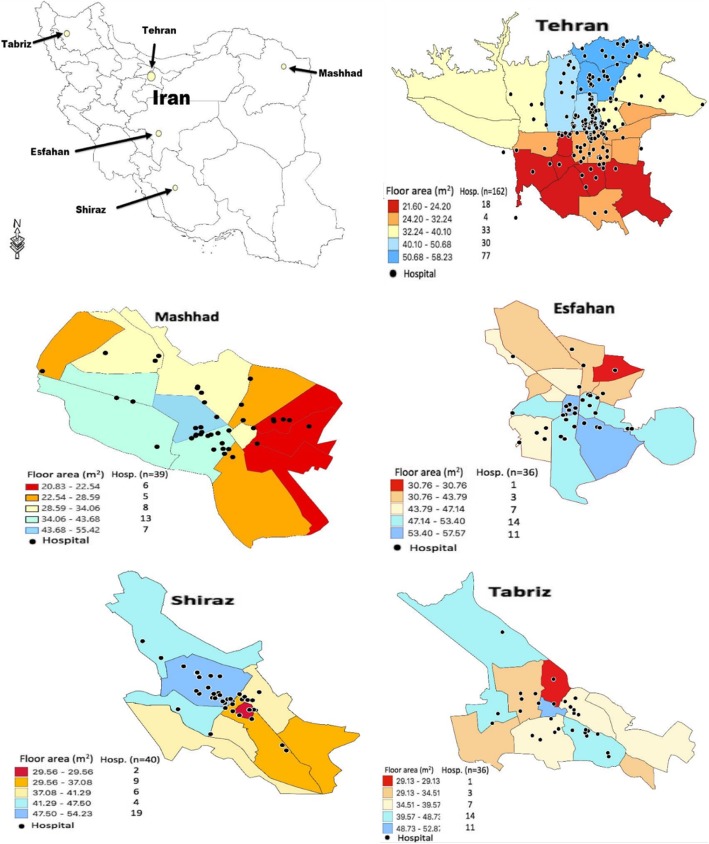
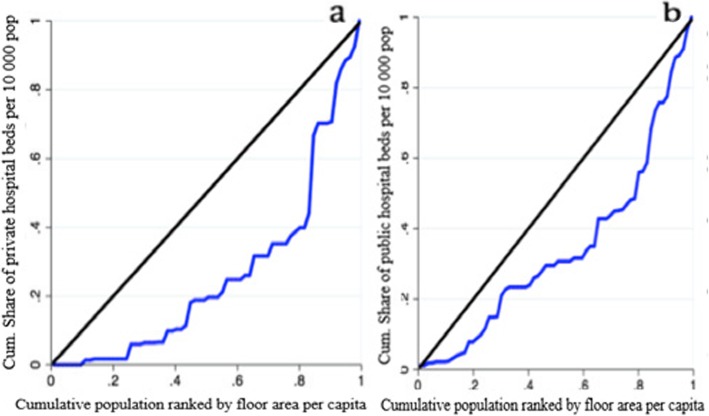
The study uncovered marked inequalities in hospitals and hospital beds distributions. The Gini indices for hospital beds were greater than 0.55. The aggregated concentration indices for public and private hospital beds were 0.33 and 0.49, respectively. The GIS revealed that 216 (70.6%) hospitals were located in two highest socioeconomic status classes in the cities. Only 29 (9.5%) hospitals were located in the lowest class. The public, private, and the cumulative hospitals beds distributions in Tehran and Esfahan showed significant (p < 0.05) positive correlation with SES of the residents.
The high inequalities in hospital and hospital beds distributions in our study imply an overlooked but growing concern for geographical access to healthcare in rapidly urbanizing metropolitan cities in Iran. Thus, regardless of ownership, decision-makers should emphasize the disadvantaged areas in metropolitan cities when need arises for the establishment of new healthcare facilities in order to ensure fairness in healthcare. The metropolitan cities and rapid urbanization settings in other countries could learn lessons to reduce or prevent similar issues which might have hampered access to healthcare.
本研究旨在评估伊朗五个主要城市的医院分布及其床位分配的公平性,以及与居民社会经济地位(SES)的关系。
采用地理信息系统(GIS)、基尼系数和集中指数,对 2016 年五个主要城市 68 个区的医院和床位分布进行了横断面分析,以衡量医院和床位分布的地理不平等。采用相关分析来显示 SES 与床位密度分布不均之间的关系。
研究发现医院和床位分配存在显著的不平等。床位的基尼系数大于 0.55。公立医院和私立医院床位的总集中指数分别为 0.33 和 0.49。GIS 显示,216 家(70.6%)医院位于城市中 SES 最高的两个等级。只有 29 家(9.5%)医院位于 SES 最低的等级。德黑兰和伊斯法罕的公立医院、私立医院和累计医院床位分布与居民 SES 呈显著正相关(p < 0.05)。
本研究中,医院和床位分布的高度不均表明,在伊朗快速城市化的大都市中,人们对获得医疗保健的地理途径存在被忽视但日益增长的关注。因此,决策者在需要建立新的医疗设施时,应优先考虑大都市中的弱势地区,以确保医疗保健的公平性。其他国家的大都市和快速城市化地区可以从中吸取经验教训,以减少或预防类似的问题,这些问题可能会阻碍医疗保健的获取。