Department of Neuroscience, Karolinska Institutet, Solnavägen 9, SE-171 77, Stockholm, Sweden.
Department of Psychiatry, Amsterdam UMC, University of Amsterdam, Meibergdreef 5, 1105 AZ, Amsterdam, The Netherlands.
Sci Rep. 2019 Aug 30;9(1):12606. doi: 10.1038/s41598-019-49099-9.
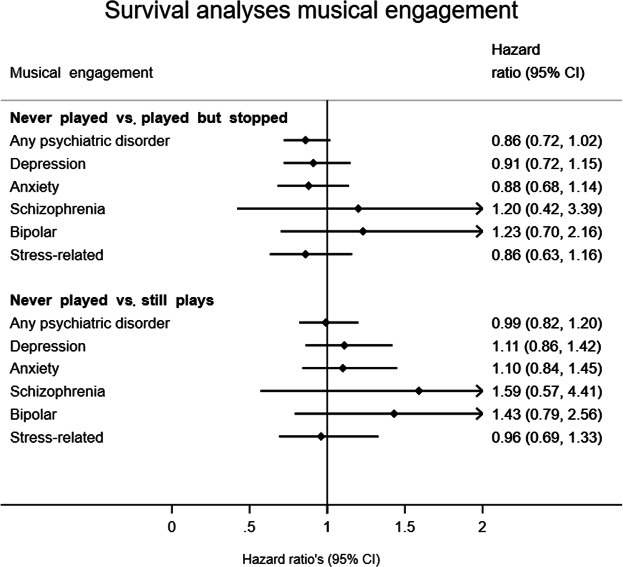
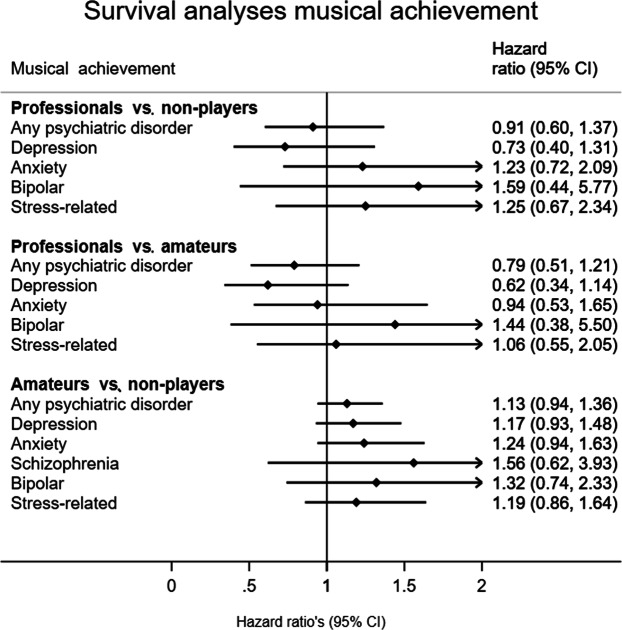
The association between active musical engagement (as leisure activity or professionally) and mental health is still unclear, with earlier studies reporting contrasting findings. Here we tested whether musical engagement predicts (1) a diagnosis of depression, anxiety, schizophrenia, bipolar or stress-related disorders based on nationwide patient registers or (2) self-reported depressive, burnout and schizotypal symptoms in 10,776 Swedish twins. Information was available on the years individuals played an instrument, including their start and stop date if applicable, and their level of achievement. Survival analyses were used to test the effect of musical engagement on the incidence of psychiatric disorders. Regression analyses were applied for self-reported psychiatric symptoms. Additionally, we conducted co-twin control analyses to further explore the association while controlling for genetic and shared environmental confounding. Results showed that overall individuals playing a musical instrument (independent of their musical achievement) may have a somewhat increased risk for mental health problems, though only significant for self-reported mental health measures. When controlling for familial liability associations diminished, suggesting that the association is likely not due to a causal negative effect of playing music, but rather to shared underlying environmental or genetic factors influencing both musicianship and mental health problems.
主动参与音乐活动(作为休闲活动或专业活动)与心理健康之间的关系尚不清楚,早期的研究报告得出了相互矛盾的结论。在这里,我们测试了音乐参与是否可以预测:(1)基于全国患者登记册的抑郁症、焦虑症、精神分裂症、双相情感障碍或与压力相关的障碍的诊断;(2)10776 名瑞典双胞胎的自我报告的抑郁、倦怠和精神分裂症样症状。我们可以获得个人演奏乐器的年份的信息,包括如果适用的开始和停止日期,以及他们的演奏水平。生存分析用于测试音乐参与对精神疾病发病率的影响。回归分析用于自我报告的精神科症状。此外,我们进行了同卵双胞胎对照分析,以进一步探索关联,同时控制遗传和共同环境混杂因素。结果表明,总体而言,演奏乐器的个体(无论其音乐成就如何)可能会有一定程度的心理健康问题风险增加,尽管这仅在自我报告的心理健康测量中显著。当控制家庭易感性关联时,关联减弱,这表明这种关联不太可能是由于演奏音乐的负面因果效应造成的,而是由于同时影响音乐能力和心理健康问题的共同潜在环境或遗传因素造成的。