Institute of Genetic Medicine, Newcastle University, Newcastle upon Tyne, United Kingdom.
FRIGE's Institute of Human Genetics, FRIGE House, Ahmedabad, India.
Hum Mutat. 2020 Jan;41(1):332-341. doi: 10.1002/humu.23906. Epub 2019 Sep 15.
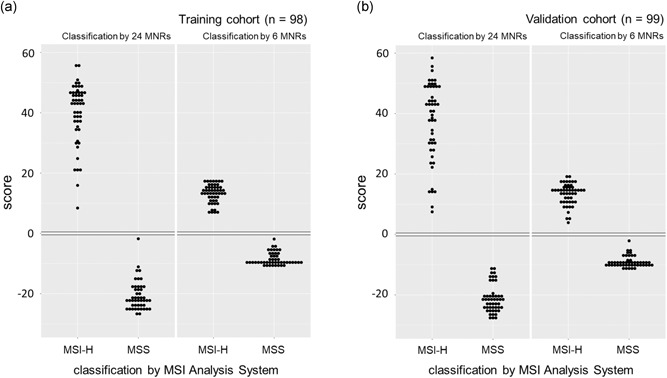
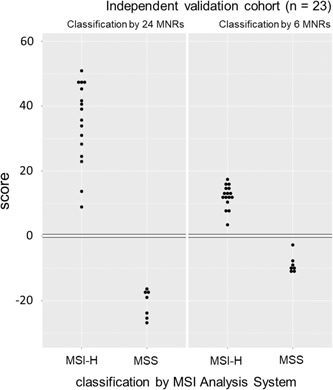
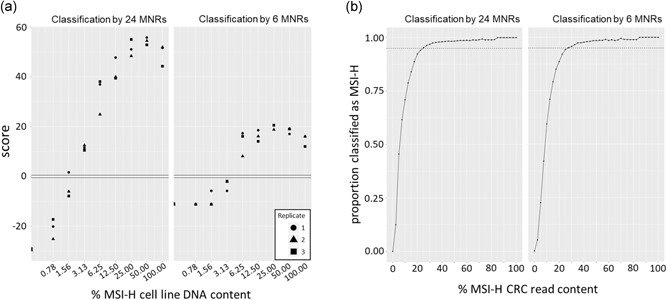
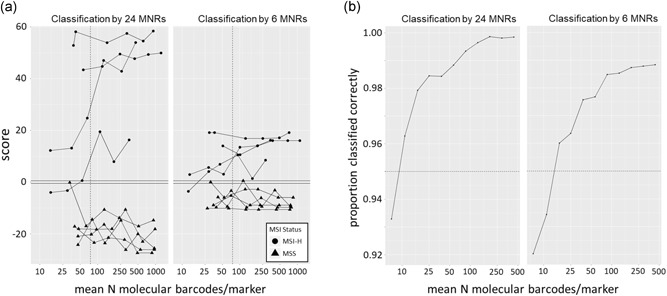
Microsatellite instability (MSI) testing of colorectal cancers (CRCs) is used to screen for Lynch syndrome (LS), a hereditary cancer-predisposition, and can be used to predict response to immunotherapy. Here, we present a single-molecule molecular inversion probe and sequencing-based MSI assay and demonstrate its clinical validity according to existing guidelines. We amplified 24 microsatellites in multiplex and trained a classifier using 98 CRCs, which accommodates marker specific sensitivities to MSI. Sample classification achieved 100% concordance with the MSI Analysis System v1.2 (Promega) in three independent cohorts, totaling 220 CRCs. Backward-forward stepwise selection was used to identify a 6-marker subset of equal accuracy to the 24-marker panel. Assessment of assay detection limits showed that the 24-marker panel is marginally more robust to sample variables than the 6-marker subset, detecting as little as 3% high levels of MSI DNA in sample mixtures, and requiring a minimum of 10 template molecules to be sequenced per marker for >95% accuracy. BRAF c.1799 mutation analysis was also included to streamline LS testing, with all c.1799T>A variants being correctly identified. The assay, therefore, provides a cheap, robust, automatable, and scalable MSI test with internal quality controls, suitable for clinical cancer diagnostics.
微卫星不稳定性 (MSI) 检测用于筛选林奇综合征 (LS),这是一种遗传性癌症易感性,并且可以用于预测免疫治疗的反应。在这里,我们提出了一种单分子分子反转探针和基于测序的 MSI 检测方法,并根据现有指南证明了其临床有效性。我们在多重反应中扩增了 24 个微卫星,并使用 98 个 CRC 训练了一个分类器,该分类器可以适应标记对 MSI 的特异性敏感性。在三个独立的队列中,总共 220 个 CRCs 中,样品分类与 MSI 分析系统 v1.2 (Promega) 达到了 100%的一致性。向后向前逐步选择用于确定与 24 个标记面板相同准确性的 6 个标记亚组。对检测限的评估表明,24 个标记面板对样本变量的稳健性略高于 6 个标记亚组,在样本混合物中检测到低至 3%的高水平 MSI DNA,并且每个标记需要最少 10 个模板分子才能进行测序,以达到>95%的准确性。还包括 BRAF c.1799 突变分析,以简化 LS 检测,所有 c.1799T>A 变体都被正确识别。因此,该检测提供了一种廉价、稳健、自动化和可扩展的 MSI 检测方法,具有内部质量控制,适用于临床癌症诊断。