Universidade Estadual de Roraima, Departamento de Medicina Interna, Boa Vista, RR, Brazil.
Universidade Federal de Roraima, Boa Vista, RR, Brazil.
Braz J Infect Dis. 2019 Sep-Oct;23(5):307-312. doi: 10.1016/j.bjid.2019.07.006. Epub 2019 Aug 28.
Following socio-economic turmoil in Venezuela, millions of the Venezuelan people are migrating to the neighboring Latin American countries including Brazil. Besides the social and economic burden of these migrants, Brazil must manage the health-related issues arising as consequence of these Venezuelan migrants. Poor health services in Venezuela along with unhygienic travelling conditions, lack of food (malnutrition) and potable water, unhealthy and overcrowded refugee camps or shelters, poor availability of medical services have made the migrant Venezuelan population susceptible to various diseases, especially infectious diseases. SINAN system is a health-related system in Brazil that keeps track of different health occurrences in the society and allows health care workers and policymakers free access to these data.
To evaluate the emergence of infectious diseases as a consequence of the arrival of Venezuelans immigrants in Brazil and to assess the importance of SINAN for epidemiological surveillance.
Observational retrospective study. Data were collected from the SINAN system between 2015 and 2017 and was analyzed using descriptive statistics, and Mann-Whitney test (using SPSS tool version 12). Evaluated infectious diseases in this study were tuberculosis, sexually transmitted infections (STIs), HIV/AIDS, syphilis, viral hepatitis, leishmaniasis, and malaria.
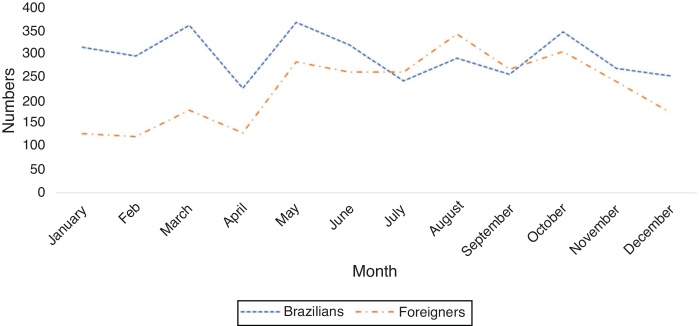
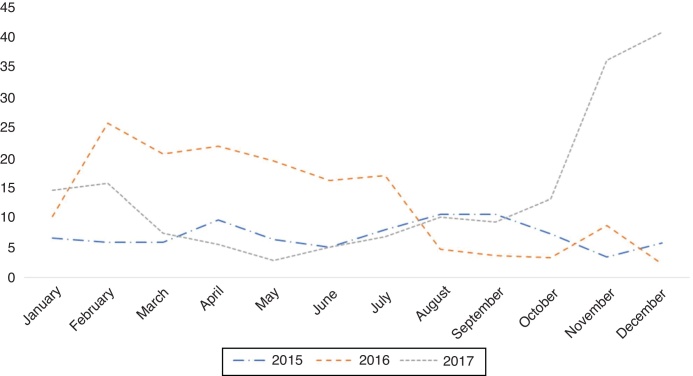
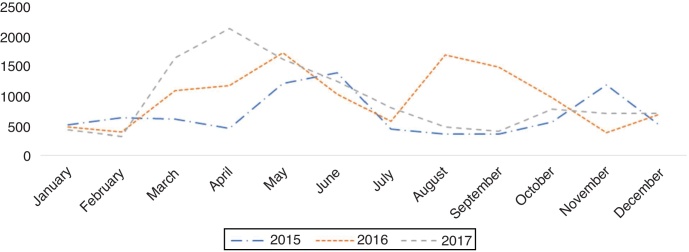
STIs were the most commonly reported diseases. Compared to Brazilians, Venezuelan migrants reported significantly higher number of HIV/Aids (p < 0.046) and leishmaniasis cases (p < 0.049), while Brazilians reported significantly higher number of hepatitis cases (p < 0.046). Malaria was also more prevalent among Venezuelan migrants than native Brazilians.
Increased incidence of infectious diseases among the migrant population should be considered seriously as lack of adequate control of these diseases might lead to outbreaks.
随着委内瑞拉社会经济的动荡,数以百万计的委内瑞拉人移民到包括巴西在内的拉美邻国。除了这些移民带来的社会和经济负担外,巴西还必须应对这些委内瑞拉移民带来的与健康相关的问题。委内瑞拉卫生服务差,旅行条件不卫生,缺乏食物(营养不良)和饮用水,不卫生且过度拥挤的难民营或收容所,医疗服务不足,使得移民委内瑞拉人口容易感染各种疾病,特别是传染病。SINAN 系统是巴西一个与健康相关的系统,用于跟踪社会中不同的健康事件,并允许医疗保健工作者和政策制定者自由访问这些数据。
评估由于委内瑞拉移民抵达巴西而导致传染病的出现,并评估 SINAN 对流行病学监测的重要性。
观察性回顾性研究。数据来自 SINAN 系统 2015 年至 2017 年期间的数据,使用描述性统计和 Mann-Whitney 检验(使用 SPSS 工具版本 12)进行分析。本研究评估的传染病包括结核病、性传播感染(STIs)、艾滋病毒/艾滋病、梅毒、病毒性肝炎、利什曼病和疟疾。
性传播感染是最常报告的疾病。与巴西人相比,委内瑞拉移民报告的艾滋病毒/艾滋病(p<0.046)和利什曼病病例明显更多(p<0.049),而巴西人报告的肝炎病例明显更多(p<0.046)。疟疾在委内瑞拉移民中的发病率也高于巴西本地人。
移民人口中传染病发病率的增加应引起高度重视,因为这些疾病如果得不到充分控制,可能会导致疫情爆发。