Chatla Srinivas, Du Wei, Wilson Andrew F, Meetei Amom Ruhikanta, Pang Qishen
Division of Experimental Hematology and Cancer Biology, Cincinnati Children's Hospital Medical Center, Cincinnati, OH 45229, United States of America.
Department of Pharmaceutical Sciences, School of Pharmacy, West Virginia University, Morgantown, WV 26506, United States of America.
Stem Cell Res. 2019 Oct;40:101550. doi: 10.1016/j.scr.2019.101550. Epub 2019 Aug 23.
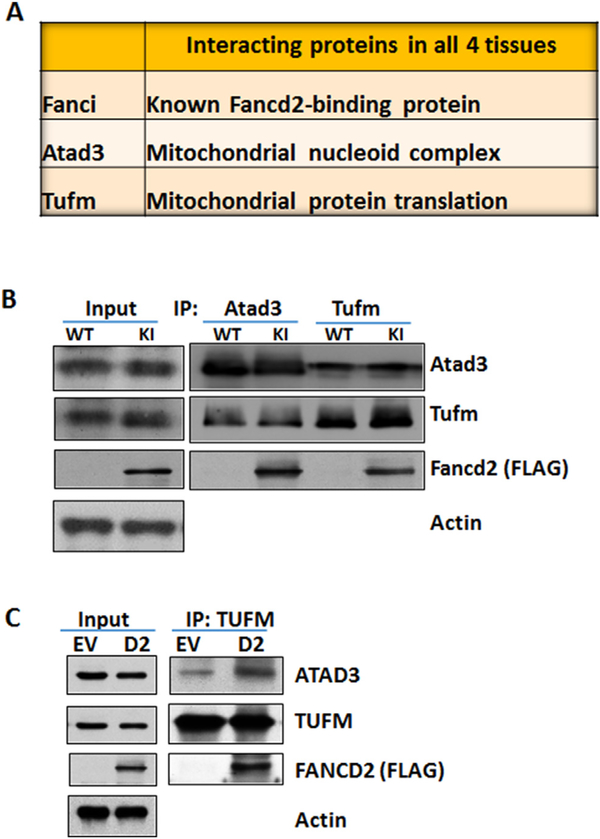
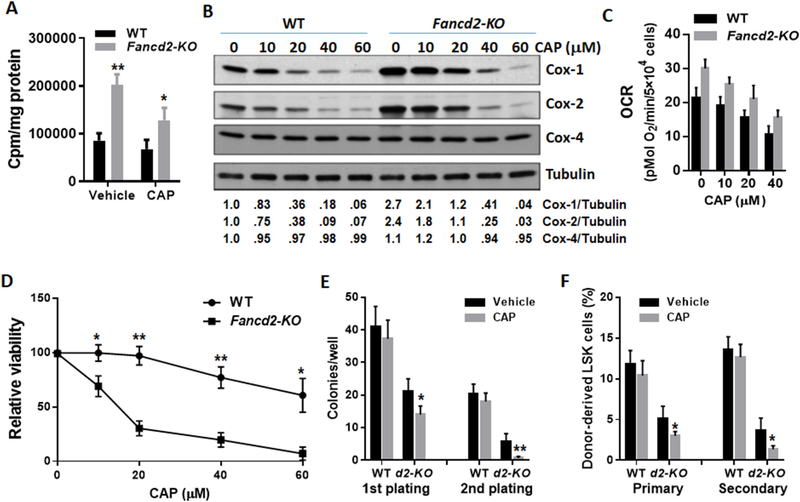
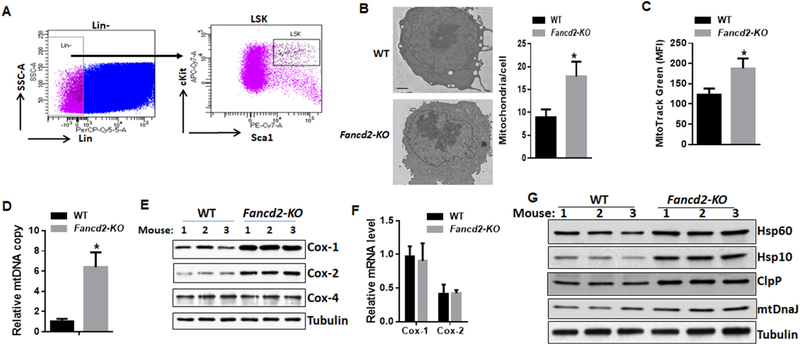
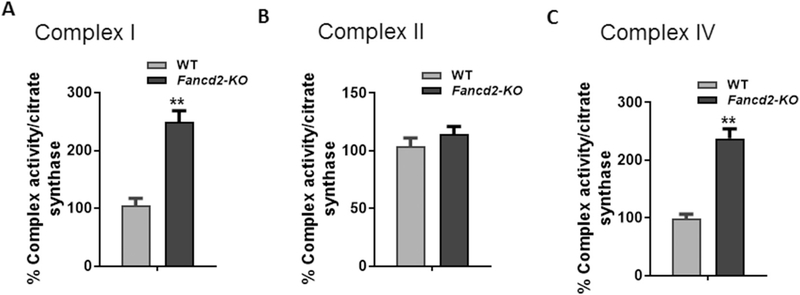
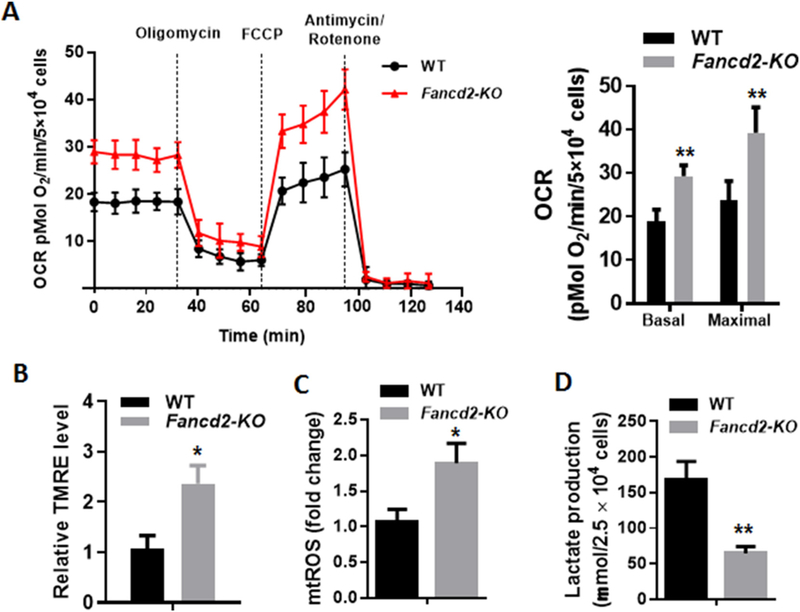
Members of the Fanconi anemia (FA) protein family are involved in multiple cellular processes including response to DNA damage and oxidative stress. Here we show that a major FA protein, Fancd2, plays a role in mitochondrial biosynthesis through regulation of mitochondrial translation. Fancd2 interacts with Atad3 and Tufm, which are among the most frequently identified components of the mitochondrial nucleoid complex essential for mitochondrion biosynthesis. Deletion of Fancd2 in mouse hematopoietic stem and progenitor cells (HSPCs) leads to increase in mitochondrial number, and enzyme activity of mitochondrion-encoded respiratory complexes. Fancd2 deficiency increases mitochondrial protein synthesis and induces mitonuclear protein imbalance. Furthermore, Fancd2-deficient HSPCs show increased mitochondrial respiration and mitochondrial reactive oxygen species. By using a cell-free assay with mitochondria isolated from WT and Fancd2-KO HSPCs, we demonstrate that the increased mitochondrial protein synthesis observed in Fancd2-KO HSPCs was directly linked to augmented mitochondrial translation. Finally, Fancd2-deficient HSPCs are selectively sensitive to mitochondrial translation inhibition and depend on augmented mitochondrial translation for survival and proliferation. Collectively, these results suggest that Fancd2 restricts mitochondrial activity through regulation of mitochondrial translation, and that augmented mitochondrial translation and mitochondrial respiration may contribute to HSC defect and bone marrow failure in FA.
范可尼贫血(FA)蛋白家族成员参与多种细胞过程,包括对DNA损伤和氧化应激的反应。在这里,我们表明一种主要的FA蛋白Fancd2通过调节线粒体翻译在线粒体生物合成中发挥作用。Fancd2与Atad3和Tufm相互作用,Atad3和Tufm是线粒体生物合成所必需的线粒体核仁复合体中最常被鉴定的成分。在小鼠造血干细胞和祖细胞(HSPCs)中缺失Fancd2会导致线粒体数量增加以及线粒体编码的呼吸复合体的酶活性增加。Fancd2缺陷会增加线粒体蛋白合成并诱导线粒体-核蛋白失衡。此外,Fancd2缺陷的HSPCs表现出线粒体呼吸增加和线粒体活性氧增加。通过使用从野生型和Fancd2基因敲除HSPCs中分离出线粒体的无细胞测定法,我们证明在Fancd2基因敲除HSPCs中观察到的线粒体蛋白合成增加与线粒体翻译增强直接相关。最后,Fancd2缺陷的HSPCs对线粒体翻译抑制具有选择性敏感性,并且依赖增强的线粒体翻译来维持生存和增殖。总的来说,这些结果表明Fancd2通过调节线粒体翻译来限制线粒体活性,并且增强的线粒体翻译和线粒体呼吸可能导致FA中的造血干细胞缺陷和骨髓衰竭。