Department of Sports Medicine, Goethe University Frankfurt/Main, Ginnheimer Landstraße 39, 60487, Frankfurt, Germany.
Institute for Occupational Medicine, Social Medicine and Environmental Medicine, University Hospital Frankfurt, Theodor-Stern-Kai 7, 60590, Frankfurt, Germany.
BMC Musculoskelet Disord. 2019 Aug 31;20(1):395. doi: 10.1186/s12891-019-2779-6.
Individuals afflicted with nonspecific chronic low back pain (CLBP) exhibit altered fundamental movement patterns. However, there is a lack of validated analysis tools. The present study aimed to elucidate the measurement properties of a functional movement analysis (FMA) in patients with CLBP.
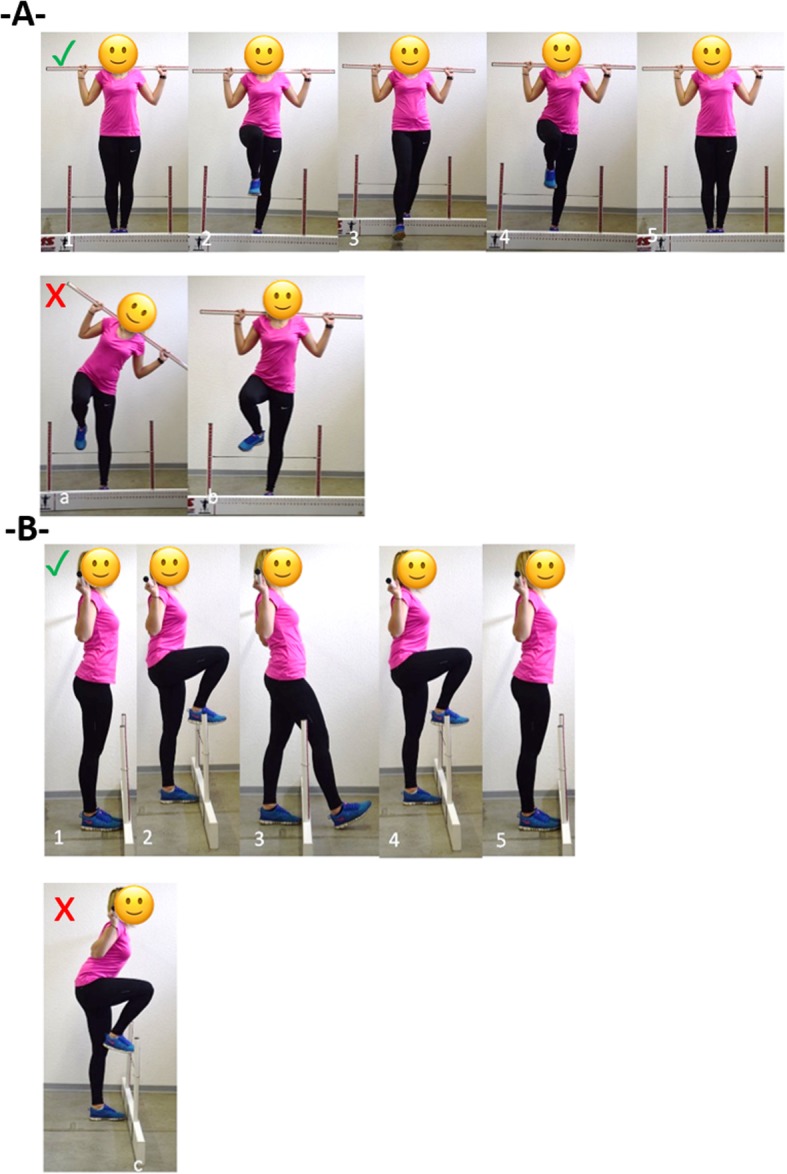
In this validation (cross-sectional) study, patients with CLPB completed the FMA. The FMA consists of 11 standardised motor tasks mimicking activities of daily living. Four investigators (two experts and two novices) evaluated each item using an ordinal scale (0-5 points, one live and three video ratings). Interrater reliability was computed for the total score (maximum 55 points) using intra class correlation and for the individual items using Cohen's weighted Kappa and free-marginal Kappa. Validity was estimated by calculating Spearman's Rho correlations to compare the results of the movement analysis and the participants' self-reported disability, and fear of movement.
Twenty-one participants (12 females, 9 males; 42.7 ± 14.3 years) were included. The reliability analysis for the sum score yielded ICC values between .92 and.94 (p < .05). The classification of individual scores are categorised 'slight' to 'almost perfect' agreement (.10-.91). No significant associations between disability or fear of movement with the overall score were found (p > .05). The study population showed comparably low pain levels, low scores of kinesiophobia and disability.
The functional movement analysis displays excellent reliability for both, live and video rating. Due to the low levels of disability and pain in the present sample, further research is necessary to conclusively judge validity.
患有非特异性慢性下腰痛(CLBP)的个体表现出基本运动模式的改变。然而,缺乏经过验证的分析工具。本研究旨在阐明 CLBP 患者功能运动分析(FMA)的测量特性。
在这项验证(横断面)研究中,CLBP 患者完成了 FMA。FMA 由 11 个标准化的运动任务组成,模拟日常生活活动。四名研究人员(两名专家和两名新手)使用等级量表(0-5 分,1 个现场和 3 个视频评分)对每个项目进行评估。使用组内相关系数计算总分(最高 55 分)的组内相关性,以及使用 Cohen 的加权 Kappa 和自由边际 Kappa 计算单个项目的组内相关性。通过计算运动分析结果与参与者自我报告的残疾和运动恐惧之间的 Spearman Rho 相关性来估计有效性。
21 名参与者(12 名女性,9 名男性;42.7±14.3 岁)被纳入。总分的可靠性分析得出 ICC 值在.92 到.94 之间(p<.05)。个别分数的分类为“轻微”到“几乎完美”一致(.10-.91)。在残疾或运动恐惧与总分之间没有发现显著的相关性(p>.05)。研究人群的疼痛水平、运动恐惧和残疾评分均较低。
功能运动分析在现场和视频评分方面均具有优异的可靠性。由于本样本的残疾和疼痛程度较低,需要进一步的研究来确定有效性。