National Center for Women and Children's Health, Chinese Center for Disease Control and Prevention.
Institute of Reproductive and Child Health, National Health Commission Key Laboratory of Reproductive Health, Department of Epidemiology and Biostatistics, School of Public Health, Peking University Health Science Center.
J Epidemiol. 2020 Aug 5;30(8):345-353. doi: 10.2188/jea.JE20180238. Epub 2019 Aug 31.
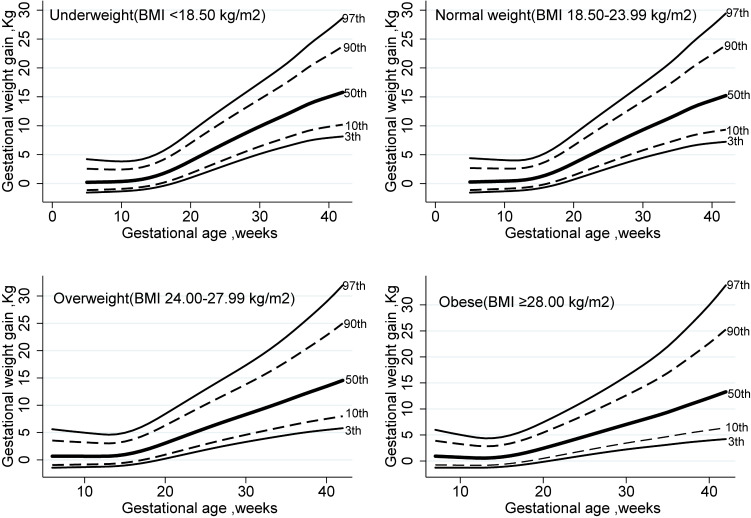
Establishment of an unbiased association between gestational weight gain (GWG) and perinatal health is urgently needed in China, which has the largest population in the world. Our study aimed to create weight-gain-for-gestational-age charts using early pregnancy body mass index (BMI) to present selected percentiles of GWG in China.
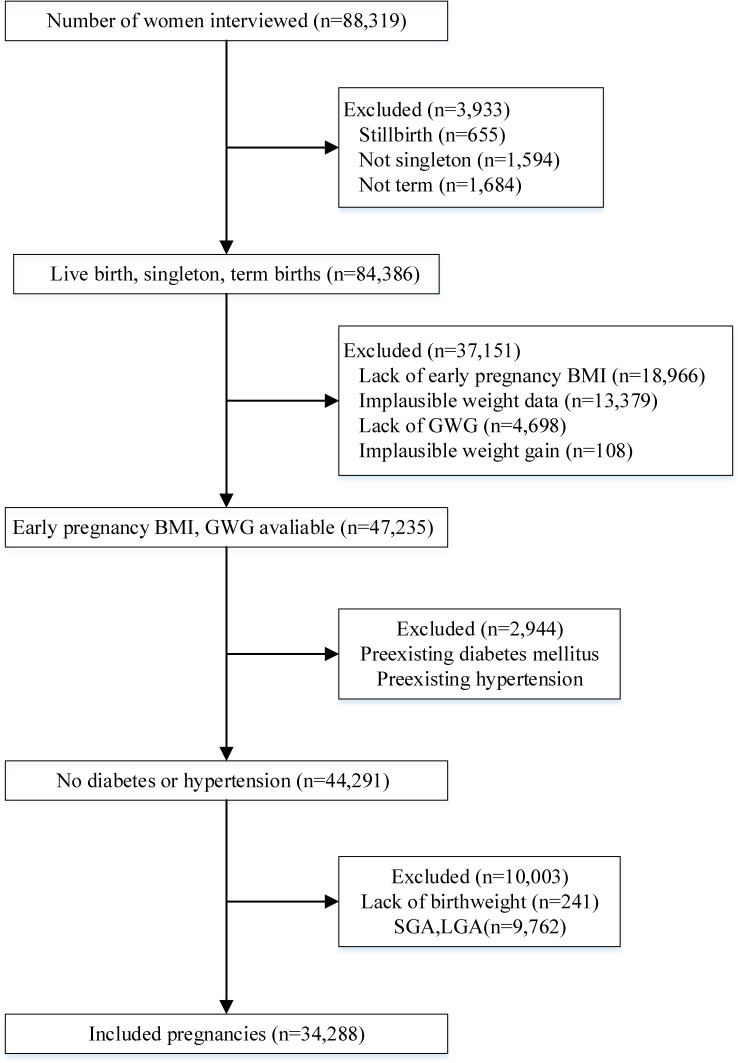
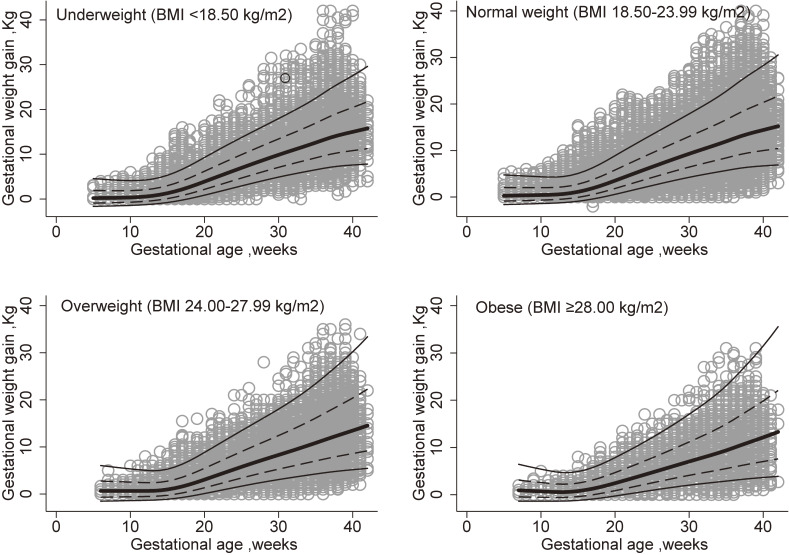
A population-based follow-up study was conducted based on the Maternal and Newborn Health Monitoring System, which recruited 132,835 pregnant women between October 2013 and September 2016 in 12 districts/counties of 6 provinces in China. Multilevel analyses and restricted cubic splines were performed to model the longitudinal repeated maternal weight gain measurements and obtain smoothed curves for GWG. The internal and external validation of each model was also assessed.
To develop models of GWG, 34,288 women were included. Smoothed percentiles of GWG in the 3rd, 10th, 50th, 90th, and 97th percentiles were estimated for each week of gestation. The median figures for GWG were 15.0 kg, 14.4 kg, 13.5 kg, and 12.1 kg in underweight, normal weight, overweight, and obese women, respectively, at 40 weeks. Of all the weight measurements, more than 70% and 95% fell within the expected 1 to 2 standard deviations, respectively. To accomplish external validation of the models, 20,458 women were included. The specificities of measurements in the 5th, 10th, 15th, 25th, 75th, 85th, 90th, and 95th percentiles in four BMI categories were between 90% and 100%.
The population-based gestational weight gain Z-score charts performed well in providing guidance regarding expected gestational weight gain in Chinese women.
中国是世界上人口最多的国家,迫切需要建立一种无偏倚的妊娠体重增加(GWG)与围产期健康之间的关联。本研究旨在利用早孕时的身体质量指数(BMI)建立体重增长-孕龄图表,以呈现中国 GWG 的部分百分位。
基于孕产妇和新生儿健康监测系统进行了一项基于人群的随访研究,该系统于 2013 年 10 月至 2016 年 9 月在中国 6 个省的 12 个区/县招募了 132835 名孕妇。采用多水平分析和限制立方样条对纵向重复的孕妇体重增长测量值进行建模,并获得 GWG 的平滑曲线。还评估了每个模型的内部和外部验证。
为了建立 GWG 模型,纳入了 34288 名女性。估计了每个孕周妊娠 3、10、50、90 和 97 百分位的 GWG 平滑百分位。在 40 周时,体重不足、正常体重、超重和肥胖女性的 GWG 中位数分别为 15.0kg、14.4kg、13.5kg 和 12.1kg。所有体重测量中,超过 70%和 95%分别在预期的 1 到 2 个标准差内。为了实现模型的外部验证,纳入了 20458 名女性。四个 BMI 类别中 5、10、15、25、75、85、90 和 95 百分位的测量特异性在 90%至 100%之间。
基于人群的妊娠体重增长 Z 评分图表在为中国女性提供预期妊娠体重增长指导方面表现良好。