Gepstein Vardit, Weiss Ram
Section of Pediatric Endocrinology, Department of Pediatrics, Ruth Children's Hospital, Rambam Medical Center, Haifa, Israel.
Front Endocrinol (Lausanne). 2019 Aug 16;10:568. doi: 10.3389/fendo.2019.00568. eCollection 2019.
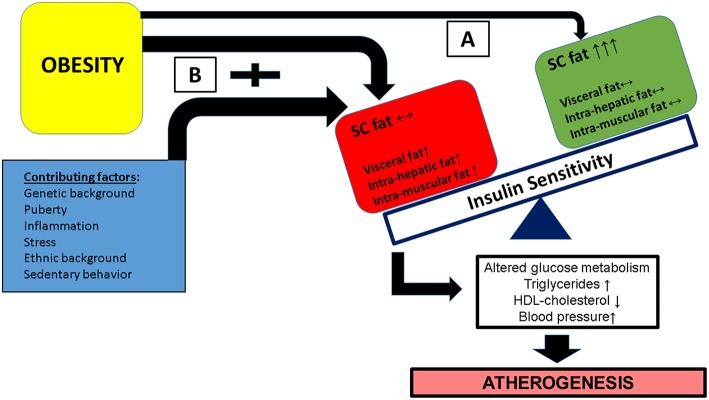
Obesity in childhood is the main determinant of whole body reduced insulin sensitivity. This association has been demonstrated in multiple adult and pediatric cohorts. The mechanistic link explaining this association is the pattern of lipid partitioning in the face of excess calories and energy surplus. A tight relation exists between typical lipid deposition patterns, specifically within the skeletal muscle and liver, as well as the intra-abdominal compartment and whole body insulin sensitivity. The impact of lipid deposition within insulin responsive tissues such as the liver and skeletal muscle relates to the ability of fatty acid derivates to inhibit elements of the insulin signal transduction pathway. Strengthening the relation of obesity and reduced insulin sensitivity are the observations that weight gain reduces insulin sensitivity while weight loss increases it. This manifests as the appearance of cardiovascular risk factor clustering with weight gain and its recovery in the face of weight loss. Both obesity , via the adipocytokine profile it induces, and low insulin sensitivity, are independent determinants of the adverse metabolic phenotype characteristic of the metabolic syndrome.
儿童肥胖是全身胰岛素敏感性降低的主要决定因素。这种关联已在多个成人和儿童队列中得到证实。解释这种关联的机制联系是在热量过剩和能量盈余情况下的脂质分配模式。典型的脂质沉积模式之间存在紧密关系,特别是在骨骼肌和肝脏内,以及腹腔内区域与全身胰岛素敏感性之间。脂质在肝脏和骨骼肌等胰岛素反应性组织中的沉积影响与脂肪酸衍生物抑制胰岛素信号转导途径元件的能力有关。体重增加会降低胰岛素敏感性,而体重减轻则会增加胰岛素敏感性,这些观察结果进一步强化了肥胖与胰岛素敏感性降低之间的关系。这表现为随着体重增加出现心血管危险因素聚集,而体重减轻时则恢复。肥胖通过其诱导的脂肪细胞因子谱以及低胰岛素敏感性,都是代谢综合征不良代谢表型特征的独立决定因素。