Ahmed Selena, Griffin Timothy S, Kraner Debra, Schaffner M Katherine, Sharma Deepak, Hazel Matthew, Leitch Alicia R, Orians Colin M, Han Wenyan, Stepp John Richard, Robbat Albert, Matyas Corene, Long Chunlin, Xue Dayuan, Houser Robert F, Cash Sean B
Food and Health Lab, Sustainable Food Systems Program, Department of Health and Human Development, Montana State University, Bozeman, MT, United States.
Friedman School of Nutrition Science and Policy, Tufts University, Boston, MA, United States.
Front Plant Sci. 2019 Aug 13;10:939. doi: 10.3389/fpls.2019.00939. eCollection 2019.
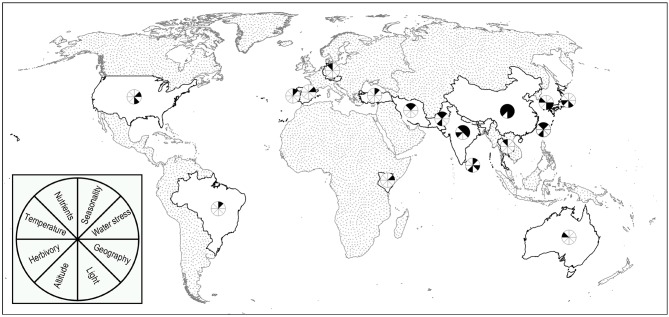
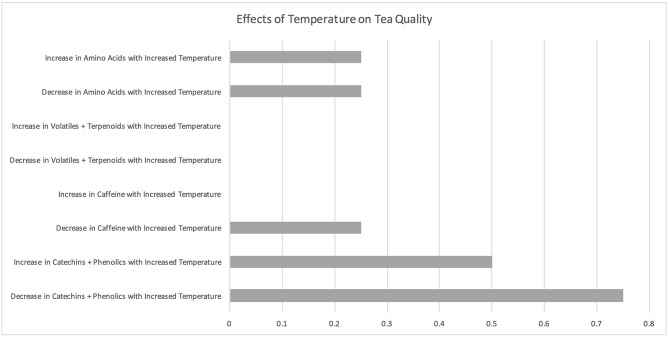
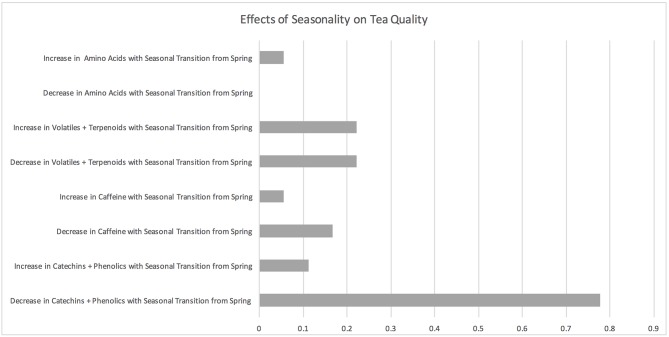
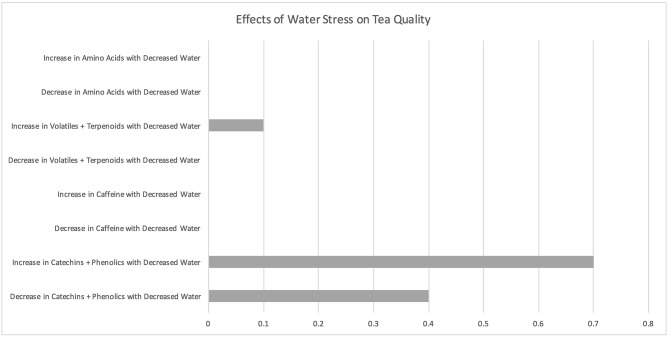
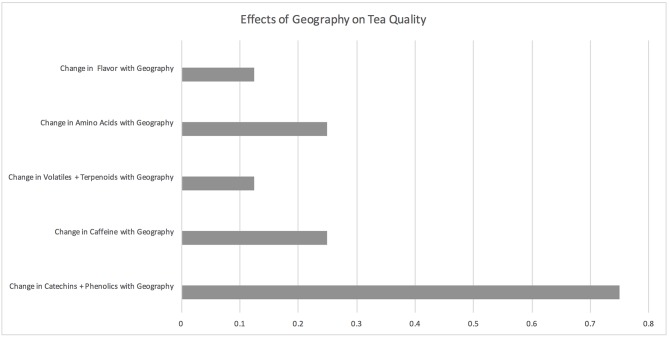
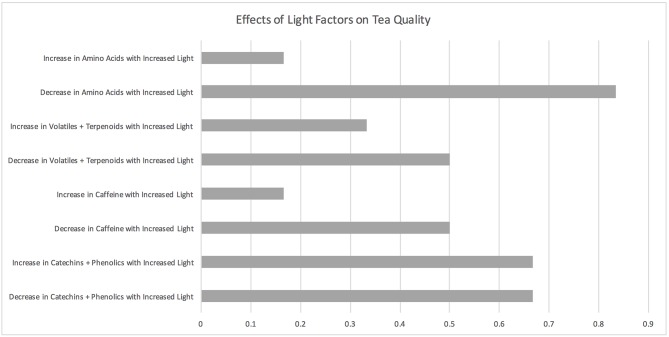
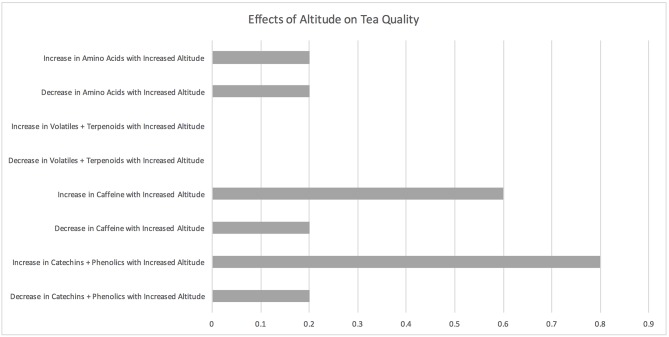
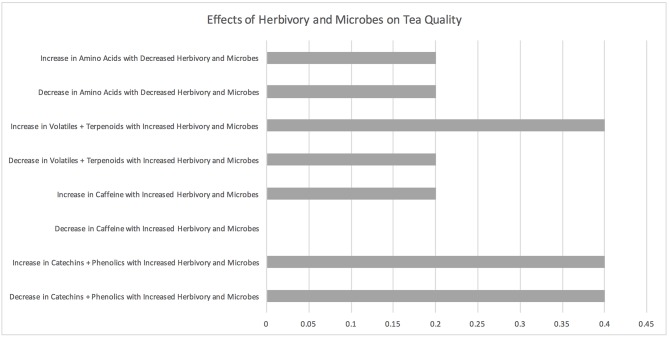
Climate change is impacting food and beverage crops around the world with implications for environmental and human well-being. While numerous studies have examined climate change effects on crop yields, relatively few studies have examined effects on crop quality (concentrations of nutrients, minerals, and secondary metabolites). This review article employs a culturally relevant beverage crop, tea (), as a lens to examine environmental effects linked to climate change on the directionality of crop quality. Our systematic review identified 86 articles as relevant to the review question. Findings provide evidence that shifts in seasonality, water stress, geography, light factors, altitude, herbivory and microbes, temperature, and soil factors that are linked to climate change can result in both increases and decreases up to 50% in secondary metabolites. A gap was found regarding evidence on the direct effects of carbon dioxide on tea quality, highlighting a critical research area for future study. While this systematic review provides evidence that multiple environmental parameters are impacting tea quality, the directionality and magnitude of these impacts is not clear with contradictory evidence between studies likely due to confounding factors including variation in tea variety, cultivar, specific environmental and agricultural management conditions, and differences in research methods. The environmental factors with the most consistent evidence in this systematic review were seasonality and water stress with 14 out of 18 studies (78%) demonstrating a decrease in concentrations of phenolic compounds or their bioactivity with a seasonal shift from the spring and /or first tea harvest to other seasons and seven out of 10 studies (70%) showing an increase in levels of phenolic compounds or their bioactivity with drought stress. Herbivory and soil fertility were two of the variables that showed the greatest contradictory evidence on tea quality. Both herbivory and soil fertility are variables which farmers have the greatest control over, pointing to the importance of agricultural management for climate mitigation and adaptation. The development of evidence-based management strategies and crop breeding programs for resilient cultivars are called for to mitigate climate impacts on crop quality and overall risk in agricultural and food systems.
气候变化正在影响世界各地的粮食和饮料作物,对环境和人类福祉产生影响。虽然众多研究探讨了气候变化对作物产量的影响,但相对较少的研究考察了其对作物品质(营养成分、矿物质和次生代谢物的浓度)的影响。这篇综述文章以一种具有文化相关性的饮料作物——茶,作为视角来审视与气候变化相关的环境因素对作物品质方向性的影响。我们的系统综述确定了86篇与综述问题相关的文章。研究结果表明,与气候变化相关的季节性变化、水分胁迫、地理位置、光照因素、海拔、食草动物和微生物、温度以及土壤因素,都可能导致次生代谢物增加或减少,幅度高达50%。在二氧化碳对茶叶品质的直接影响方面,尚未找到相关证据,这凸显了未来研究的一个关键领域。虽然这项系统综述提供了证据表明多个环境参数正在影响茶叶品质,但这些影响的方向性和程度并不明确,研究之间存在相互矛盾的数据,这可能是由于混杂因素造成的,包括茶叶品种、栽培品种、特定环境和农业管理条件的差异以及研究方法的不同。在这项系统综述中,证据最为一致的环境因素是季节性和水分胁迫,18项研究中有14项(78%)表明,随着季节从春季和/或首次采茶季向其他季节转变,酚类化合物浓度或其生物活性会降低;10项研究中有7项(70%)表明,干旱胁迫会使酚类化合物水平或其生物活性增加。食草动物和土壤肥力是在茶叶品质方面呈现出最显著矛盾证据的两个变量。食草动物和土壤肥力都是农民最能控制的变量,这表明农业管理对于气候缓解和适应的重要性。需要制定基于证据的管理策略和作物育种计划,培育具有抗逆性的品种,以减轻气候对作物品质的影响以及农业和食品系统中的整体风险。