Kakiuchi-Kiyota Satoko, Schutten Melissa M, Zhong Yu, Crawford James J, Dey Anwesha
Department of Safety Assessment, Genentech, Inc., South San Francisco, CA, United States.
Department of Discovery Chemistry, Genentech, Inc., South San Francisco, CA, United States.
Front Cell Dev Biol. 2019 Aug 14;7:156. doi: 10.3389/fcell.2019.00156. eCollection 2019.
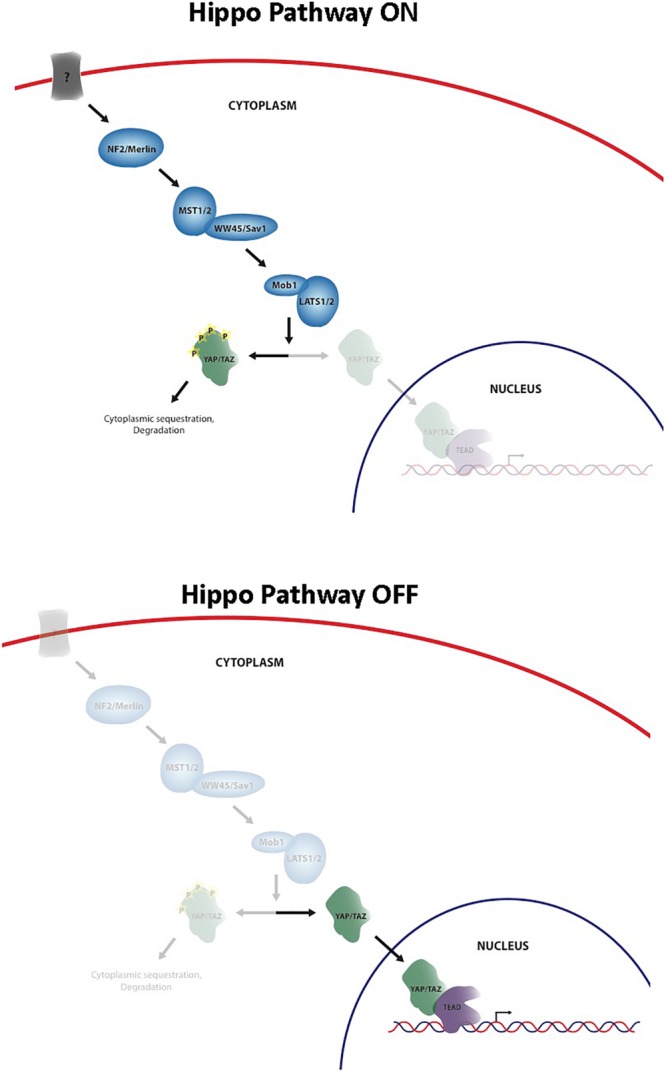
The Hippo pathway is a critical regulator of cell and organ growth and has emerged as a target for therapeutic intervention in cancers. Its signaling is thought to play an important role in various physiological processes including homeostasis and tissue regeneration. To date there has been limited information about potential pharmacology-related (on-target) safety liabilities of Hippo pathway inhibitors in the context of cancer indications. Herein, we review data from human genetic disorders and genetically engineered rodent models to gain insight into safety liabilities that may emerge from the inhibition of Hippo pathway. Germline systemic deletion of murine Hippo pathway effectors (Yap, Taz, and Teads) resulted in embryonic lethality or developmental phenotypes. Mouse models with tissue-specific deletion (or mutant overexpression) of the key effectors in Hippo pathways have indicated that, at least in some tissues, Hippo signaling may be dispensable for physiological homeostasis; and appears to be critical for regeneration upon tissue damage, indicating that patients with underlying comorbidities and/or insults caused by therapeutic agents and/or comedications may have a higher risk. Caution should be taken in interpreting phenotypes from tissue-specific transgenic animal models since some tissue-specific promoters are turned on during development. In addition, therapeutic agents may result in systemic effects not well-predicted by animal models with tissue-specific gene deletion. Therefore, the development of models that allows for systemic deletion of Yap and/or Taz in adult animals will be key in evaluating the potential safety liabilities of Hippo pathway modulation. In this review, we focus on potential challenges and strategies for targeting the Hippo pathway in cancers.
Hippo信号通路是细胞和器官生长的关键调节因子,已成为癌症治疗干预的靶点。其信号传导被认为在包括体内平衡和组织再生在内的各种生理过程中发挥重要作用。迄今为止,关于Hippo信号通路抑制剂在癌症适应症背景下潜在的与药理学相关(靶向)的安全风险的信息有限。在此,我们回顾来自人类遗传疾病和基因工程啮齿动物模型的数据,以深入了解抑制Hippo信号通路可能出现的安全风险。小鼠Hippo信号通路效应器(Yap、Taz和Teads)的种系全身性缺失导致胚胎致死或发育表型。在Hippo信号通路中具有关键效应器组织特异性缺失(或突变体过表达)的小鼠模型表明,至少在某些组织中,Hippo信号传导对于生理稳态可能是可有可无的;而对于组织损伤后的再生似乎至关重要,这表明患有潜在合并症和/或由治疗药物和/或合并用药引起损伤的患者可能具有更高的风险。在解释组织特异性转基因动物模型的表型时应谨慎,因为一些组织特异性启动子在发育过程中会被激活。此外,治疗药物可能会产生动物模型中组织特异性基因缺失无法很好预测的全身效应。因此,开发能够在成年动物中全身性缺失Yap和/或Taz的模型将是评估Hippo信号通路调节潜在安全风险的关键。在本综述中,我们重点关注在癌症中靶向Hippo信号通路的潜在挑战和策略。