
性别在决定下肢血管腔内重建术患者治疗类型中的作用。
Role of Sex in Determining Treatment Type for Patients Undergoing Endovascular Lower Extremity Revascularization.
机构信息
The Dartmouth Institute for Health Policy and Clinical Practice Lebanon NH.
Section of Vascular Surgery Department of Surgery Dartmouth-Hitchcock Medical Center Lebanon NH.
出版信息
J Am Heart Assoc. 2019 Sep 3;8(17):e013088. doi: 10.1161/JAHA.119.013088. Epub 2019 Aug 31.
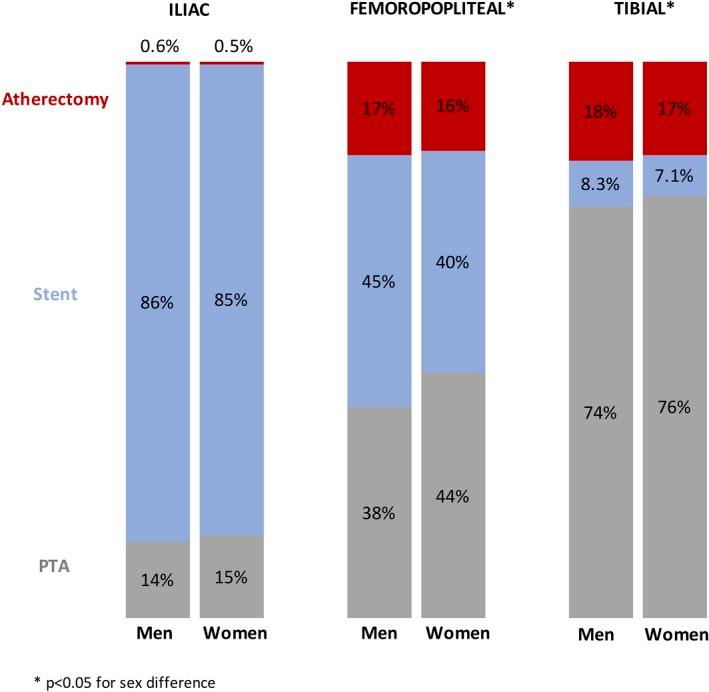
Background Limited data exist to describe factors that influence the use of different endovascular treatments for peripheral arterial disease. Therefore, we studied sex differences in the utilization of endovascular treatment modalities and their impact on arterial patency. Methods and Results We analyzed procedures from 2010 to 2016 in the Vascular Quality Initiative for arteries treated with percutaneous transluminal angioplasty (PTA) alone, stenting (with/without PTA), and atherectomy (with/without PTA). We explored sex differences in treatment modality by arterial segment (iliac, femoropopliteal, and tibial) with multivariable logistic regression. We used Kaplan-Meier survival analysis and multivariable Cox regression to study sex differences in arterial reintervention and occlusion. In this cohort, patients (n=58 247, mean age 68 years, 41% women,) had 106 073 arteries treated (median=2 arteries, interquartile range=1-3). Half (50%) of these arteries were treated with stents, 39% with PTA alone, and 11% with atherectomy. After risk adjustment, women were less likely to undergo stenting or atherectomy (versus PTA alone) in the femoropopliteal (stent risk ratio=0.78 [0.74-0.82]; atherectomy risk ratio=0.69 [0.58-0.82]) and tibial arteries (stent risk ratio=0.70 [0.55-0.89]; atherectomy risk ratio=0.87 [0.70-1.07]). In the iliac arteries there was no sex difference in stenting, and atherectomy was rarely used (0.2%). Women underwent reintervention in the femoropopliteal arteries (hazard ratio=1.28 [1.17-1.40]) or developed an occlusion in the iliac (hazard ratio=1.42 [1.12-1.81]) and femoropopliteal arteries (hazard ratio=1.19 [1.06-1.34]) more frequently than men. Conclusions Women were less likely to undergo stenting or atherectomy and had higher rates of occlusion and reintervention, especially in the femoropopliteal arteries. Evidence-based guidelines are needed to guide optimal use of endovascular treatments for men and women.
背景
关于影响外周动脉疾病血管内治疗方式选择的因素,目前仅有少量数据可供描述。因此,我们研究了不同性别在血管内治疗方式的应用上存在的差异,以及这些差异对动脉通畅率的影响。
方法和结果
我们分析了 2010 年至 2016 年期间血管质量倡议(Vascular Quality Initiative)中接受经皮腔内血管成形术(PTA)单独治疗、支架治疗(伴或不伴 PTA)和旋切术(伴或不伴 PTA)的动脉段(髂动脉、股腘动脉和胫动脉)的治疗方式差异。我们采用多变量逻辑回归分析了不同性别在动脉段上的治疗方式差异。我们采用 Kaplan-Meier 生存分析和多变量 Cox 回归分析研究了不同性别在动脉再介入和闭塞方面的差异。在这一队列中,患者(n=58247,平均年龄 68 岁,41%为女性)共有 106073 条动脉接受治疗(中位数为 2 条,四分位间距为 1-3)。其中 50%的动脉接受支架治疗,39%接受 PTA 单独治疗,11%接受旋切术治疗。经过风险调整后,女性在股腘动脉(支架治疗风险比=0.78[0.74-0.82];旋切术治疗风险比=0.69[0.58-0.82])和胫动脉(支架治疗风险比=0.70[0.55-0.89];旋切术治疗风险比=0.87[0.70-1.07])接受支架治疗或旋切术治疗的可能性均低于男性。而在髂动脉段,女性和男性接受支架治疗的差异没有统计学意义,旋切术也很少使用(0.2%)。女性在股腘动脉发生再介入的风险更高(风险比=1.28[1.17-1.40]),在髂动脉和股腘动脉发生闭塞的风险也更高(髂动脉风险比=1.42[1.12-1.81];股腘动脉风险比=1.19[1.06-1.34])。
结论
女性接受支架治疗或旋切术治疗的可能性更低,且闭塞和再介入的发生率更高,尤其是在股腘动脉。需要制定循证指南来指导男女患者的血管内治疗方式的合理应用。




 Zotero 插件