Department of NanoBiotechnology, NanoGlycobiology unit, Universität für Bodenkultur Wien, Vienna, Austria.
Department of Biology, Interfaculty Institute of Microbiology and Infection Medicine, Eberhard Karls Universität, Tübingen, Germany.
BMC Microbiol. 2019 Sep 2;19(1):200. doi: 10.1186/s12866-019-1575-7.
Tannerella forsythia is a Gram-negative oral pathogen. Together with Porphyromonas gingivalis and Treponema denticola it constitutes the "red complex" of bacteria, which is crucially associated with periodontitis, an inflammatory disease of the tooth supporting tissues that poses a health burden worldwide. Due to the absence of common peptidoglycan biosynthesis genes, the unique bacterial cell wall sugar N-acetylmuramic acid (MurNAc) is an essential growth factor of T. forsythia to build up its peptidoglycan cell wall. Peptidoglycan is typically composed of a glycan backbone of alternating N-acetylglucosamine (GlcNAc) and MurNAc residues that terminates with anhydroMurNAc (anhMurNAc), and short peptides via which the sugar backbones are cross-linked to build up a bag-shaped network.
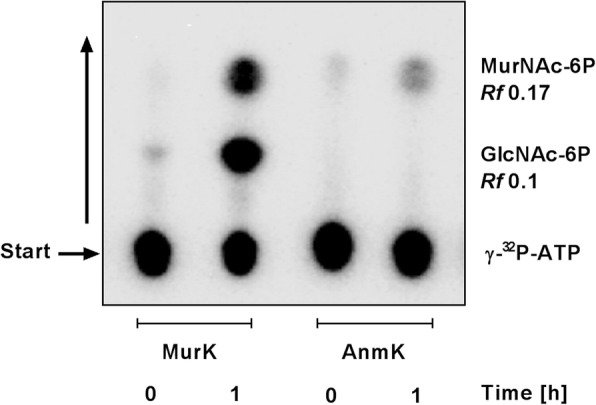
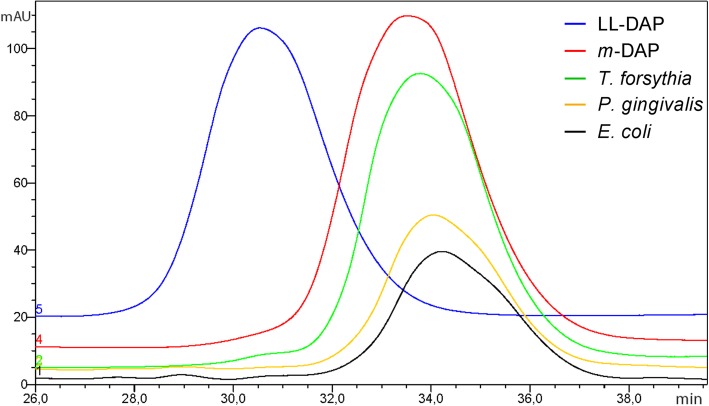
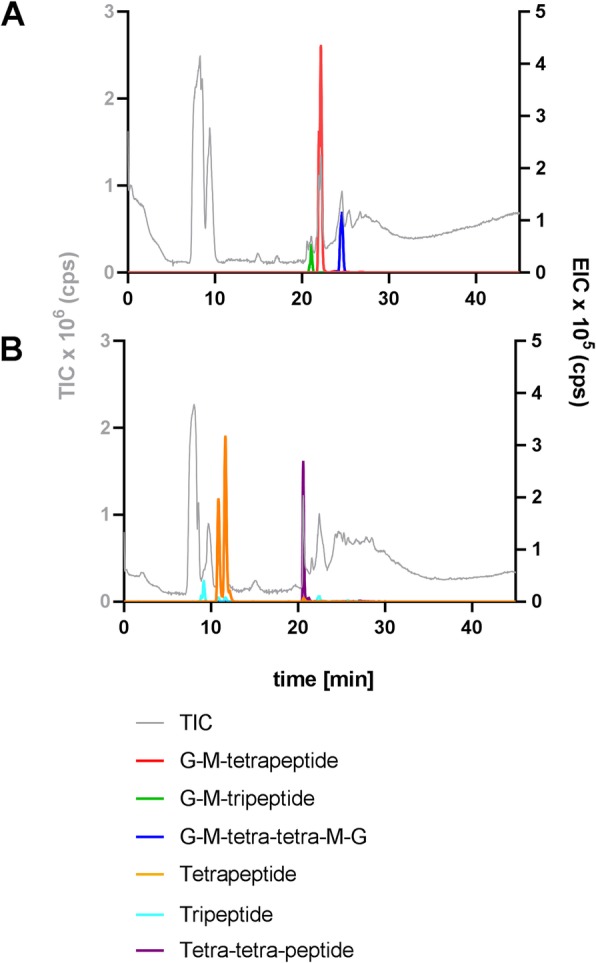
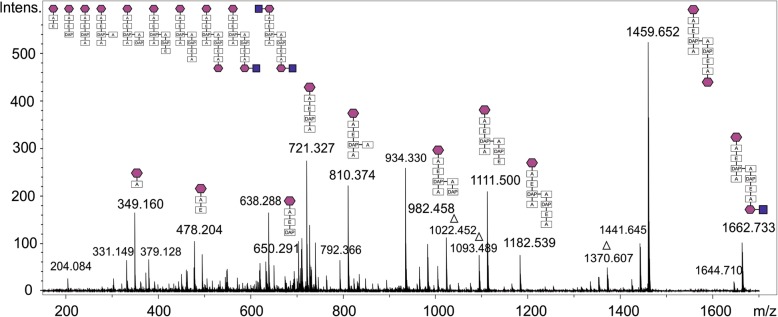
We investigated T. forsythia's peptidoglycan structure, which is an essential step towards anti-infective strategies against this pathogen. A new sensitive radioassay was developed which verified the presence of MurNAc and anhMurNAc in the cell wall of the bacterium. Upon digest of isolated peptidoglycan with endo-N-acetylmuramidase, exo-N-acetylglucosaminidase and muramyl-L-alanine amidase, respectively, peptidoglycan fragments were obtained. HPLC and mass spectrometry (MS) analyses revealed the presence of GlcNAc-MurNAc-peptides and the cross-linked dimer with retention-times and masses, respectively, equalling those of control digests of Escherichia coli and P. gingivalis peptidoglycan. Data were confirmed by tandem mass spectrometry (MS) analysis, revealing the GlcNAc-MurNAc-tetra-tetra-MurNAc-GlcNAc dimer to contain the sequence of the amino acids alanine, glutamic acid, diaminopimelic acid (DAP) and alanine, as well as a direct cross-link between DAP on the third and alanine on the fourth position of the two opposite stem peptides. The stereochemistry of DAP was determined by reversed-phase HPLC after dabsylation of hydrolysed peptidoglycan to be of the meso-type.
T. forsythia peptidoglycan is of the A1γ-type like that of E. coli. Additionally, the classification of P. gingivalis peptidoglycan as A3γ needs to be revised to A1γ, due to the presence of meso-DAP instead of LL-DAP, as reported previously.
坦纳氏菌 Forsythia 是一种革兰氏阴性口腔病原体。与牙龈卟啉单胞菌和密螺旋体一起,它构成了细菌的“红色复合体”,与牙周炎密切相关,牙周炎是一种影响牙齿支持组织的炎症性疾病,在全球范围内造成了健康负担。由于缺乏常见的肽聚糖生物合成基因,独特的细菌细胞壁糖 N-乙酰基胞壁酸 (MurNAc) 是 T. forsythia 构建其肽聚糖细胞壁的必需生长因子。肽聚糖通常由交替的 N-乙酰葡萄糖胺 (GlcNAc) 和 MurNAc 残基的聚糖主链组成,末端为脱水 MurNAc (anhMurNAc),以及通过该糖主链交联以建立袋状网络的短肽。
我们研究了 T. forsythia 的肽聚糖结构,这是对抗这种病原体的抗感染策略的重要步骤。开发了一种新的敏感放射性测定法,该方法验证了细菌细胞壁中存在 MurNAc 和 anhMurNAc。分别用内切 N-乙酰胞壁酶、外切 N-乙酰氨基葡萄糖苷酶和 muramyl-L-丙氨酸酰胺酶消化分离的肽聚糖后,获得了肽聚糖片段。HPLC 和质谱 (MS) 分析显示存在 GlcNAc-MurNAc-肽和交联二聚体,保留时间和质量分别与大肠杆菌和牙龈卟啉单胞菌肽聚糖的对照消化物相等。通过串联质谱 (MS) 分析证实了 GlcNAc-MurNAc-四-四-MurNAc-GlcNAc 二聚体含有丙氨酸、谷氨酸、二氨基庚二酸 (DAP) 和丙氨酸的氨基酸序列,以及两个相反的肽主干上的第三个 DAP 和第四个丙氨酸之间的直接交联。用水解肽聚糖的 dabsylation 后反相 HPLC 确定 DAP 的立体化学为 meso-型。
T. forsythia 的肽聚糖与大肠杆菌的 A1γ 型相同。此外,由于存在 meso-DAP 而不是 LL-DAP,如前所述,需要将牙龈卟啉单胞菌肽聚糖的分类修订为 A1γ。