NeuroGen Technologies Ltd., Genetics and Genomic Medicine Centre, Dhaka, Bangladesh.
Directorate General of Health Services, Ministry of Health and Family Welfare, Dhaka, Bangladesh.
BMC Med Genet. 2019 Sep 2;20(1):150. doi: 10.1186/s12881-019-0881-0.
Genetic testing is becoming an essential tool for breast cancer (BC) diagnosis and treatment pathway, and particularly important for early detection and cancer prevention. The purpose of this study was to explore the diagnostic yield of targeted sequencing of the high priority BC genes.
We have utilized a cost-effective targeted sequencing approach of high priority actionable BC genes (BRCA1, BRCA2, ERBB2 and TP53) in a homogeneous patient cohort from Bangladesh (n = 52) by using tumor and blood samples.
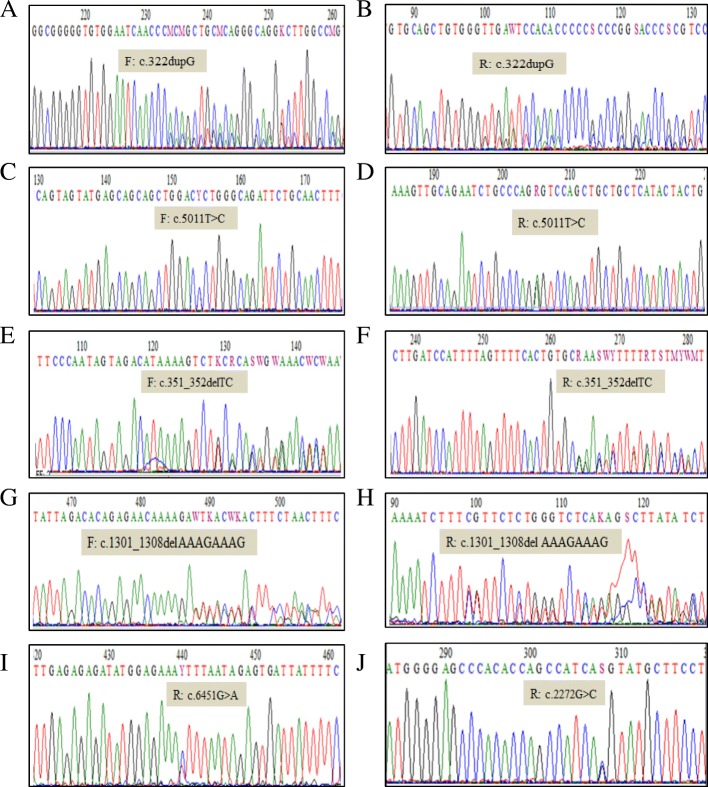
Blood derived targeted sequencing revealed 25.58% (11/43) clinically relevant mutations (both pathogenic and variants of uncertain significance (VUS)), with 13.95% (6/43) of samples carrying a pathogenic mutations. We have identified and validated five novel pathogenic germline mutations in this cohort, comprising of two frameshift deletions in BRCA2, and missense mutations in BRCA1, BRCA2 and ERBB2 gene respectively. Furthermore, we have identified three pathogenic mutations and a VUS within three tumor samples, including a sample carrying pathogenic mutations impacting both TP53 (c.322dupG; a novel frameshift insertion) and BRCA1 genes (c.116G > A). 22% of tissue samples had a clinically relevant TP53 mutation. Although the cohort is small, we have found pathogenic mutations to be enriched in BRCA2 (9.30%, 4/43) compare to BRCA1 (4.65%, 2/43). The frequency of germline VUS mutations found to be similar in both BRCA1 (4.65%; 2/43) and BRCA2 (4.65%; 2/43) compared to ERBB2 (2.32%; 1/43).
This is the first genetic study of BC predisposition genes in this population, implies that genetic screening through targeted sequencing can detect clinically significant and actionable BC-relevant mutations.
基因检测正成为乳腺癌(BC)诊断和治疗途径的重要工具,尤其对于早期检测和癌症预防非常重要。本研究的目的是探索高优先级 BC 基因靶向测序的诊断产量。
我们利用一种经济有效的靶向测序方法,对来自孟加拉国的同质患者队列(n=52)中的高优先级可操作 BC 基因(BRCA1、BRCA2、ERBB2 和 TP53)进行肿瘤和血液样本检测。
血液衍生的靶向测序揭示了 25.58%(11/43)具有临床意义的突变(包括致病性和意义不明的变异(VUS)),其中 13.95%(6/43)的样本携带致病性突变。我们在该队列中鉴定并验证了五个新的致病性种系突变,包括 BRCA2 中的两个移码缺失,以及 BRCA1、BRCA2 和 ERBB2 基因中的错义突变。此外,我们在三个肿瘤样本中发现了三个致病性突变和一个 VUS,其中一个样本携带影响 TP53(c.322dupG;一种新的移码插入)和 BRCA1 基因(c.116G>A)的致病性突变。22%的组织样本存在具有临床意义的 TP53 突变。尽管该队列规模较小,但我们发现 BRCA2 中的致病性突变(9.30%,4/43)比 BRCA1(4.65%,2/43)更为丰富。在 BRCA1(4.65%,2/43)和 BRCA2(4.65%,2/43)中发现的种系 VUS 突变频率与 ERBB2(2.32%,1/43)相似。
这是该人群中首次对 BC 易感性基因进行的遗传研究,表明通过靶向测序进行遗传筛查可以检测到具有临床意义和可操作的 BC 相关突变。