Department of Hematology, Rigshospitalet, University Hospital of Copenhagen, Copenhagen, Denmark.
Department of Clinical Biochemistry, Rigshospitalet, University Hospital of Copenhagen, Copenhagen, Denmark.
Cytometry B Clin Cytom. 2020 May;98(3):250-258. doi: 10.1002/cyto.b.21842. Epub 2019 Sep 3.
The aim of this study was to evaluate the diagnostic and prognostic role of multiparameter flow cytometry (FC) in patients with idiopathic cytopenia of undetermined significance (ICUS) and clonal cytopenia of undetermined significance (CCUS).
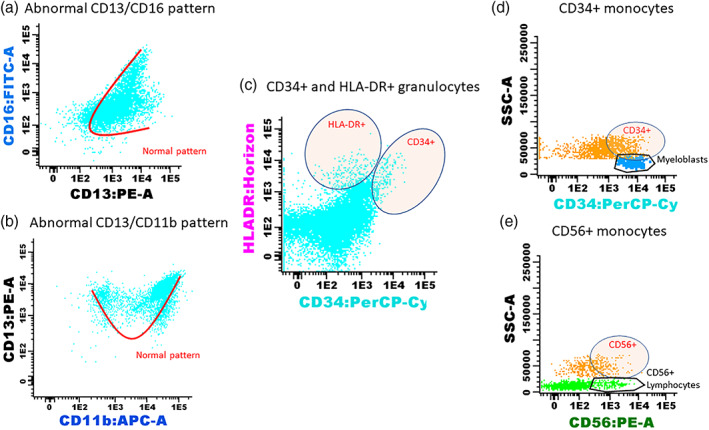
We performed FC using a standardized panel and two different diagnostic algorithms (Ogata, Wells) in a well-characterized cohort of 79 patients with ICUS/CCUS and compared it with a retrospective blinded morphological evaluation and data from targeted next-generation DNA sequencing of 20 myelodysplastic syndrome (MDS)-related genes.
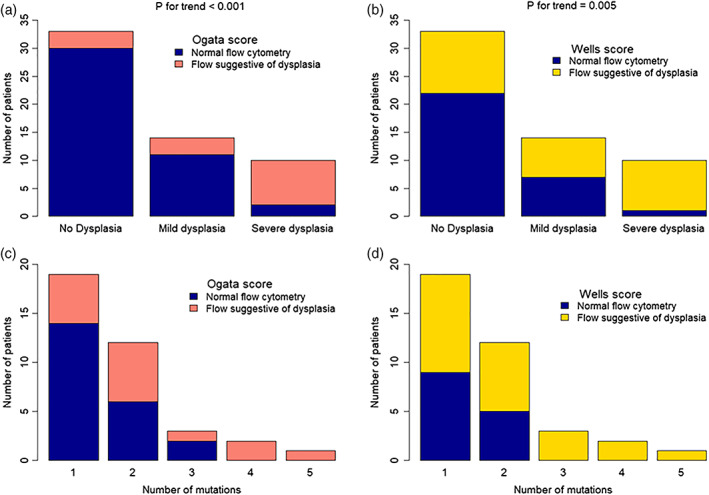
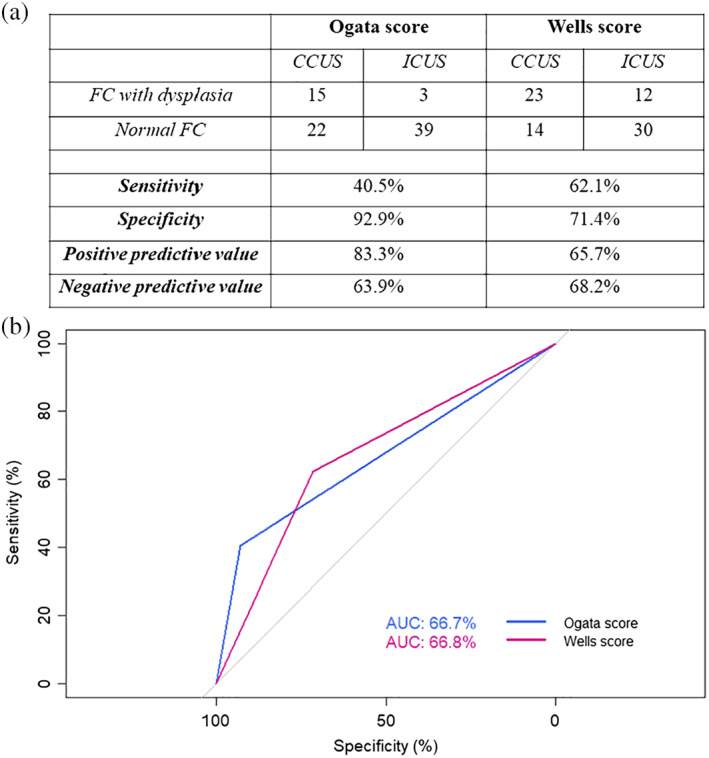
Our data show that FC has low sensitivity in distinguishing CCUS from ICUS patients (40.5% for Ogata score and 59.5% for Wells score). The Wells score was suggestive of dysplasia in ICUS/CCUS patients with concurrent morphological signs of dysplasia in the bone marrow (following re-evaluation by two hematopathologists) and in CCUS patients with a higher mutational burden. Eight patients with ICUS/CCUS from our cohort progressed to another myeloid malignancy (MDS, acute myeloid leukemia, or chronic myelomonocytic leukemia), all showing flow cytometric signs of dysplasia.
FC performs poorly in diagnosing CCUS versus ICUS. However, it can potentially provide prognostic information in cytopenic patients by identifying a subgroup of patients with a higher grade of dysplasia, higher mutational burden, and higher risk of progression and, together with mutational screening, also identify a group of patients who might require morphological reassessment of dysplastic changes in their bone marrow.
本研究旨在评估多参数流式细胞术(FC)在特发性血细胞减少症不确定意义(ICUS)和克隆性血细胞减少症不确定意义(CCUS)患者中的诊断和预后作用。
我们使用标准化面板和两种不同的诊断算法(Ogata、Wells)对 79 例 ICUS/CCUS 患者进行了 FC 检测,并将其与回顾性盲法形态学评估以及 20 个骨髓增生异常综合征(MDS)相关基因的靶向二代 DNA 测序数据进行了比较。
我们的数据表明,FC 在区分 CCUS 与 ICUS 患者方面的敏感性较低(Ogata 评分的敏感性为 40.5%,Wells 评分的敏感性为 59.5%)。Wells 评分提示伴有骨髓形态学发育不良迹象(两名血液病理学家重新评估后)的 ICUS/CCUS 患者和具有更高突变负担的 CCUS 患者存在发育不良。我们队列中有 8 例 ICUS/CCUS 患者进展为另一种髓系恶性肿瘤(MDS、急性髓系白血病或慢性粒单核细胞白血病),所有患者均表现出流式细胞术发育不良迹象。
FC 在诊断 CCUS 与 ICUS 方面表现不佳。然而,它可以通过识别具有更高发育不良程度、更高突变负担和更高进展风险的患者亚组,为血细胞减少症患者提供预后信息,并且与突变筛查一起,还可以识别出一组可能需要对骨髓发育不良变化进行形态学重新评估的患者。