Guo Tianfu, Gao Jun, Yang Bin, Yan Guorong, Xiao Shijun, Zhang Zhiyan, Huang Lusheng
State Key Laboratory of Pig Genetic Improvement and Production Technology, Jiangxi Agricultural University, Nanchang 330045, China.
Department of Biochemistry and Molecular Biology, Gannan Medical University, Ganzhou, Jiangxi 341000, China.
Asian-Australas J Anim Sci. 2020 May;33(5):704-711. doi: 10.5713/ajas.18.0767. Epub 2019 Jul 1.
Muscle fiber types, numbers and area are crucial aspects associated with meat production and quality. However, there are few studies of pig muscle fibre traits in terms of the detection power, false discovery rate and confidence interval precision of whole-genome quantitative trait loci (QTL). We had previously performed genome scanning for muscle fibre traits using 183 microsatellites and detected 8 significant QTLs in a White Duroc× Erhualian F2 population. The confidence intervals of these QTLs ranged between 11 and 127 centimorgan (cM), which contained hundreds of genes and hampered the identification of QTLs. A whole-genome sequence imputation of the population was used for fine mapping in this study.
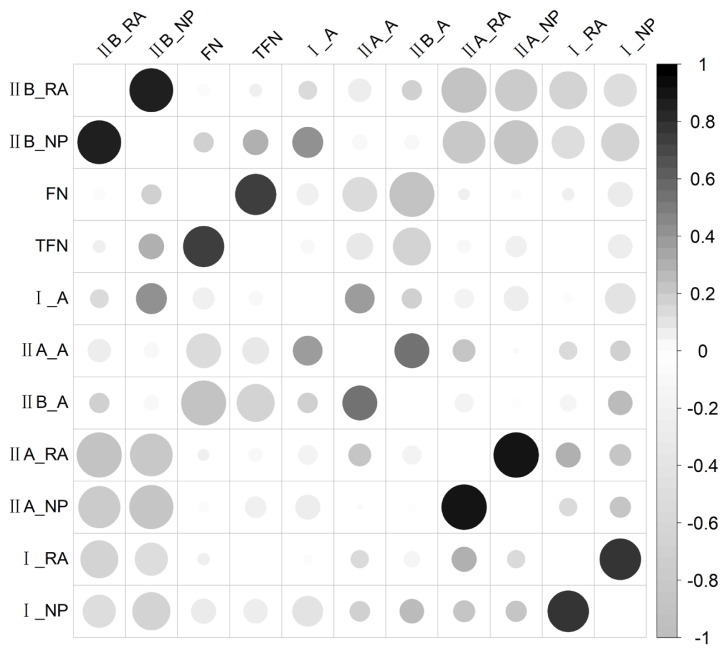
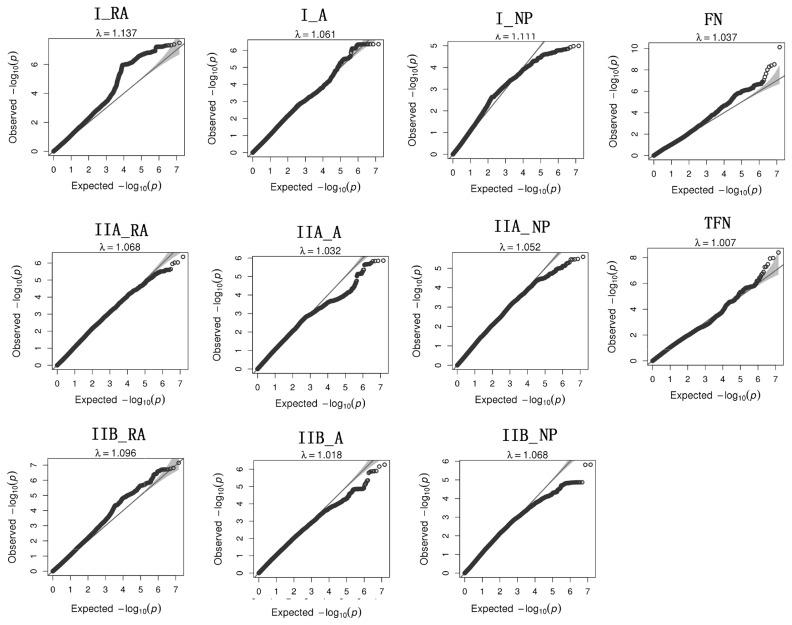
A whole-genome sequences association study was performed in the F2 population. Genotyping was performed for 1,020 individuals (19 F0, 68 F1, and 933 F2). The whole-genome variants were imputed and 21,624,800 single nucleotide polymorphisms (SNPs) were identified and examined for associations to 11 longissimus dorsi muscle fiber traits.
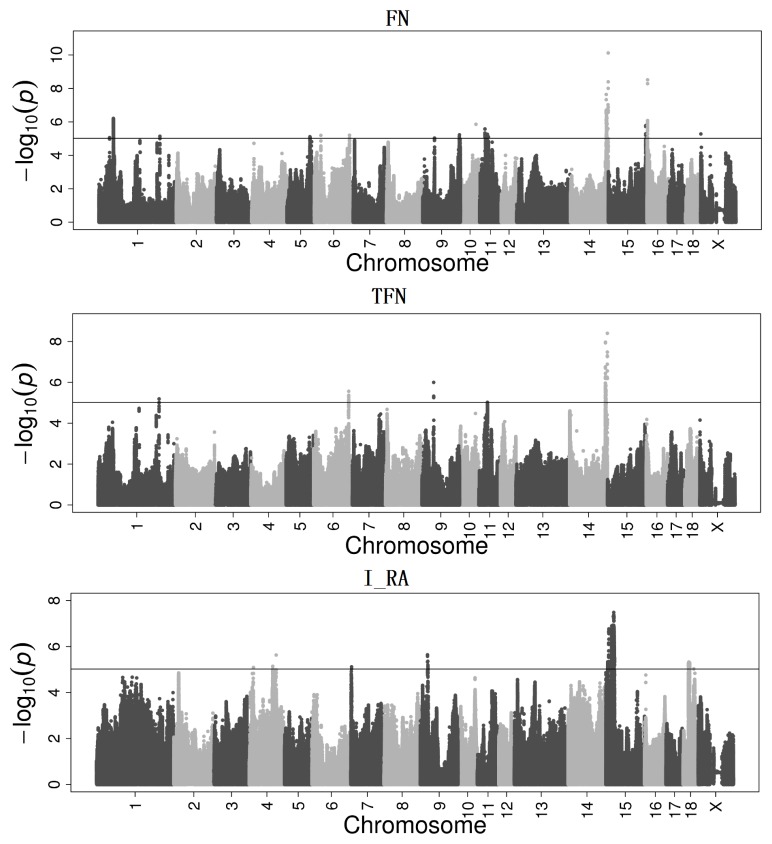
A total of 3,201 significant SNPs comprising 7 novel QTLs showing associations with the relative area of fiber type I (I_RA), the fiber number per square centimeter (FN) and the total fiber number (TFN). Moreover, one QTL on pig chromosome 14 was found to affect both FN and TFN. Furthermore, four plausible candidate genes associated with FN (kinase non-catalytic C-lobe domain containing [KNDC1]), TFN (KNDC1), and I_RA (solute carrier family 36 member 4, contactin associated protein like 5, and glutamate metabotropic receptor 8) were identified.
An efficient and powerful imputation-based association approach was utilized to identify genes potentially associated with muscle fiber traits. These identified genes and SNPs could be explored to improve meat production and quality via marker-assisted selection in pigs.
肌纤维类型、数量和面积是与肉类生产和品质相关的关键因素。然而,关于猪肌纤维性状在全基因组数量性状位点(QTL)的检测能力、假发现率和置信区间精度方面的研究较少。我们之前使用183个微卫星对肌纤维性状进行了基因组扫描,并在大白杜洛克×二花脸F2群体中检测到8个显著的QTL。这些QTL的置信区间在11至127厘摩(cM)之间,其中包含数百个基因,阻碍了QTL的鉴定。本研究使用群体的全基因组序列插补进行精细定位。
在F2群体中进行全基因组序列关联研究。对1020个个体(19个F0、68个F1和933个F2)进行基因分型。对全基因组变异进行插补,鉴定出21624800个单核苷酸多态性(SNP),并检测它们与11个背最长肌肌纤维性状的关联。
共发现3201个显著的SNP,包括7个新的QTL,它们与I型纤维相对面积(I_RA)、每平方厘米纤维数量(FN)和总纤维数量(TFN)相关。此外,发现猪14号染色体上的一个QTL同时影响FN和TFN。此外,还鉴定出4个与FN(含激酶非催化C叶结构域[KNDC1])、TFN(KNDC1)和I_RA(溶质载体家族36成员4、接触蛋白相关蛋白样5和谷氨酸代谢型受体8)相关的可能候选基因。
利用一种高效且强大的基于插补的关联方法来鉴定可能与肌纤维性状相关的基因。这些鉴定出的基因和SNP可通过猪的标记辅助选择来探索改善肉类生产和品质。