Paracelsus Medical University, Institute of Nursing Science and Practice, Strubergasse 21, 5020, Salzburg, Austria.
Department of Sociology, Paris Lodron University Salzburg, Salzburg, Austria.
BMC Geriatr. 2019 Sep 3;19(1):244. doi: 10.1186/s12877-019-1258-0.
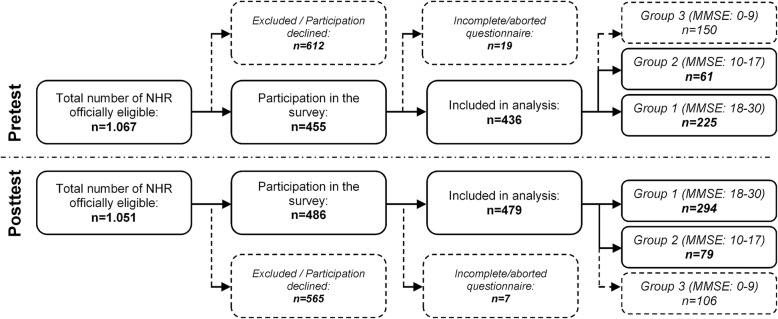
Data quality is of special concern when it comes to survey research in nursing homes. Very little is known about specifics of cognitively impaired elderly in responding to survey questions. This study examines effects of cognitive impairment, age, gender, and interview duration on the data quality in a sample of 659 nursing home residents (NHR).
Within a cross-sectional design, survey methodology was used to evaluate the pain situation in 13 nursing homes. Residents were stratified into NHR with no/mild (Mini-Mental State Examination MMSE: 18-30) and NHR with moderate (MMSE: 10-17) cognitive impairment. Data quality is measured by item nonresponse (INR). Correlation analyses, ANCOVA, linear and logistic regression models are applied.
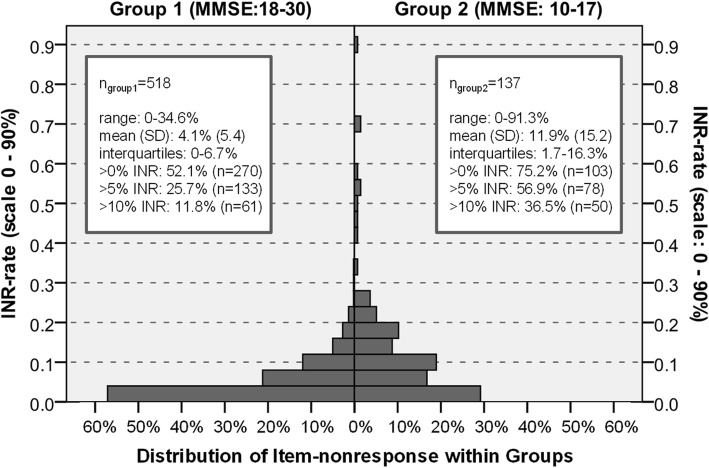
Neither interview duration nor gender have effects on item nonresponse. Age accounts for higher INR (β = 0.12, p < 0.001). Cognitive impairment strongly predicts INR (β = - 0.40, p < 0.001). INR significantly differs between NHR with no/mild (3.98%) and moderate cognitive impairment (11.85%). The likelihood of INR > 5% for residents with moderate cognitive impairment is 3.8-times (p < 0.001) of that for those with no/mild impairment.
Surveys are adequate for residents with no/mild cognitive impairment but data quality is threatened in residents with moderate impairments. Precision and validity of responses from NHR with progressed cognitive impairment are potentially limited and results may be biased. The results clearly do support the need for a multidisciplinary 'general theory' of the question-/answer-process which has to be also inclusive for cognitively impaired elderly persons.
在养老院的调查研究中,数据质量是特别需要关注的问题。对于认知障碍的老年人在回答调查问题时的具体情况,我们知之甚少。本研究在 659 名养老院居民(NHR)样本中,研究了认知障碍、年龄、性别和访谈时间对数据质量的影响。
在横断面设计中,采用调查方法评估了 13 家养老院的疼痛情况。居民分为认知无障碍(MMSE:18-30)和中度认知障碍(MMSE:10-17)的 NHR。数据质量通过项目无应答(INR)来衡量。应用相关分析、协方差分析、线性和逻辑回归模型。
访谈时间和性别均对项目无应答无影响。年龄导致更高的 INR(β=0.12,p<0.001)。认知障碍强烈预测 INR(β=-0.40,p<0.001)。NHR 无/轻度认知障碍(3.98%)和中度认知障碍(11.85%)的 INR 显著不同。中度认知障碍居民 INR>5%的可能性是无/轻度认知障碍居民的 3.8 倍(p<0.001)。
对于无/轻度认知障碍的居民,调查是足够的,但中度认知障碍居民的数据质量受到威胁。有进展性认知障碍的 NHR 的反应准确性和有效性可能受到限制,结果可能存在偏差。研究结果明确支持需要一种多学科的“通用理论”来解释问题/答案的过程,该理论还必须包括认知障碍的老年人。