Parsons Janet P, Bedford Rachael, Jones Emily J H, Charman Tony, Johnson Mark H, Gliga Teodora
Centre for Brain and Cognitive Development, Birkbeck, University of London, London, United Kingdom.
Biostatistics Department, Institute of Psychiatry, Psychology & Neuroscience, King's College London, London, United Kingdom.
Front Psychol. 2019 Aug 20;10:1799. doi: 10.3389/fpsyg.2019.01799. eCollection 2019.
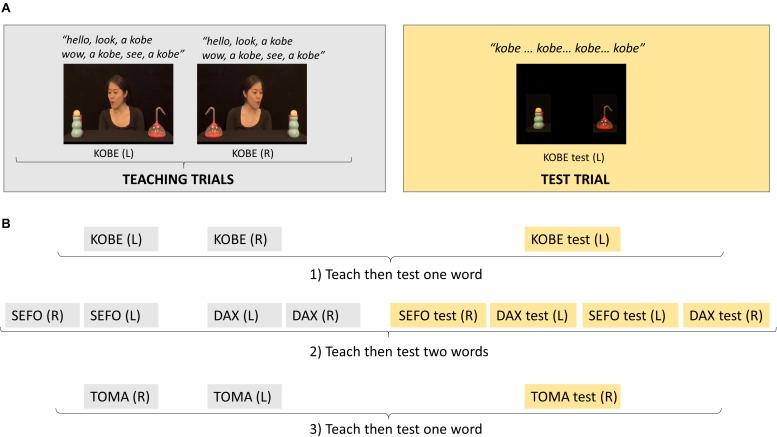
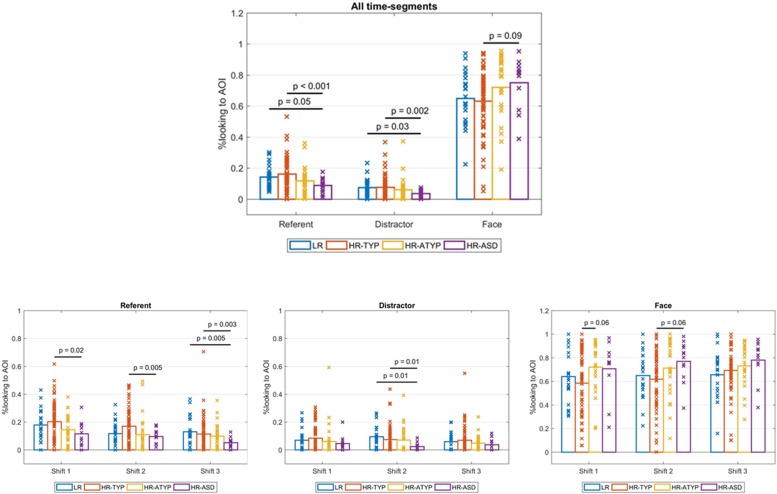
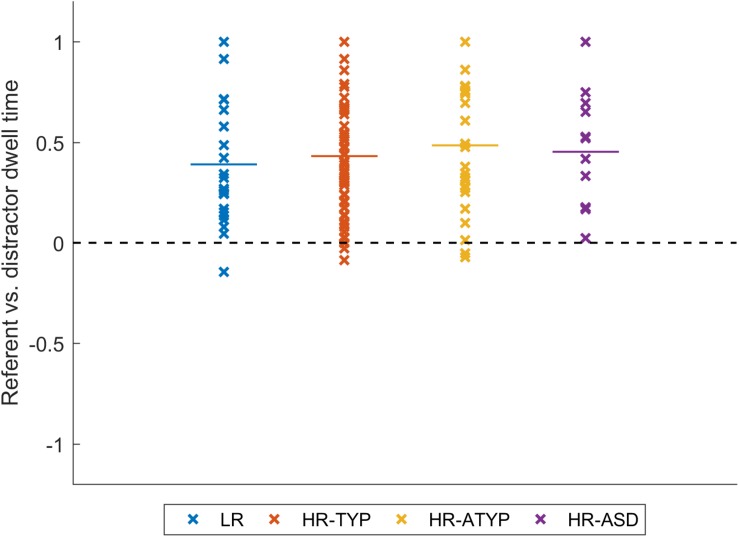
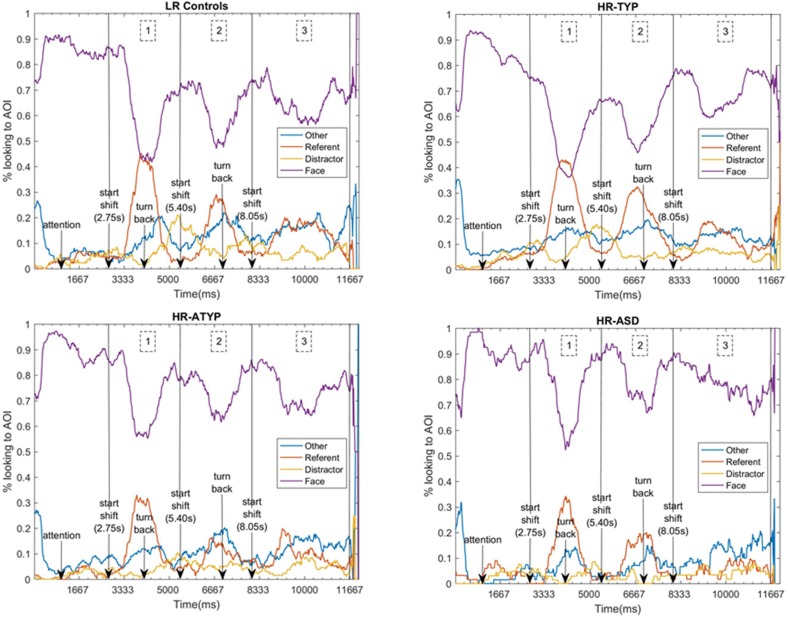
Reduced gaze following has been associated previously with lower language scores in children with autism spectrum disorder (ASD). Here, we use eye-tracking in a controlled experimental setting to investigate whether gaze following and attention distribution during a word learning task associate with later developmental and clinical outcomes in a population of infants at familial risk for ASD. Fifteen-month-old infants ( = 124; = 101 with familial risk) watched an actress repeatedly gaze toward and label one of two objects present in front of her. We show that infants who later developed ASD followed gaze as frequently as typically developing peers but spent less time engaged with either object. Moreover, more time spent on faces and less on objects was associated with lower concurrent or later verbal abilities, but not with later symptom severity. No outcome group showed evidence for word learning. Thus, atypical distribution of attention rather than poor gaze following is a limiting factor for language development in infants at familial risk for ASD.
目光追随能力降低先前已被发现与自闭症谱系障碍(ASD)儿童的语言得分较低有关。在此,我们在可控的实验环境中使用眼动追踪技术,以研究在单词学习任务中目光追随和注意力分配是否与有ASD家族风险的婴儿群体日后的发育和临床结果相关。15个月大的婴儿(n = 124;n = 101有家族风险)观看一名女演员反复看向并标记她面前两个物体中的一个。我们发现,后来发展为ASD的婴儿目光追随频率与发育正常的同龄人一样,但与任一物体互动的时间较少。此外,花在面部上的时间更多而花在物体上的时间更少与同时期或后期较低的语言能力相关,但与后期症状严重程度无关。没有结果组显示出单词学习的证据。因此,注意力分布异常而非目光追随能力差是有ASD家族风险的婴儿语言发展的限制因素。