Wang Hong-Jiao, Wang Chuan-Qing, Hua Chun-Zhen, Yu Hui, Zhang Ting, Zhang Hong, Wang Shi-Fu, Lin Ai-Wei, Cao Qing, Huang Wei-Chun, Deng Hui-Ling, Cao Shan-Cheng, Chen Xue-Jun
Division of Infectious Diseases, The Children's Hospital, Zhejiang University School of Medicine, Hangzhou 310003, China.
Department of Clinical Laboratory, Children's Hospital of Fudan University, Shanghai 201102, China.
Can J Infect Dis Med Microbiol. 2019 Aug 14;2019:6456321. doi: 10.1155/2019/6456321. eCollection 2019.
(HI) is a common cause of community-acquired pneumonia in children. In many countries, HI strains are increasingly resistant to ampicillin and other commonly prescribed antibiotics, posing a challenge for effective clinical treatment. This study was undertaken to determine the antibiotic resistance profiles of HI isolates from Chinese children and to provide guidelines for clinical treatment.
Our Infectious Disease Surveillance of Pediatrics (ISPED) collaboration group includes six children's hospitals in different regions of China. The same protocols and guidelines were used by all collaborators for the culture and identification of HI. The Kirby-Bauer method was used to test antibiotic susceptibility, and a cefinase disc was used to detect -lactamase activity.
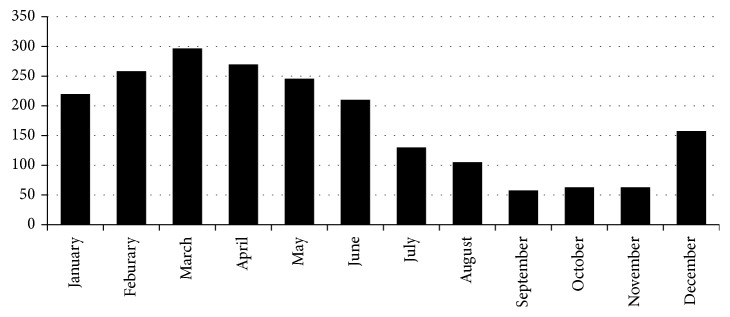
We isolated 2073 HI strains in 2016: 83.9% from the respiratory tract, 11.1% from vaginal secretions, and 0.5% from blood. Patients with respiratory isolates were significantly younger than nonrespiratory patients ( < 0.001). Of all 2073 strains, 50.3% were positive for -lactamase and 58.1% were resistant to ampicillin; 9.3% were -lactamase-negative and ampicillin-resistant. The resistance rates of the HI isolates to trimethoprim-sulfamethoxazole, azithromycin, cefuroxime, ampicillin-sulbactam, cefotaxime, and meropenem were 71.1%, 32.0%, 31.2%, 17.6%, 5.9%, and 0.2%, respectively.
More than half of the HI strains isolated from Chinese children were resistant to ampicillin, primarily due to the production of -lactamase. Cefotaxime and other third-generation cephalosporins could be the first choice for the treatment of ampicillin-resistant HI infections.
流感嗜血杆菌(HI)是儿童社区获得性肺炎的常见病因。在许多国家,HI菌株对氨苄西林和其他常用抗生素的耐药性日益增强,给有效的临床治疗带来挑战。本研究旨在确定中国儿童HI分离株的抗生素耐药谱,并为临床治疗提供指导。
我们的儿科传染病监测(ISPED)协作组包括中国不同地区的六家儿童医院。所有合作者采用相同的方案和指南进行HI的培养和鉴定。采用 Kirby-Bauer 法检测抗生素敏感性,并用头孢菌素酶纸片检测β-内酰胺酶活性。
2016年我们分离出2073株HI菌株:83.9%来自呼吸道,11.1%来自阴道分泌物,0.5%来自血液。呼吸道分离株患者明显比非呼吸道患者年轻(P<0.001)。在所有2073株菌株中,50.3%的β-内酰胺酶阳性,58.1%对氨苄西林耐药;9.3%的β-内酰胺酶阴性但对氨苄西林耐药。HI分离株对甲氧苄啶-磺胺甲恶唑、阿奇霉素、头孢呋辛、氨苄西林-舒巴坦、头孢噻肟和美罗培南的耐药率分别为71.1%、32.0%、31.2%、17.6%、5.9%和0.2%。
从中国儿童中分离出的HI菌株半数以上对氨苄西林耐药,主要原因是产生β-内酰胺酶。头孢噻肟和其他第三代头孢菌素可作为治疗耐氨苄西林HI感染的首选药物。