Department of Medical Microbiology, NUTRIM School of Nutrition and Translational Research in Metabolism, Maastricht University Medical Center, PO box 5800, 6202AZ Maastricht, Netherlands.
Department of Medical Microbiology & Infection Control, VU University Medical Center, P.O. Box 7057, 1007MB Amsterdam, Netherlands.
Oxid Med Cell Longev. 2019 Aug 14;2019:5204218. doi: 10.1155/2019/5204218. eCollection 2019.
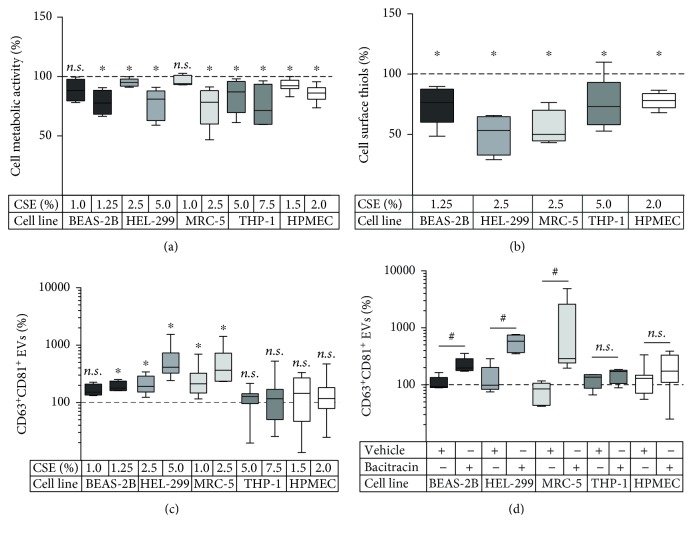
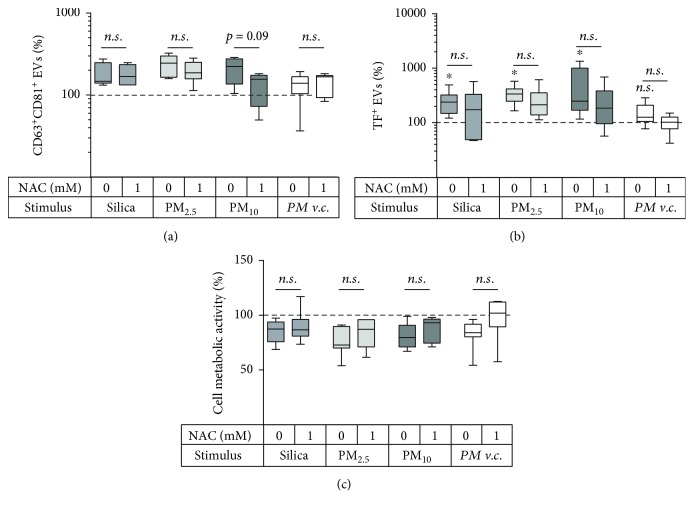
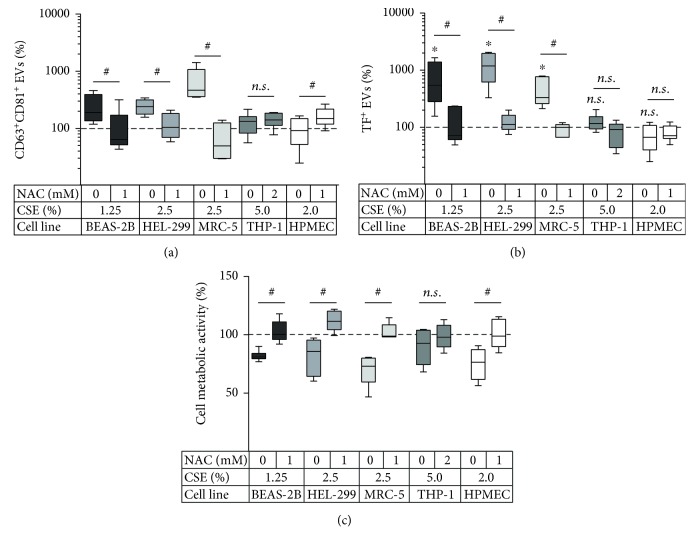
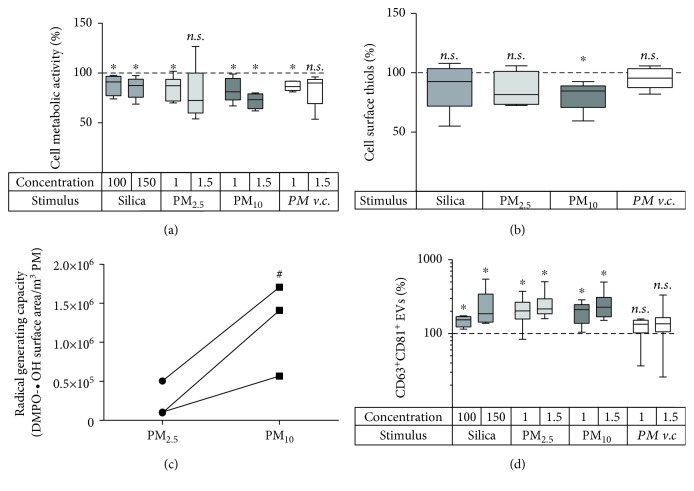
Chronic exposure to respiratory stressors increases the risk for pulmonary and cardiovascular diseases. Previously, we have shown that cigarette smoke extract (CSE) triggers the release of CD63CD81 and tissue factor (TF) procoagulant extracellular vesicles (EVs) by bronchial epithelial cells via depletion of cell surface thiols. Here, we hypothesized that this represents a universal response for different pulmonary cell types and respiratory exposures. Using bead-based flow cytometry, we found that bronchial epithelial cells and pulmonary fibroblasts, but not pulmonary microvascular endothelial cells or macrophages, release CD63CD81 and TF EVs in response to CSE. Cell surface thiols decreased in all cell types upon CSE exposure, whereas depletion of cell surface thiols using bacitracin only triggered EV release by epithelial cells and fibroblasts. The thiol-antioxidant NAC prevented the EV induction by CSE in epithelial cells and fibroblasts. Exposure of epithelial cells to occupational silica nanoparticles and particulate matter (PM) from outdoor air pollution also enhanced EV release. Cell surface thiols were mildly decreased and NAC partly prevented the EV induction for PM, but not for silica and PM. Taken together, induction of procoagulant EVs is a cell type-specific response to CSE. Moreover, induction of CD63CD81 and TF EVs in bronchial epithelial cells appears to be a universal response to various respiratory stressors. TF EVs may serve as biomarkers of exposure and/or risk in response to respiratory exposures and may help to guide preventive treatment decisions.
慢性暴露于呼吸应激物会增加肺部和心血管疾病的风险。此前,我们已经表明,香烟烟雾提取物 (CSE) 通过耗尽细胞表面巯基,引发支气管上皮细胞释放 CD63CD81 和组织因子 (TF) 促凝血细胞外囊泡 (EVs)。在这里,我们假设这代表了不同肺部细胞类型和呼吸暴露的普遍反应。使用基于珠子的流式细胞术,我们发现支气管上皮细胞和肺成纤维细胞,但不是肺微血管内皮细胞或巨噬细胞,会对 CSE 释放 CD63CD81 和 TF EVs。细胞表面巯基在所有细胞类型中都会在 CSE 暴露后减少,而使用杆菌肽仅耗尽上皮细胞和成纤维细胞的细胞表面巯基会触发 EV 释放。巯基抗氧化剂 NAC 可防止 CSE 诱导上皮细胞和成纤维细胞的 EV 产生。暴露于上皮细胞的职业性二氧化硅纳米颗粒和来自室外空气污染的颗粒物 (PM) 也会增强 EV 释放。细胞表面巯基轻度减少,NAC 部分预防 PM 的 EV 诱导,但不能预防二氧化硅和 PM。总之,促凝血 EV 的诱导是 CSE 的一种细胞类型特异性反应。此外,支气管上皮细胞中 CD63CD81 和 TF EVs 的诱导似乎是对各种呼吸应激物的普遍反应。TF EVs 可能作为暴露和/或风险的生物标志物,以响应呼吸暴露,并可能有助于指导预防性治疗决策。