Department of Nuclear Medicine, Catholic Kwandong University College of Medicine, International St. Mary's Hospital, Incheon, Korea.
Department of Surgery, Soonchunhyang University Cheonan Hospital, 31 Suncheonhyang 6-gil, Dongnam-gu, Cheonan, Chungcheongnam-do, 31151, Korea.
Gastric Cancer. 2020 Mar;23(2):273-284. doi: 10.1007/s10120-019-01001-2. Epub 2019 Sep 4.
The purpose of this study was to investigate the prognostic significance of computed tomography (CT) attenuation and F-18 fluorodeoxyglucose (FDG) uptake of visceral adipose tissue (VAT) to predict peritoneal recurrence-free survival (RFS) as well as RFS and overall survival (OS) in patients with advanced gastric cancer (AGC).
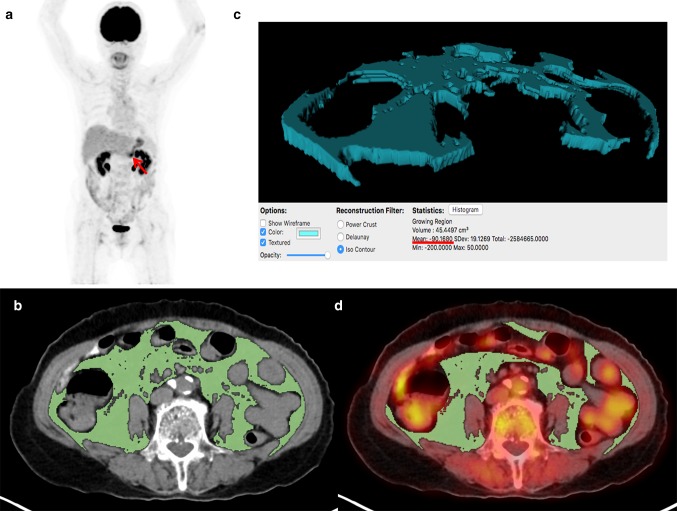
We retrospectively enrolled 117 patients with AGC who underwent staging FDG positron emission tomography (PET)/CT and subsequent curative surgical resection. CT attenuation and FDG uptake (SUV) of VAT and maximum FDG uptake of primary tumor (SUVmaxT) were measured from PET/CT images. The relationship of VAT attenuation and SUV with clinico-histopathologic factors and survival was assessed.
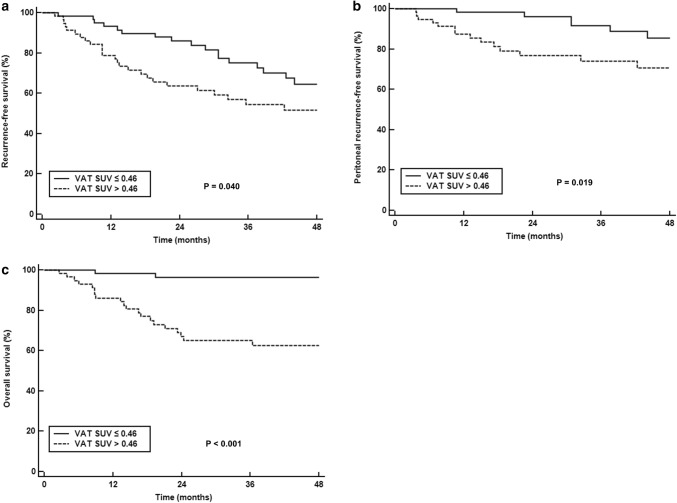
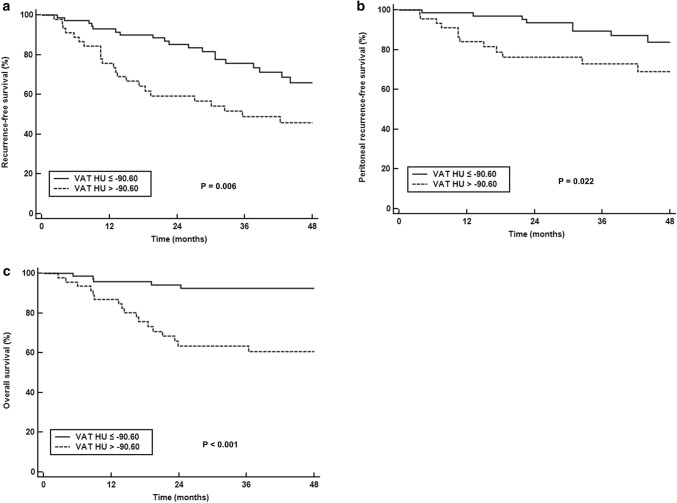
There was a significant positive correlation between VAT attenuation and SUV (p < 0.001, r = 0.799). In correlation analyses, both VAT attenuation and SUV showed significant positive correlations with T stage, TNM stage, tumor size, and platelet-to-lymphocyte ratio (p < 0.05), and patients who experienced recurrence during the first 3-year after surgery had significantly higher VAT attenuation and SUV than those who had no recurrence (p < 0.05). Patients with high VAT attenuation and SUV showed significantly worse RFS, peritoneal RFS, and OS than those with low values (p < 0.05). On multivariate survival analysis, VAT attenuation was significantly associated with peritoneal RFS and OS and VAT SUV was significantly associated with OS (p < 0.05).
CT attenuation and FDG uptake of VAT on staging FDG PET/CT were correlated with tumor characteristics and were significant predictive factors for peritoneal RFS and OS in patients with AGC.
本研究旨在探讨计算机断层扫描(CT)衰减和 F-18 氟脱氧葡萄糖(FDG)摄取内脏脂肪组织(VAT)对预测腹膜无复发生存(RFS)以及晚期胃癌(AGC)患者的 RFS 和总生存(OS)的预后意义。
我们回顾性纳入了 117 例接受分期 FDG 正电子发射断层扫描(PET)/CT 检查和随后根治性手术切除的 AGC 患者。从 PET/CT 图像中测量 VAT 的 CT 衰减和 FDG 摄取(SUV)以及原发肿瘤的最大 FDG 摄取(SUVmaxT)。评估 VAT 衰减和 SUV 与临床病理因素和生存的关系。
VAT 衰减和 SUV 之间存在显著的正相关(p<0.001,r=0.799)。在相关性分析中,VAT 衰减和 SUV 均与 T 分期、TNM 分期、肿瘤大小和血小板与淋巴细胞比值呈显著正相关(p<0.05),并且在手术后 3 年内发生复发的患者的 VAT 衰减和 SUV 明显高于未复发的患者(p<0.05)。VAT 衰减和 SUV 较高的患者的 RFS、腹膜 RFS 和 OS 明显较差(p<0.05)。多变量生存分析显示,VAT 衰减与腹膜 RFS 和 OS 显著相关,VAT SUV 与 OS 显著相关(p<0.05)。
分期 FDG PET/CT 上 VAT 的 CT 衰减和 FDG 摄取与肿瘤特征相关,是 AGC 患者腹膜 RFS 和 OS 的重要预测因素。