Iida Shinichiro, Matsumoto Yasunori, Toyozumi Takeshi, Otsuka Ryota, Shiraishi Tadashi, Morishita Hiroki, Makiyama Tenshi, Nishioka Yuri, Yamada Masanari, Hirata Atsushi, Hayano Koichi, Ohira Gaku, Kano Masayuki, Matsubara Hisahiro
Department of Frontier Surgery, Chiba University Graduate School of Medicine, Chiba, Japan.
Division of Gastroenterological Surgery, Chiba Cancer Center, Chiba, Japan.
Cancer Diagn Progn. 2024 Nov 3;4(6):754-761. doi: 10.21873/cdp.10392. eCollection 2024 Nov-Dec.
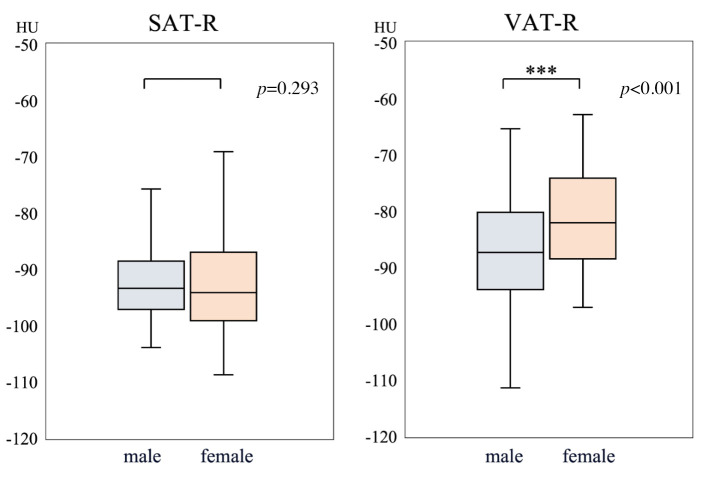
BACKGROUND/AIM: Although the impact of body composition on cancer treatment outcomes of patients with cancer has been increasingly reported, it is still unclear whether the radiodensity of subcutaneous adipose tissue (SAT) on computed tomography (CT) images has a prognostic impact on patients with gastric cancer. We measured muscle and SAT profiles on CT and performed an integrated analysis with clinicopathologic factors.
We retrospectively analyzed 230 patients with gastric cancer who underwent gastrectomy between June 2016 and December 2020. SAT radiodensity (SAT-R), and skeletal muscle index (SMI) were measured in preoperative CT images. These were compared with clinicopathologic factors, overall survival (OS), and recurrence-free survival (RFS).
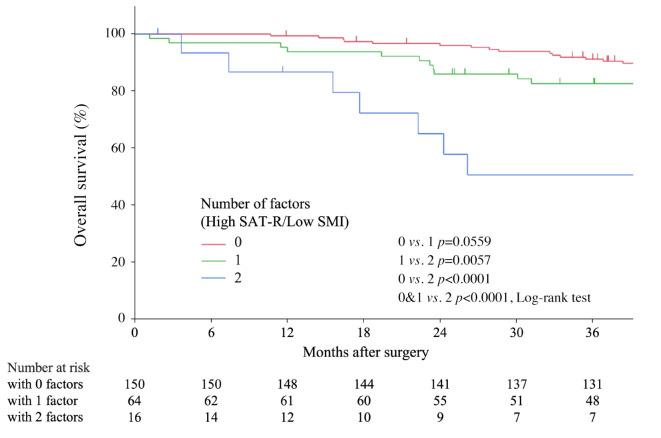
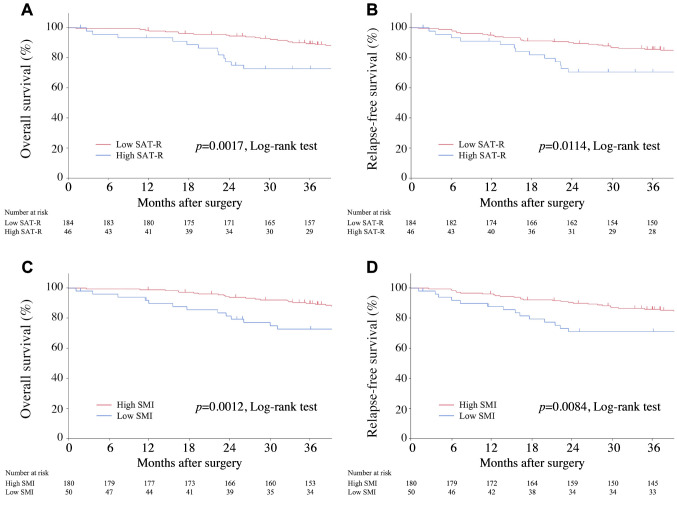
High SAT-R was significantly associated with older age (p=0.003) and lower BMI, lymphocyte, hemoglobin, γ-GTP, cholinesterase, albumin, and triglyceride values (p<0.001, <0.001, 0.027, 0.032, <0.001, 0.001, and <0.001, respectively). In the univariate analysis, high SAT-R, and low SMI were significantly associated with poor OS (p=0.003 and <0.001) and poor RFS (p=0.014 and 0.011). In the multivariate analysis by Cox proportional hazard model, high SAT-R and low SMI were identified as independent prognostic factors for poor OS (p=0.037 and 0.007).
High SAT-R on preoperative CT was associated with poor OS in patients with gastric cancer after gastrectomy. SAT-R has a potential to be a novel prognostic marker for surgically treated patients with gastric cancer.
背景/目的:尽管越来越多的报道指出身体组成对癌症患者的癌症治疗结果有影响,但目前仍不清楚计算机断层扫描(CT)图像上皮下脂肪组织(SAT)的放射密度是否对胃癌患者具有预后影响。我们在CT上测量了肌肉和SAT特征,并与临床病理因素进行了综合分析。
我们回顾性分析了2016年6月至2020年12月期间接受胃切除术的230例胃癌患者。在术前CT图像上测量SAT放射密度(SAT-R)和骨骼肌指数(SMI)。将这些结果与临床病理因素、总生存期(OS)和无复发生存期(RFS)进行比较。
高SAT-R与老年(p = 0.003)以及较低的体重指数、淋巴细胞、血红蛋白、γ-谷氨酰转肽酶、胆碱酯酶、白蛋白和甘油三酯值显著相关(分别为p < 0.001、< 0.001、0.027、0.032、< 0.001、0.001和< 0.001)。在单因素分析中,高SAT-R和低SMI与较差的OS(p = 0.003和< 0.001)以及较差的RFS(p = 0.014和0.011)显著相关。在Cox比例风险模型的多因素分析中,高SAT-R和低SMI被确定为OS较差的独立预后因素(p = 0.037和0.007)。
术前CT上的高SAT-R与胃切除术后胃癌患者的较差OS相关。SAT-R有可能成为手术治疗的胃癌患者的一种新的预后标志物。