Servicio de Neurología, Hospital Clínico San Carlos, IdISSC, Departamento de Medicina, Universidad Complutense, Madrid, Spain.
Member of the MS in the 21st Century Steering Group, Bucharest, Romania.
Adv Ther. 2019 Nov;36(11):3238-3252. doi: 10.1007/s12325-019-01071-9. Epub 2019 Sep 5.
Effective communication between patients and healthcare professionals (HCPs) is important to enhance outcomes in multiple sclerosis (MS). However, in practice, patients often report a disconnect in communication. Communication tools to aid patient-HCP communication have a long history of use in many chronic conditions. For example, symptom diaries have been shown to enhance outcomes in cancer, headache and sleep disorder management. MS in the 21st Century, a Steering Group of HCP specialists and patients with MS (PwMS), has created two communication tools designed for use by both patients and their HCPs.
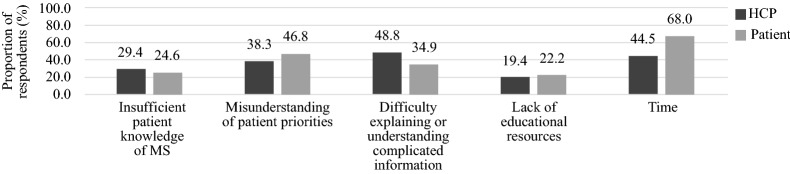
The Steering Group first identified prominent issues in patient-HCP communication through group discussions and survey data. Following this, a series of workshops led to the development of two communication tools as potential solutions to these identified issues in communication.
The two most prominent issues identified were HCP time constraints during appointments and the misalignment of patient and HCP priorities-the communication tools developed through the workshops were created to address these. The "myMS priorities" tool [see supplementary materials] is designed to maximize the use of consultation time while the "myMS commitments" tool [see supplementary materials] aims to improve patient-HCP shared decision-making.
The MS in the 21st Century Steering Group adopted a broad, iterative and collaborative approach in the development of these tools to help ensure they would be as useful as possible to both HCPs and PwMS. These tools have been developed through shared patient-HCP expertise and are based on existing tools in other therapy areas as well as a review of the existing literature and data from MS in the 21st Century Steering Group surveys. The next steps will focus on the validation of these tools through testing them in real-world environments and clinical trials.
Merck KGaA, Darmstadt, Germany.
医患之间的有效沟通对于改善多发性硬化症(MS)的治疗结果非常重要。然而,在实际中,患者常常反映沟通存在障碍。沟通工具在许多慢性病中已经有很长的使用历史,用于帮助患者与医护人员进行沟通。21 世纪的多发性硬化症(MS)协作组,由医疗保健专业人员(HCP)和多发性硬化症患者(PwMS)组成的专家组,创建了两个旨在供患者及其 HCP 使用的沟通工具。
协作组首先通过小组讨论和调查数据确定了医患沟通中突出的问题。在此之后,一系列的研讨会促成了这两个沟通工具的开发,以解决沟通中发现的问题。
确定的两个最突出的问题是在预约期间 HCP 的时间限制和患者与 HCP 优先级的不匹配——通过研讨会开发的沟通工具旨在解决这些问题。“我的 MS 优先级”工具[见补充材料]旨在最大限度地利用咨询时间,而“我的 MS 承诺”工具[见补充材料]旨在改善医患共同决策。
21 世纪的多发性硬化症协作组采用了广泛、迭代和协作的方法来开发这些工具,以确保它们对 HCP 和 PwMS 尽可能有用。这些工具是通过共享的医患专业知识开发的,并基于其他治疗领域的现有工具以及对现有文献和 21 世纪的多发性硬化症协作组调查数据的审查。下一步将集中于通过在现实环境和临床试验中测试这些工具来验证这些工具。
德国达姆施塔特默克股份有限公司。