Lee Gyeora, Lee Jun-Suh, Kim Ji Hoon, Hwang Duk Yeon, Lee Yoon-Suk
Department of Surgery, Incheon St. Mary's Hospital, College of Medicine, The Catholic University of Korea, Incheon, Korea.
Department of Surgery, Seoul St. Mary's Hospital, College of Medicine, The Catholic University of Korea, Seoul, Korea.
Ann Coloproctol. 2019 Aug;35(4):209-215. doi: 10.3393/ac.2018.11.29. Epub 2019 Aug 31.
Hospital stays after laparoscopic surgery for colorectal cancer tend to be much shorter than those after conventional open surgery. Many factors, including surgical outcomes and complications, are associated with patient discharge planning. However, few studies have analyzed the impact of patient subjective discomfort (including pain and fatigue) on the decision to discharge after surgery. Therefore, the purpose of this study was to determine how patient pain and fatigue play a role in the decision to discharge after laparoscopic surgery for colorectal cancer.
Between March 2014 and February 2015, we conducted a questionnaire survey of 91 patients who underwent laparoscopic surgery for colorectal cancer to estimate the expectation criteria for discharge and patient subjective discomfort at that time. Patients were divided into the following 2 groups: group A, those who complied with the medical professional's decision to discharge; and group B, those who refused discharge despite the medical professional's decision. The participants' subjective factors were analyzed.
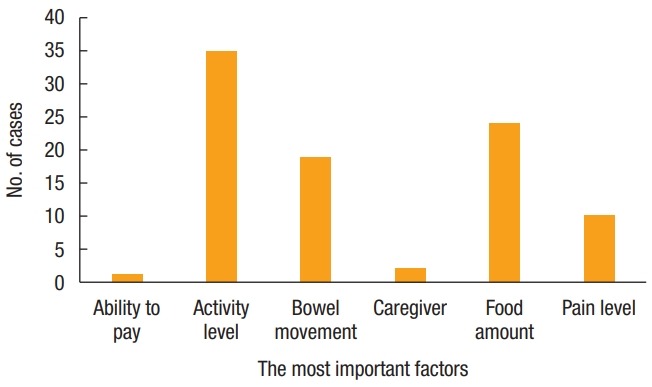
Preoperatively, 78 of 91 patients (85.7%) identified activity level, amount of food (tolerance), and bowel movements as important factors that should be considered in the decision to discharge a patient postoperatively. Postoperatively, 17 patients (18.7%) refused discharge despite a discharge recommendation. Subjective pain and fatigue were significantly different in linear-by-linear association between the group of patients who agreed to be discharge and those who disagreed. Despite this difference, there was no significant difference in mean length of hospital stay between the 2 groups.
A patient's subjective feelings of pain and fatigue can impact their decision regarding hospital discharge.
结直肠癌腹腔镜手术后的住院时间往往比传统开放手术后短得多。包括手术结果和并发症在内的许多因素与患者出院计划相关。然而,很少有研究分析患者主观不适(包括疼痛和疲劳)对术后出院决定的影响。因此,本研究的目的是确定患者的疼痛和疲劳在结直肠癌腹腔镜手术后出院决定中如何发挥作用。
在2014年3月至2015年2月期间,我们对91例行结直肠癌腹腔镜手术的患者进行了问卷调查,以评估出院的期望标准和当时患者的主观不适。患者分为以下两组:A组,即那些遵从医疗专业人员出院决定的患者;B组,即那些尽管医疗专业人员决定出院但仍拒绝出院的患者。对参与者的主观因素进行了分析。
术前,91例患者中有78例(85.7%)认为活动水平、食物量(耐受性)和排便情况是术后出院决定中应考虑的重要因素。术后,17例患者(18.7%)尽管被建议出院但仍拒绝出院。同意出院和不同意出院的患者组之间,主观疼痛和疲劳在线性关联上有显著差异。尽管存在这种差异,但两组之间的平均住院时间没有显著差异。
患者的主观疼痛和疲劳感受会影响他们关于出院的决定。