
加工后的L.叶中酚类化合物、原花青素及抗氧化活性的测定
Determination of Phenolic Compounds, Procyanidins, and Antioxidant Activity in Processed L. Leaves.
作者信息
Ngamsuk Samuchaya, Huang Tzou-Chi, Hsu Jue-Liang
机构信息
Department of Tropical Agriculture and International Cooperation, National Pingtung University of Science and Technology, 1 Shuefu Road, Neipu, Pingtung 91201, Taiwan.
Department of Biological Science and Technology, National Pingtung University of Science and Technology, 1 Shuefu Road, Neipu, Pingtung 91202, Taiwan.
出版信息
Foods. 2019 Sep 4;8(9):389. doi: 10.3390/foods8090389.
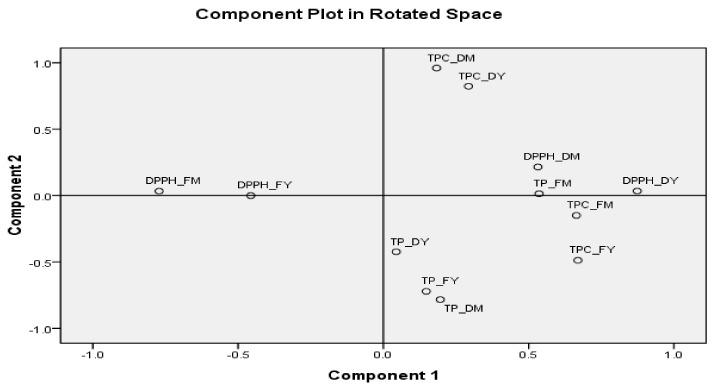
The effects of dry processing and maturity on antioxidant activity, total phenolic content, total procyanidins, and identity of phenolic compounds in coffee leaves were evaluated. Fresh coffee leaves were tray-dried at 40 °C for 8 h before total phenolic content, total procyanidins, and antioxidant activity were analyzed. The drying process significantly ( < 0.05) improved the release of total phenolic content and total procyanidins compared with the fresh leaves. The results showed that the young leaves exposed to drying processes had the highest total phenolic content, total procyanidins, and DPPH radical scavenging activity. Therefore, the effect of different drying temperatures (30, 40, and 50 °C) in the young leaves were further analyzed. The results indicated that DPPH radical scavenging activity, total phenolic content, and total procyanidins were increasingly generated when exposed to an increase in drying temperatures, whereby the highest bioactivity was evident at 50 °C. The DPPH radical scavenging activity of the coffee leaf teas was significantly correlated with total phenolic content and total procyanidins. Identification of L. bioactive compounds by LC-MS showed the presence of catechin or epicatechin, mangiferin or isomangiferin, procyanidin B, caffeoylquinic acids (CQA), caffeine, quercetin-3--glucoside, procyanidin C, rutin, and 3,4-diCQA. L. leaf tea was confirmed to be a potential functional food rich in phenolic compounds with strong antioxidant activity.
评估了干燥处理和成熟度对咖啡叶抗氧化活性、总酚含量、总原花青素以及酚类化合物特性的影响。新鲜咖啡叶在40℃下托盘干燥8小时后,分析其总酚含量、总原花青素和抗氧化活性。与新鲜叶片相比,干燥过程显著(<0.05)提高了总酚含量和总原花青素的释放量。结果表明,经过干燥处理的幼叶具有最高的总酚含量、总原花青素和DPPH自由基清除活性。因此,进一步分析了不同干燥温度(30、40和50℃)对幼叶的影响。结果表明,随着干燥温度升高,DPPH自由基清除活性、总酚含量和总原花青素生成量增加,其中50℃时生物活性最高。咖啡叶茶的DPPH自由基清除活性与总酚含量和总原花青素显著相关。通过液相色谱-质谱联用(LC-MS)鉴定生物活性化合物表明,存在儿茶素或表儿茶素、芒果苷或异芒果苷、原花青素B、咖啡酰奎尼酸(CQA)、咖啡因、槲皮素-3-O-葡萄糖苷、原花青素C、芦丁和3,4-二咖啡酰奎尼酸。咖啡叶茶被证实是一种富含酚类化合物且具有强抗氧化活性的潜在功能性食品。


 Zotero 插件