Health Psychology Research Unit, Department of Psychology, University of A Coruña, 15071 A Coruña, Spain.
Department of Clinical Psychology and Psychobiology, University of Santiago de Compostela, 15782 Santiago de Compostela, Spain.
Int J Environ Res Public Health. 2019 Sep 4;16(18):3247. doi: 10.3390/ijerph16183247.
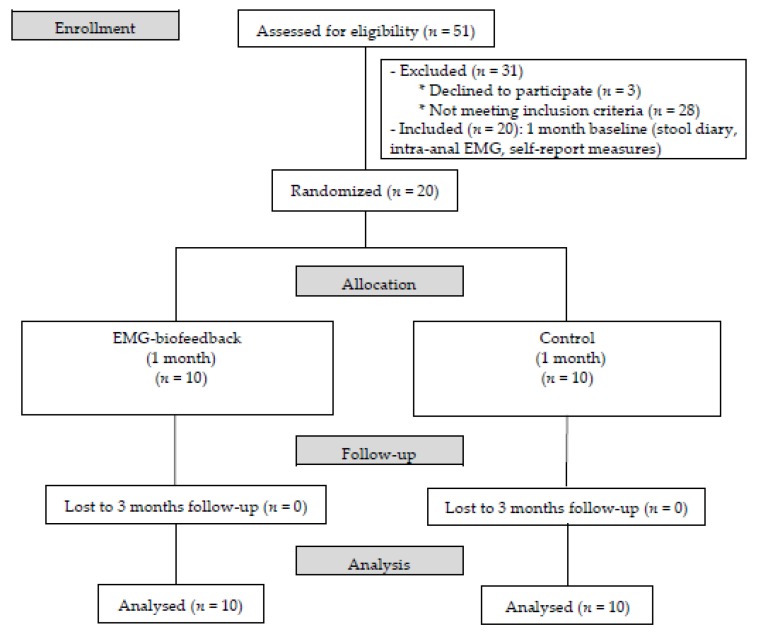
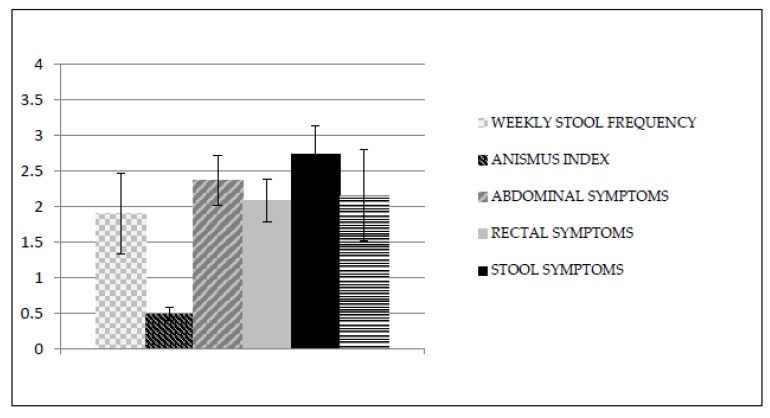
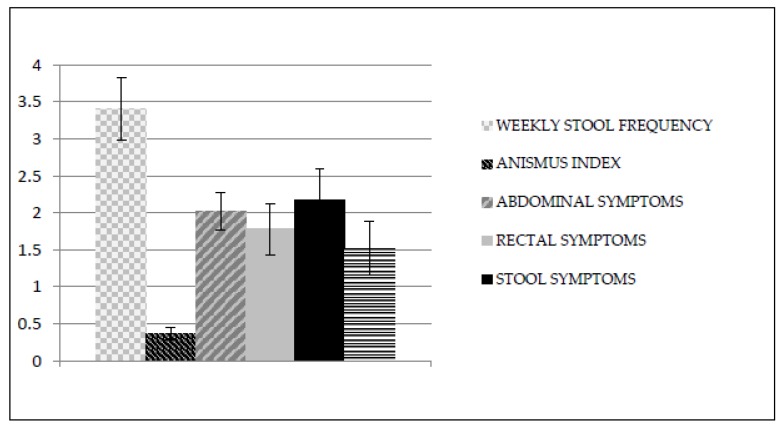
Dyssynergic defecation is a usual cause of chronic constipation in elderly women, with a negative impact on health-related quality of life. The present randomized controlled trial aims to evaluate the effects of behavioral treatment through electromyographic biofeedback (EMG-BF) on quality of life and bowel symptoms in elderly women with dyssynergic defecation. Twenty chronically constipated elderly women, due to dyssynergic defecation, were enrolled in the study. Outcome measures included weekly stool frequency, anismus index, severity of patient-reported chronic constipation symptoms (abdominal, rectal, and stool symptoms), and overall measure of quality of life. After 1 month of baseline, participants were randomly assigned to either EMG-BF group ( = 10) or control group ( = 10). Three months after treatment, female patients were once again assessed following the same procedure in baseline. One-way multivariate analysis of variance MANOVA revealed no significant differences between the groups before treatment in any of the measured dependent variables (Wilks's λ = 0.74; F = 0.77; = 0.61). Likewise, univariate analysis showed no differences between the groups, either in terms of age (F = 0.96; = 0.34) or mean disease duration (F = 2.99; = 0.11). Three months after treatment, MANOVA revealed statistically significant differences between the groups (Wilks's λ = 0.29; F = 5.19; < 0.01). These differences were significant in all outcome measures. EMG-BF produces significant improvements in bowel symptoms and health-related quality of life of elderly women with dyssynergic defecation.
协同失调性排便障碍是老年女性慢性便秘的常见原因,对健康相关生活质量有负面影响。本随机对照试验旨在评估肌电图生物反馈(EMG-BF)对协同失调性排便障碍老年女性生活质量和排便症状的影响。
共纳入 20 名因协同失调性排便障碍而慢性便秘的老年女性。观察指标包括每周排便次数、肛门直肠测压指数、患者报告的慢性便秘症状(腹部、直肠和粪便症状)严重程度以及总体生活质量评分。在基线期 1 个月后,患者被随机分配至 EMG-BF 组(n = 10)或对照组(n = 10)。治疗 3 个月后,再次对女性患者进行相同的基线评估。
单因素多元方差分析(MANOVA)显示,治疗前两组在任何测量的因变量上均无显著差异(Wilks's λ = 0.74;F = 0.77; = 0.61)。同样,单因素分析显示,两组在年龄(F = 0.96; = 0.34)或平均疾病持续时间(F = 2.99; = 0.11)方面均无差异。治疗 3 个月后,MANOVA 显示两组间存在统计学差异(Wilks's λ = 0.29;F = 5.19; < 0.01)。这些差异在所有观察指标中均具有统计学意义。EMG-BF 可显著改善协同失调性排便障碍老年女性的排便症状和健康相关生活质量。