LEASP, UMR 1027, Equipe labellisée Ligue Nationale Contre le Cancer, Faculté de médecine de Purpan, Inserm-Université Toulouse III Paul Sabatier, 37 allées Jules Guesde, 31000, Toulouse, France.
Service de Pharmacologie Clinique, CHU de Toulouse, Toulouse, France.
BMC Cancer. 2019 Sep 5;19(1):883. doi: 10.1186/s12885-019-6093-3.
Evidences support social inequalities in cancer survival. Studies on hematological malignancies, and more specifically Acute Myeloid Leukemia (AML), are sparser. Our study assessed: 1/ the influence of patients' socioeconomic position on survival, 2/ the role of treatment in this relationship, and 3/ the influence of patients' socioeconomic position on treatment utilization.
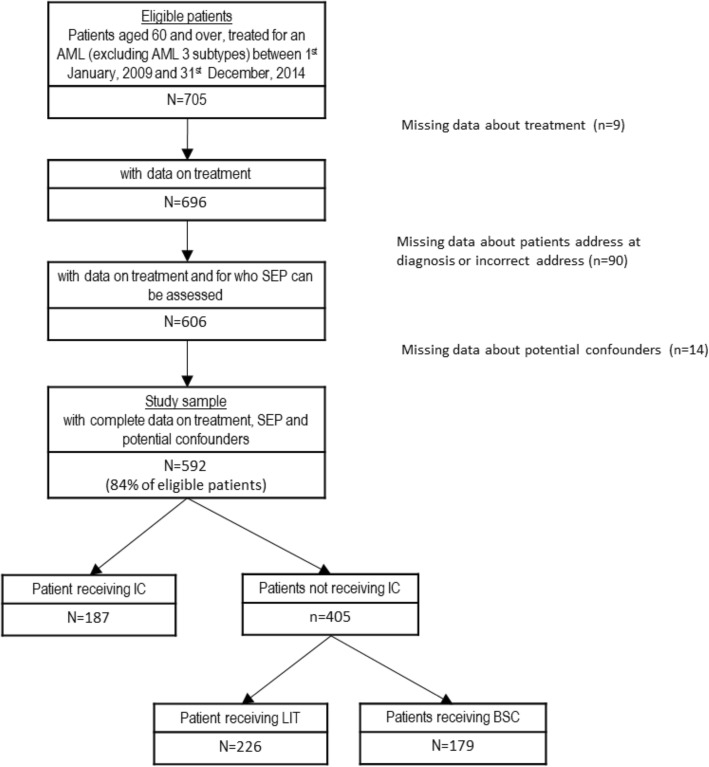
This prospective multicenter study includes all patients aged 60 and older, newly diagnosed with AML, excluding promyelocytic subtypes, between 1st January 2009 to 31st December 2014 in the South-West of France. Data came from medical files. Patients' socioeconomic position was measured by an ecological deprivation index, the European Deprivation Index. We studied first, patients' socioeconomic position influence on overall survival (n = 592), second, on the use of intensive chemotherapy (n = 592), and third, on the use of low intensive treatment versus best supportive care among patients judged unfit for intensive chemotherapy (n = 405).
We found an influence of patients' socioeconomic position on survival (highest versus lowest position HR: 1.39 [1.05;1.87] that was downsized to become no more significant after adjustment for AML ontogeny (HR: 1.31[0.97;1.76] and cytogenetic prognosis HR: 1.30[0.97;1.75]). The treatment was strongly associated with survival. A lower proportion of intensive chemotherapy was observed among patients with lowest socioeconomic position (OR: 0.41[0.19;0.90]) which did not persist after adjustment for AML ontogeny (OR: 0.59[0.25;1.40]). No such influence of patients' socioeconomic position was found on the treatment allocation among patients judged unfit for intensive chemotherapy.
Finally, these results suggest an indirect influence of patients' socioeconomic position on survival through AML initial presentation.
癌症生存存在社会不平等现象。关于血液恶性肿瘤的研究,特别是急性髓系白血病(AML)的研究则更为稀少。我们的研究评估了:1/患者社会经济地位对生存的影响,2/治疗在这种关系中的作用,以及 3/患者社会经济地位对治疗利用的影响。
这项前瞻性多中心研究纳入了 2009 年 1 月 1 日至 2014 年 12 月 31 日期间法国西南部新诊断为 AML(不包括早幼粒细胞亚型)且年龄在 60 岁及以上的所有患者。数据来自病历。患者的社会经济地位通过生态剥夺指数,即欧洲剥夺指数来衡量。我们首先研究了患者社会经济地位对总生存(n=592)的影响,其次研究了患者社会经济地位对强化化疗的使用(n=592)的影响,最后研究了在不适合强化化疗的患者中,低强度治疗与最佳支持治疗相比的使用情况(n=405)。
我们发现患者的社会经济地位对生存有影响(最高与最低位置的 HR:1.39[1.05;1.87],在调整 AML 发生学后不再显著(HR:1.31[0.97;1.76]和细胞遗传学预后 HR:1.30[0.97;1.75])。治疗与生存密切相关。社会经济地位最低的患者中,强化化疗的比例较低(OR:0.41[0.19;0.90]),在调整 AML 发生学后不再持续(OR:0.59[0.25;1.40])。在不适合强化化疗的患者中,患者社会经济地位对治疗分配没有影响。
最终,这些结果表明,患者的社会经济地位通过 AML 的初始表现对生存产生间接影响。