Division of Hematology-Oncology, Department of Internal Medicine, and.
Department of Biostatistics, College of Public Health, University of Nebraska Medical Center, Omaha, NE.
Blood Adv. 2018 Jun 12;2(11):1277-1282. doi: 10.1182/bloodadvances.2018019125.
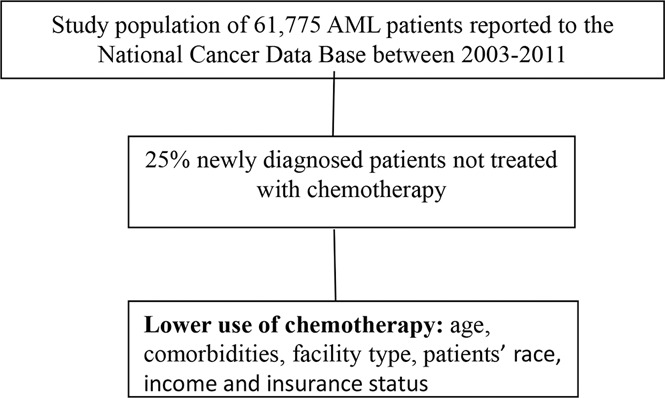
The use of chemotherapy in patients with acute myeloid leukemia (AML) is associated with survival benefits and alleviation of symptoms related to AML. Prior studies have demonstrated a lower receipt of chemotherapy with increasing age and comorbidities. We hypothesized that socioeconomic and health system factors also determine the use of chemotherapy. We included 61 775 adults with AML diagnosed between 2003 and 2011 from the National Cancer Database, and performed a multivariable logistic regression model to determine the association between receipt of chemotherapy and several factors. A total of 15 608 patients (25.3%) did not receive chemotherapy. In a multivariable analysis, the likelihood of getting chemotherapy declined with increasing age and comorbidities and among patients with therapy-related and intermediate-/high-risk AML. Other factors associated with a lower likelihood of receiving chemotherapy included receipt of care in nonacademic centers, African American race, lower income status, uninsured or Medicare insurance status, and female sex. Compared with the previous studies, our study is novel because it provides data from a large, unselected cohort of patients diagnosed in the United States in recent years, and simultaneously examines the effect of various biological, socioeconomic, and health system factors. The results of our study raise a possibility of leukemia care disparity based on socioeconomic and health system factors. Better understanding of ways such factors may influence receipt of chemotherapy may allow an increase in the use of chemotherapy.
在急性髓细胞白血病 (AML) 患者中使用化疗与生存获益和缓解 AML 相关症状有关。先前的研究表明,随着年龄的增长和合并症的增加,接受化疗的比例会降低。我们假设社会经济和卫生系统因素也决定了化疗的使用。我们纳入了 2003 年至 2011 年间来自国家癌症数据库的 61775 名成人 AML 患者,并进行了多变量逻辑回归模型分析,以确定接受化疗与多种因素之间的关联。共有 15608 名患者(25.3%)未接受化疗。在多变量分析中,随着年龄的增长和合并症的增加,以及在治疗相关和中/高危 AML 患者中,接受化疗的可能性会降低。其他与接受化疗可能性降低相关的因素包括在非学术中心接受治疗、非裔美国人种族、收入水平较低、没有保险或医疗保险以及女性。与之前的研究相比,我们的研究是新颖的,因为它提供了近年来在美国诊断的大量未经选择的患者的数据集,并同时检查了各种生物学、社会经济和卫生系统因素的影响。我们的研究结果提出了基于社会经济和卫生系统因素的白血病治疗差异的可能性。更好地了解这些因素可能影响化疗的方式,可能会增加化疗的使用。