Department of Orthopedic Surgery, University of Groningen, University Medical Center Groningen, Groningen, the Netherlands.
Orthopedic Department, Wilhelmina Hospital, Assen, The Netherlands.
BMC Musculoskelet Disord. 2019 Sep 6;20(1):415. doi: 10.1186/s12891-019-2781-z.
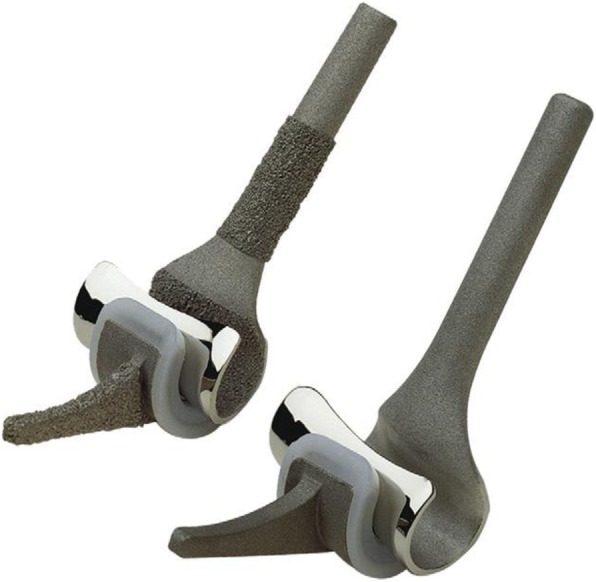
The aim of this study was to review the long-term results of the instrumented Bone Preserving (iBP) elbow prosthesis.
Thirty-one patients (10 M, 21F, 28-77 year) were retrospectively evaluated using the Oxford Elbow Score (OES), Disabilities of Arm, Shoulder and Hand Outcome Measure (DASH), Mayo Elbow Performance (MEPS), physical examination and standard radiographs. Kaplan-Meier survival analysis was used.
Thirty-seven primary iBPs have been placed in 31 patients between 2000 and 2007. Six patients (8 prostheses) had died, 10 elbows had been revised and three patients (4 prostheses) were lost to follow-up. Fourteen patients (15 prostheses) were available for follow-up. The main indication for surgery was rheumatoid arthritis. Mean follow-up was 11 years (8-15). Kaplan-Meier survival analysis showed a survival of 81% at 10 years after surgery. Main reason for revision was particle disease and loosening due to instability and malalignment. Eleven of 14 patients were satisfied, although radiographs showed radiolucencies in 11 patients.
The iBP elbow prosthesis gives a survival rate of 81% 10 years after surgery with a progressive decline beyond 10 years. However, many patients have radiolucencies. Discrepancy between clinical signs and radiological results warrants structural follow-up, to assure quality of bone stock in case revision surgery is indicated. The study was reviewed and approved by the Medical Ethical Committee of University Medical Center Groningen (METc2016/038).
Level IV, Case series.
本研究旨在回顾带假体的保骨(iBP)肘关节假体的长期结果。
对 31 例患者(10 例男性,21 例女性,年龄 28-77 岁)采用牛津肘部评分(OES)、上肢功能障碍问卷(DASH)、 Mayo 肘部功能(MEPS)、体格检查和标准影像学进行回顾性评估。采用 Kaplan-Meier 生存分析。
2000 年至 2007 年间,共对 31 例患者的 37 例初次 iBP 进行了评估。6 例(8 例假体)患者死亡,10 例肘部进行了翻修,3 例患者(4 例假体)失访。14 例患者(15 例假体)可随访。手术的主要适应证为类风湿关节炎。平均随访时间为 11 年(8-15 年)。Kaplan-Meier 生存分析显示术后 10 年的生存率为 81%。翻修的主要原因是颗粒病和因不稳定及对线不良导致的松动。14 例患者中有 11 例满意,尽管影像学显示 11 例患者有透亮线。
iBP 肘关节假体在术后 10 年的生存率为 81%,超过 10 年后生存率逐渐下降。然而,许多患者有透亮线。临床体征与影像学结果的差异提示需要进行结构性随访,以确保在需要翻修手术时,骨量的质量。本研究已由格罗宁根大学医学中心医学伦理委员会(METc2016/038)审查和批准。
IV 级,病例系列。