Department of Earth Sciences, University of Oxford, Oxford OX1 3AN, UK.
Ocean and Earth Science, University of Southampton, National Oceanography Centre, Southampton SO14 3ZH, UK.
Sci Adv. 2019 Aug 28;5(8):eaav6410. doi: 10.1126/sciadv.aav6410. eCollection 2019 Aug.
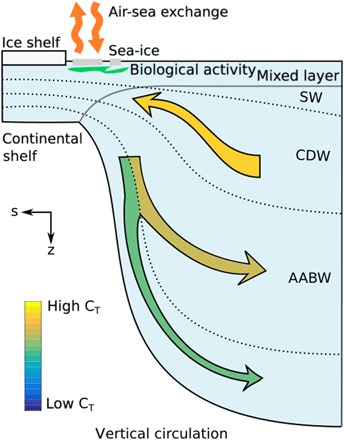
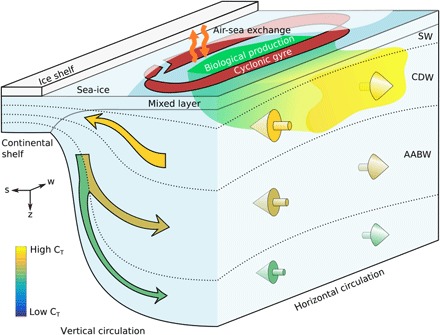
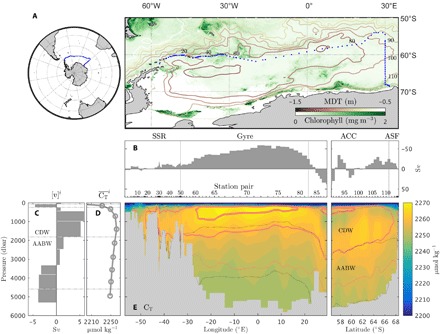
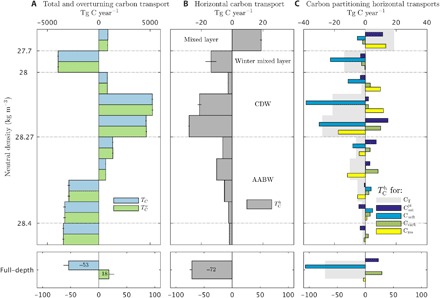
Global climate is critically sensitive to physical and biogeochemical dynamics in the subpolar Southern Ocean, since it is here that deep, carbon-rich layers of the world ocean outcrop and exchange carbon with the atmosphere. Here, we present evidence that the conventional framework for the subpolar Southern Ocean carbon cycle, which attributes a dominant role to the vertical overturning circulation and shelf-sea processes, fundamentally misrepresents the drivers of regional carbon uptake. Observations in the Weddell Gyre-a key representative region of the subpolar Southern Ocean-show that the rate of carbon uptake is set by an interplay between the Gyre's horizontal circulation and the remineralization at mid-depths of organic carbon sourced from biological production in the central gyre. These results demonstrate that reframing the carbon cycle of the subpolar Southern Ocean is an essential step to better define its role in past and future climate change.
全球气候对副极地南大洋的物理和生物地球化学动态极为敏感,因为这里是世界海洋深层富碳层与大气进行碳交换的地方。在这里,我们提供的证据表明,传统的副极地南大洋碳循环框架,将垂直翻转环流和陆架海过程归因于主导作用,从根本上误解了区域碳吸收的驱动因素。在威德尔环流(副极地南大洋的一个关键代表性区域)的观测表明,碳吸收的速率是由环流的水平循环和源自环流中心生物生产力的中层有机碳的再矿化之间的相互作用决定的。这些结果表明,重新构建副极地南大洋的碳循环是更好地定义其在过去和未来气候变化中作用的必要步骤。