Center for Pharmacogenomics and Translational Research.
Centre for Health Care Delivery Science, Nemours Children's Health System.
J Pediatr Gastroenterol Nutr. 2019 Nov;69(5):581-587. doi: 10.1097/MPG.0000000000002480.
Proton pump inhibitors (PPIs) are an effective treatment for eosinophilic esophagitis (EoE); however, only 30% to 60% of patients respond. Common genetic variants in CYP2C19 and STAT6 associate with PPI plasma concentration and magnitude of inflammatory response, respectively. Our objective was to determine if genetic variation in the genes for CYP2C19 and STAT6 influence differentiation between PPI responsive esophageal eosinophilia versus PPI nonresponsive EoE (PPI-REE, PPI-nonresponsive EoE).
Genomic DNA was isolated from 92 esophageal tissue biopsies collected from participants of a prospective clinical trial of high-dose PPI therapy for esophageal eosinophilia in children.
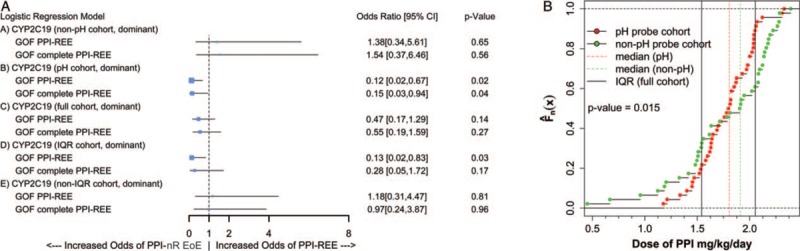
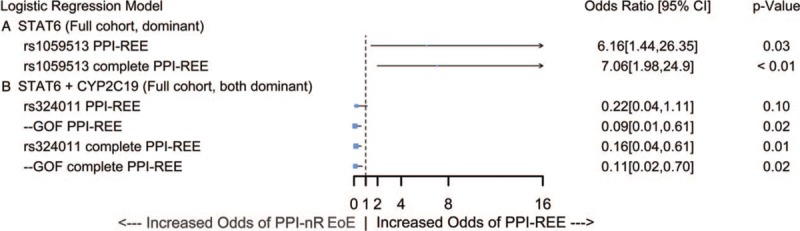
Of the 92 patients examined, 57 (62%) were PPI-REE and 35 (38%) were PPI-nonresponsive EoE. Forty-six of the 92 patients were further characterized by pH probe monitoring; there was no association between reflux index and carriage of CYP2C1917 (P = 0.35). In children who received a PPI dose between ≥1.54 and ≤2.05 mg/kg/day, binary logistic regression modeling showed that carriage of CYP2C1917 associated with PPI-nonresponsive EoE (odds ratio (OR) [95% confidence interval (CI)] = 7.71 [1.21, 49.11], P = 0.031). Carriage of STAT6 allelic variant rs1059513 predicts PPI-REE (OR [95% CI] = 6.16 [1.44, 26.4], P = 0.028), whereas carriage of STAT6 rs324011 synergizes with CYP2C1917 to predict PPI-nonresponsive EoE (rs324011 OR [95% CI] = 5.56 [1.33, 20.72], P = 0.022; CYP2C1917 OR [95% CI] = 8.19[1.42, 50.57], P = 0.023).
Common variants in CYP2C19 and STAT6 associate with a PPI-nonresponsive EoE outcome of PPI therapy for esophageal eosinophilia suggesting that response rates may be improved by adopting a genotype-guided approach to PPI dosing.
质子泵抑制剂 (PPI) 是治疗嗜酸性食管炎 (EoE) 的有效方法;然而,只有 30% 至 60%的患者有反应。CYP2C19 和 STAT6 的常见遗传变异分别与 PPI 血浆浓度和炎症反应幅度相关。我们的目的是确定 CYP2C19 和 STAT6 基因的遗传变异是否影响 PPI 反应性食管嗜酸性粒细胞增多与 PPI 无反应性 EoE(PPI-REE、PPI 无反应性 EoE)之间的区分。
从参加儿童高剂量 PPI 治疗食管嗜酸性粒细胞增多症的前瞻性临床试验的 92 例食管组织活检中分离基因组 DNA。
在 92 例患者中,57 例(62%)为 PPI-REE,35 例(38%)为 PPI 无反应性 EoE。对 92 例患者中的 46 例进行 pH 探头监测进一步特征描述;反流指数与 CYP2C1917 携带之间无关联(P = 0.35)。在接受 1.54 至 2.05mg/kg/天之间的 PPI 剂量的儿童中,二元逻辑回归模型显示 CYP2C1917 携带与 PPI 无反应性 EoE 相关(比值比 (OR) [95%置信区间 (CI)] = 7.71 [1.21, 49.11],P = 0.031)。STAT6 等位基因变异 rs1059513 预测 PPI-REE(OR [95% CI] = 6.16 [1.44, 26.4],P = 0.028),而 STAT6 rs324011 与 CYP2C1917 协同预测 PPI 无反应性 EoE(rs324011 OR [95% CI] = 5.56 [1.33, 20.72],P = 0.022;CYP2C1917 OR [95% CI] = 8.19[1.42, 50.57],P = 0.023)。
CYP2C19 和 STAT6 的常见变异与 PPI 治疗食管嗜酸性粒细胞增多的 PPI 无反应性 EoE 结果相关,这表明通过采用基于基因型的 PPI 剂量方法,反应率可能会提高。