Cardiology, Afficiated Liutie Central Hospital &Clinical Medical College of Guangxi Medical University, Liuzhou, China.
Medical Imaging Center, Nanfang Hospital, Southern Medical University, Guangzhou, China.
BMJ Open. 2019 Sep 5;9(9):e029885. doi: 10.1136/bmjopen-2019-029885.
N-terminal pro-B-type natriuretic peptide (NT-pro-BNP) is an unfavourable factor responsible for poor outcomes in the cardiovascular diseases. Nevertheless, the prognostic role of NT-pro-BNP in type B aortic dissection (TBAD) remains unclear. The aim of the current study was to investigate the relationship between NT-pro-BNP levels and in-hospital and long-term adverse prognosis in patients with TBAD.
A retrospective multicentre study.
Liutie Central Hospital, Nanfang Hospital and Huiyang Hospital in China.
A total of 657 consecutive patients with TBAD were enrolled in the study. NT-pro-BNP was measured at admission and included patients were divided into three groups according to the tertiles of NT-pro-BNP (pg/mL): <95 (n=220), 95-312 (n=218) and >312 (n=219).
Long-term mortality and in-hospital major adverse clinical events.
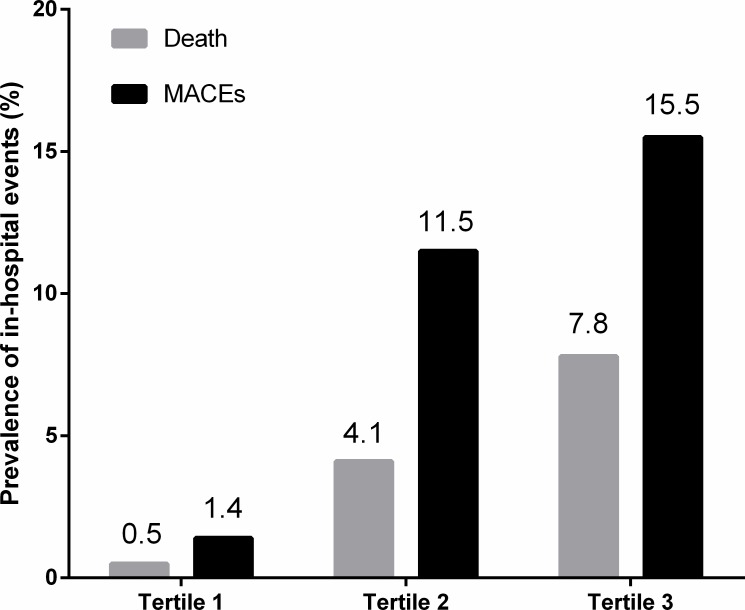
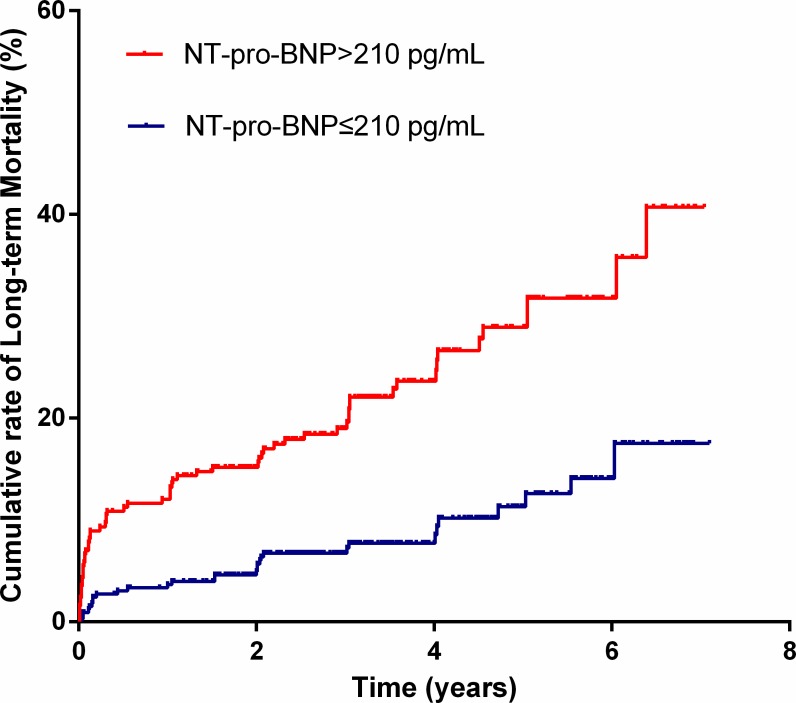
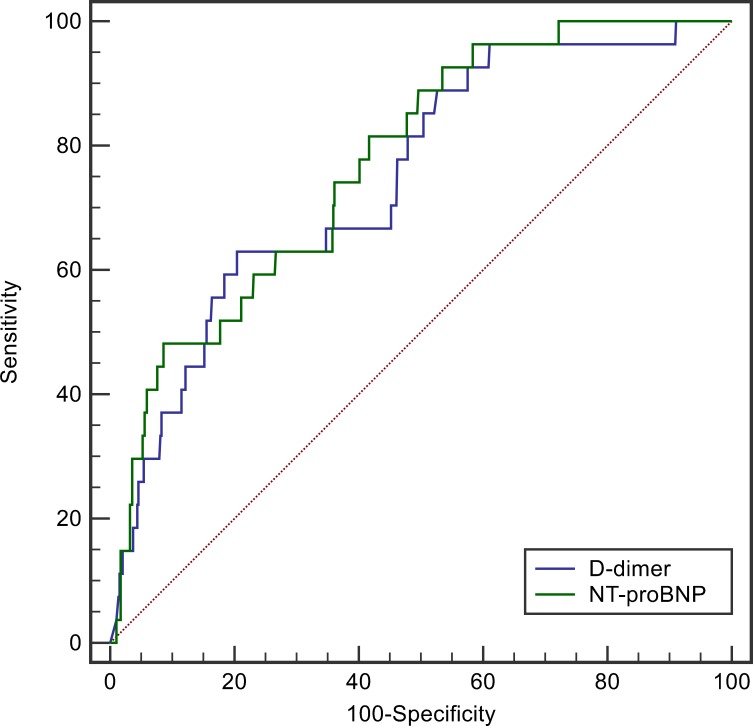
Overall, in-hospital death occurred in 27 patients (4.1%), which was significantly higher in upper tertiles of NT-pro-BNP (0.5% vs 4.1% vs 7.8%, p<0.001). The incident of in-hospital major adverse clinical events increased along with higher NT-pro-BNP (1.4% vs 11.5% vs 15.5%, p<0.001). NT-pro-BNP >210 pg/mL had 81.5% sensitivity and 58.6% specificity for predicting in-hospital death (area under the curve= 0.774, 95% CI 0.692 to 0.855; p<0.001). After a median of 3.1 years of follow-up, 97 (14.8%) patients died. The Kaplan-Meier analysis indicated that the long-term cumulative mortality was higher in patients with NT-pro-BNP >210 pg/mL compared with patients with NT-pro-BNP ≤210 pg/mL (log-rank=26.92, p<0.001). In multivariable Cox survival modelling, NT-pro-BNP >210 pg/mL was independently associated with long-term death (adjusted HR 2.47, 95% CI 1.45 to 4.22, p=0.001).
NT-pro-BNP resulted as an independent predictor of adverse prognosis in patients with TBAD, thus could be used as a potential risk-stratification tool.
N 端脑利钠肽前体(NT-pro-BNP)是心血管疾病不良预后的危险因素。然而,NT-pro-BNP 在 B 型主动脉夹层(TBAD)中的预后作用尚不清楚。本研究旨在探讨 NT-pro-BNP 水平与 TBAD 患者住院期间和长期不良预后的关系。
回顾性多中心研究。
中国的柳铁中心医院、南方医院和惠阳医院。
共纳入 657 例连续 TBAD 患者。入院时测量 NT-pro-BNP,并根据 NT-pro-BNP 的三分位值(pg/mL)将纳入患者分为三组:<95(n=220)、95-312(n=218)和>312(n=219)。
长期死亡率和住院期间主要不良临床事件。
共有 27 例(4.1%)患者住院期间死亡,上三分位组的死亡率明显更高(0.5%比 4.1%比 7.8%,p<0.001)。随着 NT-pro-BNP 水平升高,住院期间主要不良临床事件的发生率也随之增加(1.4%比 11.5%比 15.5%,p<0.001)。NT-pro-BNP>210 pg/mL 对预测住院期间死亡的敏感性为 81.5%,特异性为 58.6%(曲线下面积=0.774,95%置信区间 0.692 至 0.855;p<0.001)。中位随访 3.1 年后,97 例(14.8%)患者死亡。Kaplan-Meier 分析表明,NT-pro-BNP>210 pg/mL 患者的长期累积死亡率高于 NT-pro-BNP≤210 pg/mL 患者(log-rank=26.92,p<0.001)。多变量 Cox 生存模型分析显示,NT-pro-BNP>210 pg/mL 与长期死亡独立相关(调整后的 HR 2.47,95%置信区间 1.45 至 4.22,p=0.001)。
NT-pro-BNP 是 TBAD 患者不良预后的独立预测因子,因此可作为潜在的风险分层工具。