Department of Pathology, The Children's Memorial Health Institute, Av. Dzieci Polskich 20, 04-730, Warsaw, Poland.
Clinic of Oncology, The Children's Memorial Health Institute, Av. Dzieci Polskich 20, 04-730, Warsaw, Poland.
Diagn Pathol. 2019 Sep 7;14(1):103. doi: 10.1186/s13000-019-0883-4.
The most frequent histological types of rhabdomyosarcoma (RMS) in children are embryonal (ERMS) and alveolar (ARMS) tumours. The majority of ARMS are characterized by the presence of PAX3/7-FOXO1 gene fusion and have a worse prognosis than fusion gene-negative ARMS. However, identification of PAX3/7-FOXO1 fusion status is challenging when using formalin-fixed, paraffin-embedded (FFPE) material. Microarray analyses revealed that high expression of several genes is associated with PAX3/7-FOXO1 fusion status. Therefore, we investigated if immunohistochemical approach may detect surrogate marker genes as indicators of fusion gene-positive RMS.
Forty five RMS patients were included in the analysis and immunohistochemistry was applied to FFPE tissues collected at diagnosis. Protein expression of OLIG2, a novel marker in RMS, was investigated using antibody EP112 (Cell Marque). In addition already known two markers were also analyzed: TFAP2B using rabbit anti-TFAP2β antibody (Santa Cruz Biotechnology) and ALK using anti-ALK antibody clone D5F3 #3633 (Cell Signalling). Fluorescence in situ hybridization (FISH) was performed on FFPE sections with FOXO1/PAX3 and/or FOXO1/PAX7 probes (Dual Colour Single Fusion Probe, Zytovision).
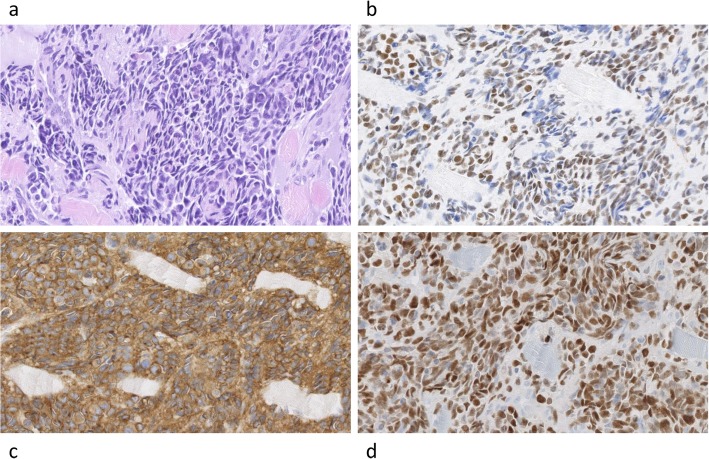
Our analysis revealed that all three immunohistochemical markers are associated with the presence of PAX3/7-FOXO1 fusion: TFAP2B (p < 0.00001), OLIG2 (p = 0.0001) and ALK (p = 0.0007). Four ARMS had negative PAX3/7-FOXO1 status and none of them displayed positive reaction with the analysed markers. Positive reaction with OLIG2 (6 tumours) was always associated with the presence of PAX3/7-FOXO1 rearrangement. Two additional OLIG2 positive cases showed inconclusive FISH results, but were positive for TFAP2B and ALK, what suggests that these tumours expressed fusion positive signature.
Our results indicate that TFAP2B, ALK and a novel marker OLIG2 may serve as surrogate markers for PAX3/7-FOXO1 status what is especially beneficial in cases where poor quality tumour tissue is not suitable for reliable genetic analyses or shows inconclusive result.
儿童横纹肌肉瘤(RMS)最常见的组织学类型是胚胎性(ERMS)和肺泡性(ARMS)肿瘤。大多数 ARMS 的特征是存在 PAX3/7-FOXO1 基因融合,并且预后比融合基因阴性的 ARMS 差。然而,当使用福尔马林固定、石蜡包埋(FFPE)材料时,鉴定 PAX3/7-FOXO1 融合状态具有挑战性。微阵列分析显示,一些基因的高表达与 PAX3/7-FOXO1 融合状态相关。因此,我们研究了免疫组织化学方法是否可以检测替代标志物基因作为融合基因阳性 RMS 的指标。
分析了 45 名 RMS 患者,应用免疫组织化学方法检测诊断时采集的 FFPE 组织。使用抗体 EP112(Cell Marque)检测 RMS 中的新标志物 OLIG2 的蛋白表达。此外,还分析了已经已知的两个标志物:使用兔抗 TFAP2β 抗体(Santa Cruz Biotechnology)检测 TFAP2B 和使用抗 ALK 抗体克隆 D5F3 #3633(Cell Signalling)检测 ALK。使用 FOXO1/PAX3 和/或 FOXO1/PAX7 探针(双色单融合探针,Zytovision)对 FFPE 切片进行荧光原位杂交(FISH)。
我们的分析表明,所有三种免疫组织化学标志物均与 PAX3/7-FOXO1 融合的存在相关:TFAP2B(p<0.00001)、OLIG2(p=0.0001)和 ALK(p=0.0007)。4 例 ARMS 的 PAX3/7-FOXO1 状态为阴性,它们均未显示出与分析标志物的阳性反应。6 例 OLIG2 阳性肿瘤始终与 PAX3/7-FOXO1 重排相关。另外 2 例 OLIG2 阳性病例的 FISH 结果不确定,但 TFAP2B 和 ALK 阳性,这表明这些肿瘤表达了融合阳性特征。
我们的结果表明,TFAP2B、ALK 和新标志物 OLIG2 可以作为 PAX3/7-FOXO1 状态的替代标志物,这在肿瘤组织质量差不适合可靠的遗传分析或结果不确定的情况下尤其有益。