WHO Collaborating Centre for Infectious Disease Epidemiology and Control, School of Public Health, Li Ka Shing Faculty of Medicine, The University of Hong Kong, Hong Kong Special Administrative Region, China.
National Center for Chronic and Noncommunicable Disease Control and Prevention, Chinese Center for Disease Control and Prevention, Beijing, China.
Lancet Public Health. 2019 Sep;4(9):e473-e481. doi: 10.1016/S2468-2667(19)30163-X.
The estimation of influenza-associated excess mortality in countries can help to improve estimates of the global mortality burden attributable to influenza virus infections. We did a study to estimate the influenza-associated excess respiratory mortality in mainland China for the 2010-11 through 2014-15 seasons.
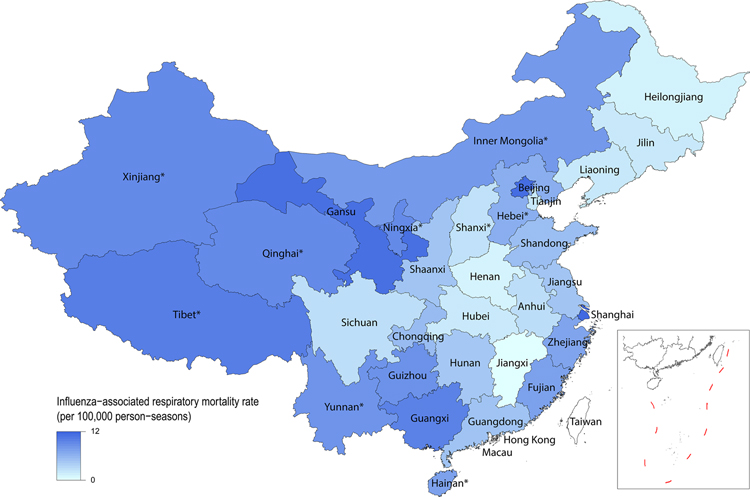
We obtained provincial weekly influenza surveillance data and population mortality data for 161 disease surveillance points in 31 provinces in mainland China from the Chinese Center for Disease Control and Prevention for the years 2005-15. Disease surveillance points with an annual average mortality rate of less than 0·4% between 2005 and 2015 or an annual mortality rate of less than 0·3% in any given years were excluded. We extracted data for respiratory deaths based on codes J00-J99 under the tenth edition of the International Classification of Diseases. Data on respiratory mortality and population were stratified by age group (age <60 years and ≥60 years) and aggregated by province. The overall annual population data of each province and national annual respiratory mortality data were compiled from the China Statistical Yearbook. Influenza surveillance data on weekly proportion of samples testing positive for influenza virus by type or subtype for 31 provinces were extracted from the National Sentinel Hospital-based Influenza Surveillance Network. We estimated influenza-associated excess respiratory mortality rates between the 2010-11 and 2014-15 seasons for 22 provinces with valid data in the country using linear regression models. Extrapolation of excess respiratory mortality rates was done using random-effect meta-regression models for nine provinces without valid data for a direct estimation of the rates.
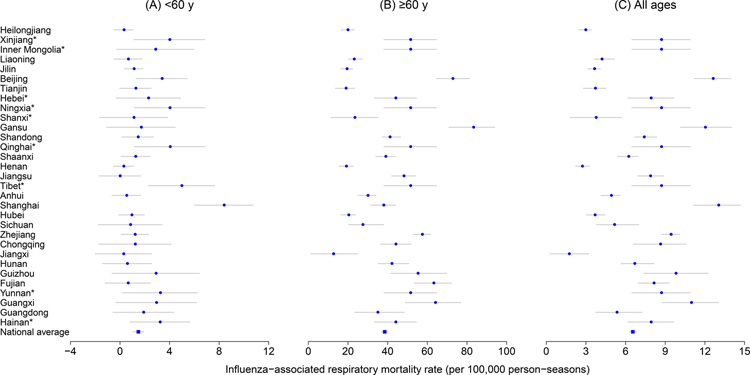
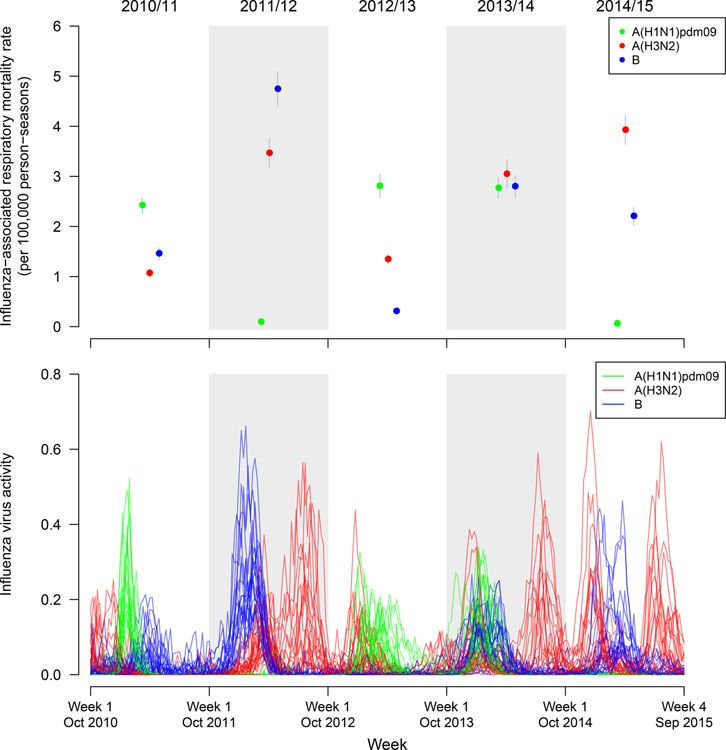
We fitted the linear regression model with the data from 22 of 31 provinces in mainland China, representing 83·0% of the total population. We estimated that an annual mean of 88 100 (95% CI 84 200-92 000) influenza-associated excess respiratory deaths occurred in China in the 5 years studied, corresponding to 8·2% (95% CI 7·9-8·6) of respiratory deaths. The mean excess respiratory mortality rates per 100 000 person-seasons for influenza A(H1N1)pdm09, A(H3N2), and B viruses were 1·6 (95% CI 1·5-1·7), 2·6 (2·4-2·8), and 2·3 (2·1-2·5), respectively. Estimated excess respiratory mortality rates per 100 000 person-seasons were 1·5 (95% CI 1·1-1·9) for individuals younger than 60 years and 38·5 (36·8-40·2) for individuals aged 60 years or older. Approximately 71 000 (95% CI 67 800-74 100) influenza-associated excess respiratory deaths occurred in individuals aged 60 years or older, corresponding to 80% of such deaths.
Influenza was associated with substantial excess respiratory mortality in China between 2010-11 and 2014-15 seasons, especially in older adults aged at least 60 years. Continuous and high-quality surveillance data across China are needed to improve the estimation of the disease burden attributable to influenza and the best public health interventions are needed to curb this burden.
National Science Fund for Distinguished Young Scholars, National Science and Technology Major Project of China, National Institute of Health Research, the Harvard Center for Communicable Disease Dynamics from the National Institute of General Medical Sciences, and the China-US Collaborative Program on Emerging and Re-emerging Infectious Disease.
在国家层面上评估流感相关超额死亡率有助于提高对流感病毒感染所致全球死亡负担的估计。我们开展了一项研究,以评估 2010-11 年至 2014-15 年期间中国大陆的流感相关超额呼吸道死亡率。
我们从中国疾病预防控制中心获得了中国大陆 31 个省份的 161 个疾病监测点的省级每周流感监测数据和人群死亡率数据,时间范围为 2005-15 年。我们排除了 2005-15 年期间每年平均死亡率低于 0.4%或任何一年死亡率低于 0.3%的疾病监测点。我们根据第十版国际疾病分类(ICD-10)中的 J00-J99 代码提取了呼吸道死亡数据。根据年龄组(年龄<60 岁和≥60 岁)对呼吸道死亡率和人口数据进行分层,并按省份进行汇总。我们从《中国统计年鉴》中汇编了每个省份的年度总人口数据和全国年度呼吸道死亡率数据。我们从国家基于哨点医院的流感监测网络中提取了 31 个省份每周流感病毒检测阳性样本的比例数据,按类型或亚型进行分类。我们使用线性回归模型对 22 个有有效数据的省份进行了 2010-11 年至 2014-15 年期间的流感相关超额呼吸道死亡率估计。对于没有有效数据的 9 个省份,我们使用随机效应荟萃回归模型进行了超额呼吸道死亡率的外推,以直接估计这些省份的死亡率。
我们使用中国大陆 31 个省份中的 22 个省份的数据拟合了线性回归模型,这些省份代表了总人口的 83.0%。我们估计,在研究期间,中国每年平均有 88100 例(95%CI 84200-92000)流感相关超额呼吸道死亡,占呼吸道死亡的 8.2%(95%CI 7.9-8.6)。甲型 H1N1pdm09、甲型 H3N2 和乙型流感病毒的每 10 万人-季节超额呼吸道死亡率分别为 1.6(95%CI 1.5-1.7)、2.6(2.4-2.8)和 2.3(2.1-2.5)。每 10 万人-季节的超额呼吸道死亡率分别为 1.5(95%CI 1.1-1.9),60 岁以下人群为 38.5(36.8-40.2)。60 岁及以上人群中约有 71000 例(95%CI 67800-74100)流感相关超额呼吸道死亡,占此类死亡的 80%。
2010-11 年至 2014-15 年期间,流感在中国导致了大量的超额呼吸道死亡,特别是在 60 岁及以上的老年人中。中国需要连续和高质量的监测数据,以提高对流感所致疾病负担的估计,并采取最佳的公共卫生干预措施来遏制这一负担。
国家杰出青年科学基金、国家科技重大专项、国家卫生健康委、美国国立卫生研究院、哈佛大学传染病动力学中心和中美新发和再发传染病合作研究项目。