Department of Gastroenterology and Hepatology, Graduate School of Medicine, Kyoto University, 54 Shogoin-Kawaharacho, Sakyo-ku, Kyoto, 6068507, Japan.
Department of Gastroenterology and Hepatology, Osaka Red Cross Hospital, 5-30 Fudegasaki-cho, Tennoji-ku, Osaka, 5438555, Japan.
J Gastroenterol. 2020 Jan;55(1):15-26. doi: 10.1007/s00535-019-01620-7. Epub 2019 Sep 7.
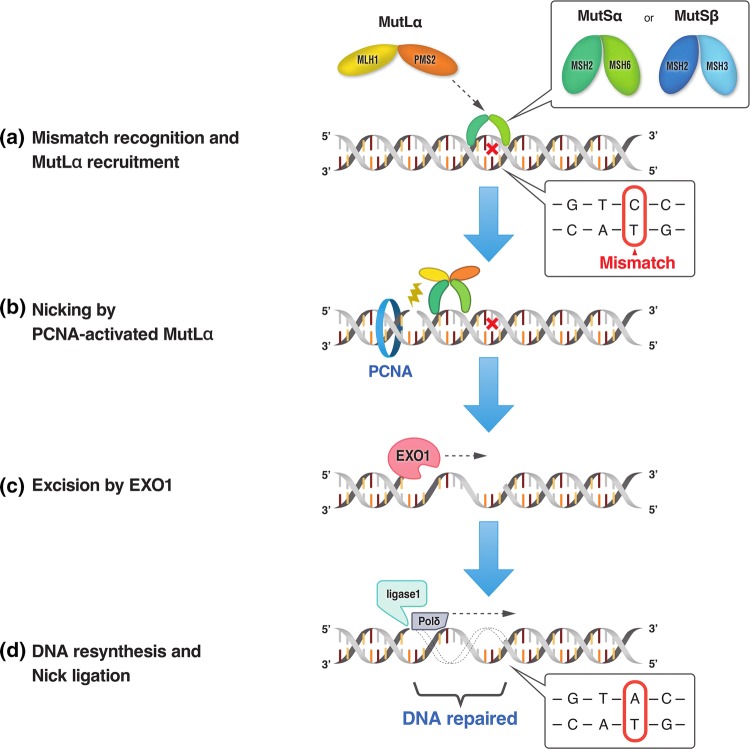
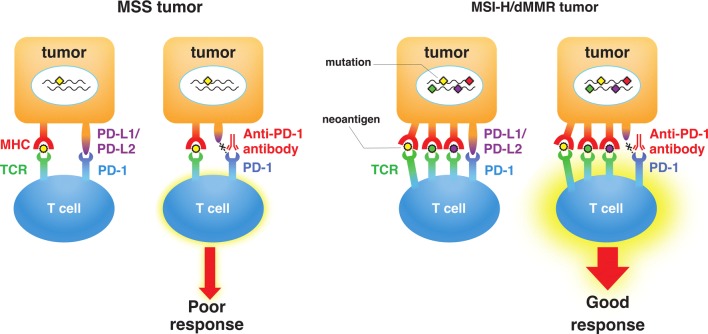
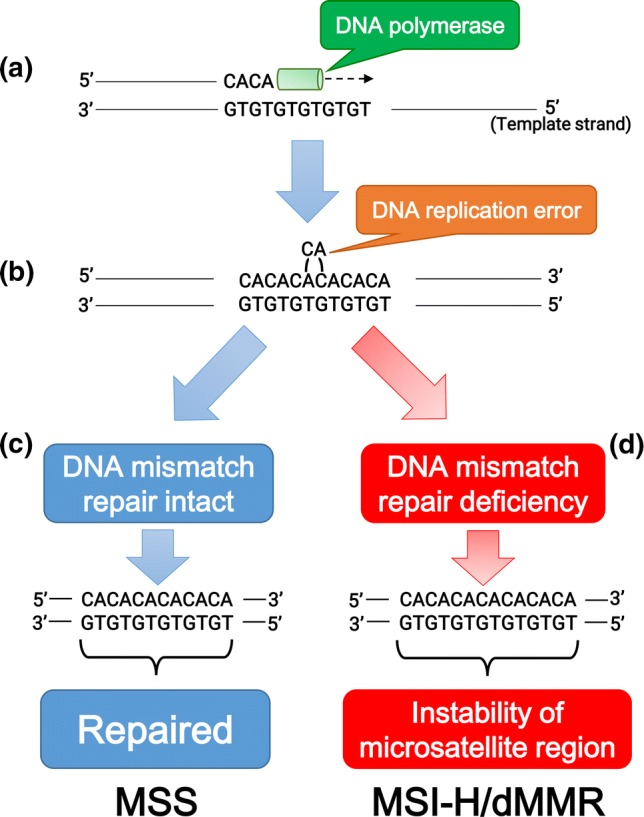
Recent innovations in the next-generation sequencing technologies have unveiled that the accumulation of genetic alterations results in the transformation of normal cells into cancer cells. Accurate and timely repair of DNA is, therefore, essential for maintaining genetic stability. Among various DNA repair pathways, the mismatch repair (MMR) pathway plays a pivotal role. MMR deficiency leads to a molecular feature of microsatellite instability (MSI) and predisposes to cancer. Recent studies revealed that MSI-high (MSI-H) or mismatch repair-deficient (dMMR) tumors, regardless of their primary site, have a promising response to immune checkpoint inhibitors (ICIs), leading to the approval of the anti-programmed cell death protein 1 monoclonal antibody pembrolizumab for the treatment of advanced or recurrent MSI-H/dMMR solid tumors that continue to progress after conventional chemotherapies. This new indication marks a paradigm shift in the therapeutic strategy of cancers; however, when considering the optimum indication for ICIs and their safe and effective usage, it is important for clinicians to understand the genetic and immunologic features of each tumor. In this review, we describe the molecular basis of the MMR pathway, diagnostics of MSI status, and the clinical importance of MSI status and the tumor mutation burden in developing therapeutic strategies against gastrointestinal and hepatobiliary malignancies.
近年来,下一代测序技术的创新揭示了遗传改变的积累导致正常细胞转化为癌细胞。因此,准确和及时地修复 DNA 对于维持遗传稳定性至关重要。在各种 DNA 修复途径中,错配修复(MMR)途径起着关键作用。MMR 缺陷导致微卫星不稳定性(MSI)的分子特征,并易患癌症。最近的研究表明,MSI 高(MSI-H)或错配修复缺陷(dMMR)肿瘤,无论其原发部位如何,对免疫检查点抑制剂(ICI)有明显的反应,导致抗程序性死亡蛋白 1 单克隆抗体 pembrolizumab 被批准用于治疗在常规化疗后继续进展的晚期或复发性 MSI-H/dMMR 实体瘤。这一新的适应证标志着癌症治疗策略的范式转变;然而,当考虑 ICI 的最佳适应证及其安全有效的使用时,临床医生了解每个肿瘤的遗传和免疫特征非常重要。在这篇综述中,我们描述了 MMR 途径的分子基础、MSI 状态的诊断以及 MSI 状态和肿瘤突变负担在制定针对胃肠道和肝胆恶性肿瘤的治疗策略中的临床重要性。