Li Tong, Ding Weiwei, Li Xiaowen, Lin Aihua
Department of Medical Statistics and Epidemiology, School of Public Health, Sun Yat-sen University, Guangzhou, People's Republic of China.
Department of Health Service and Management, Xinhua College of Sun Yat-sen University, Guangzhou, People's Republic of China.
Patient Prefer Adherence. 2019 Aug 9;13:1339-1352. doi: 10.2147/PPA.S215719. eCollection 2019.
The prevalence of hypertension continues to increase worldwide, raising an urgent need for novel and efficient methods for controlling hypertension. As the Internet and smartphones become more popular, their multiple functions and large user base make mobile health (mHealth) technology a potential tool for hypertension management. We aim to evaluate the use of mHealth technology to improve blood pressure and self-management behavior in people with hypertension and prehypertension.
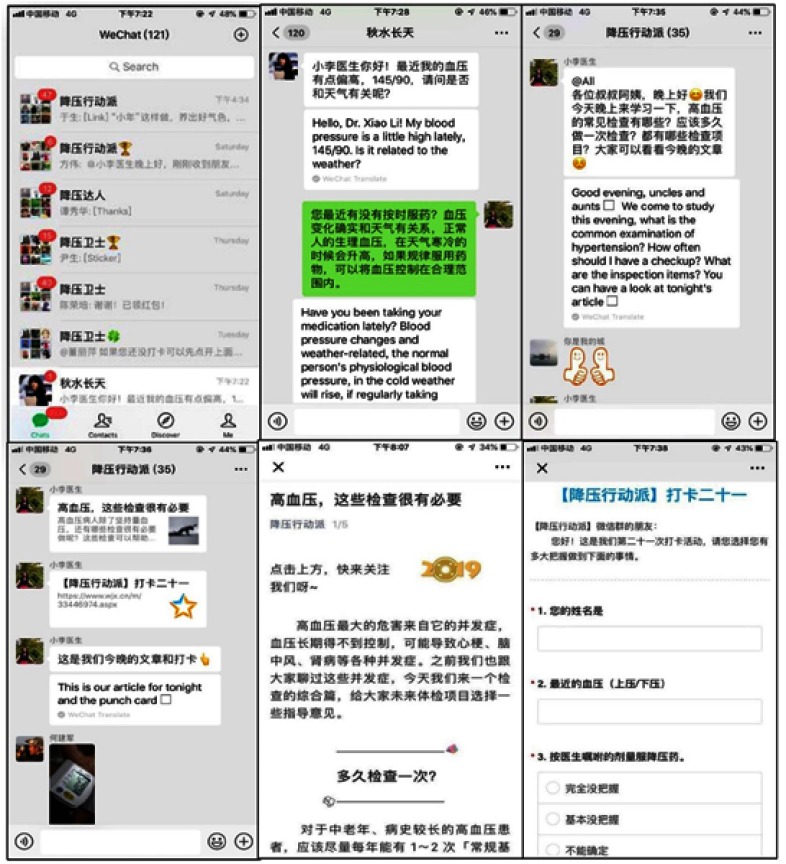
The mHealth intervention measures include health education, behavior promotion, group chatting and long-term blood pressure monitoring hierarchically delivered via WeChat application among 242 participants. The frequency, intensity and content of the hierarchical intervention are determined based on the cardiovascular risk stratification of the intervention subjects.
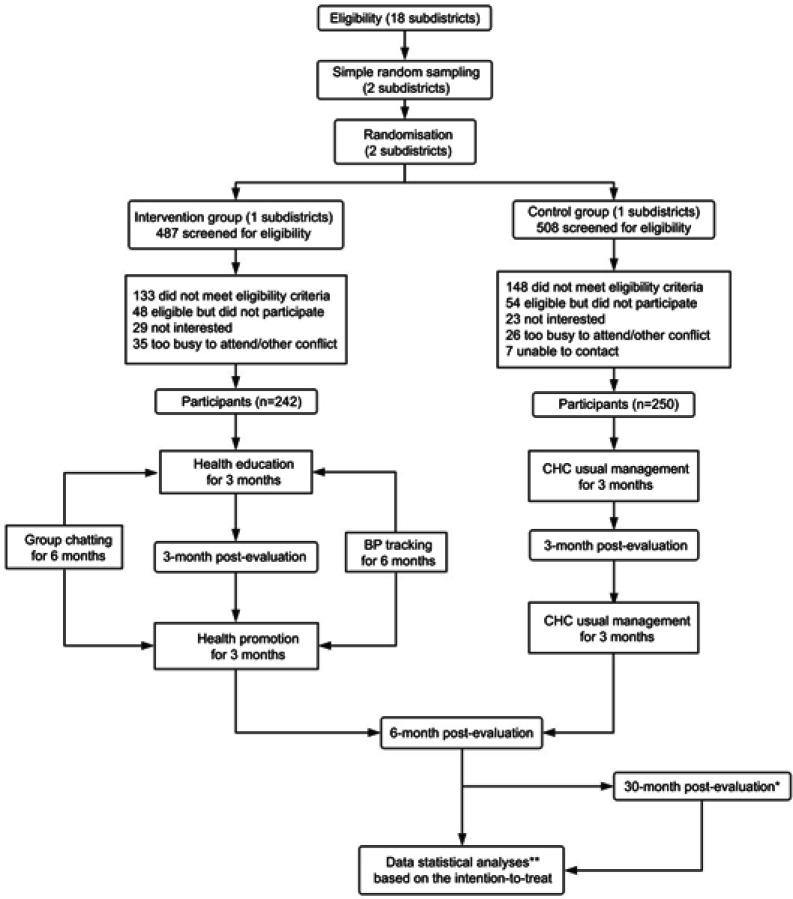
This cluster randomized controlled trial was carried out in two subdistricts in Guangzhou, China, among 492 smartphone users with hypertension or prehypertension, from August 2018 to September 2019. The intervention group received hierarchical intervention through WeChat for six months, while the control group received usual care in the community healthcare center during this period. Indicators are measured at three time points for each group, and a telephone follow-up is planned for two years after the intervention. The primary outcome is systolic blood pressure; secondary outcomes include BMI, CPAT score, improvements in behavior and diet, score of self-efficacy and self-management. Feasibility is evaluated by intervention participation. The cost-effectiveness is evaluated by ICER.
This study aims to evaluate the effect of the WeChat-based hierarchical management mode on improving blood pressure and self-management behavior in population with hypertension and prehypertension, based on health-related knowledge, self-efficacy and medication adherence. If successful, the management mode will serve as a feasible, economical and efficient hypertension management mode suitable for the community. ChiCTR1900023002.
高血压的患病率在全球范围内持续上升,因此迫切需要新颖且有效的高血压控制方法。随着互联网和智能手机越来越普及,其多种功能和庞大的用户群体使移动健康(mHealth)技术成为高血压管理的潜在工具。我们旨在评估mHealth技术对改善高血压和高血压前期患者的血压及自我管理行为的作用。
mHealth干预措施包括健康教育、行为促进、群组聊天以及通过微信应用程序对242名参与者进行分层的长期血压监测。分层干预的频率、强度和内容根据干预对象的心血管风险分层来确定。
这项整群随机对照试验于2018年8月至2019年9月在中国广州的两个街道对492名患有高血压或高血压前期的智能手机用户开展。干预组通过微信接受为期六个月的分层干预,而在此期间对照组在社区医疗中心接受常规护理。对每组在三个时间点测量指标,并计划在干预后进行为期两年 的电话随访。主要结局指标为收缩压;次要结局指标包括体重指数(BMI)、心血管疾病预防和管理工具(CPAT)评分、行为和饮食改善情况、自我效能感评分以及自我管理情况。通过干预参与度评估可行性。通过增量成本效果比(ICER)评估成本效益。
本研究旨在基于健康相关知识、自我效能感和药物依从性,评估基于微信的分层管理模式对改善高血压和高血压前期人群血压及自我管理行为的效果。如果成功,该管理模式将成为一种适用于社区的可行、经济且高效的高血压管理模式。中国临床试验注册中心注册号:ChiCTR1900023002。