Graduate School, University of Science and Technology of China, Hefei, China.
Hefei Institutes of Physical Science, Chinese Academy of Sciences, Hefei, China.
JMIR Mhealth Uhealth. 2024 Apr 5;12:e53006. doi: 10.2196/53006.
The effectiveness of timely medication, physical activity (PA), a healthy diet, and blood pressure (BP) monitoring for promoting health outcomes and behavioral changes among patients with hypertension is supported by a substantial amount of literature, with "adherence" playing a pivotal role. Nevertheless, there is a lack of consistent evidence regarding whether digital interventions can improve adherence to healthy behaviors among individuals with hypertension.
The aim was to develop a health behavioral digital intervention for hypertensive patients (HBDIHP) based on an intelligent health promotion system and WeChat following the behavior change wheel (BCW) theory and digital micro-intervention care (DMIC) model and assess its efficacy in controlling BP and improving healthy behavior adherence.
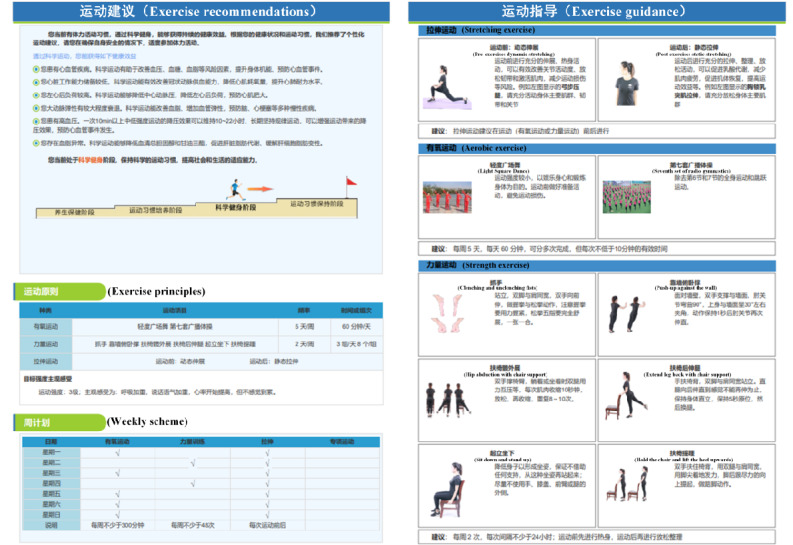
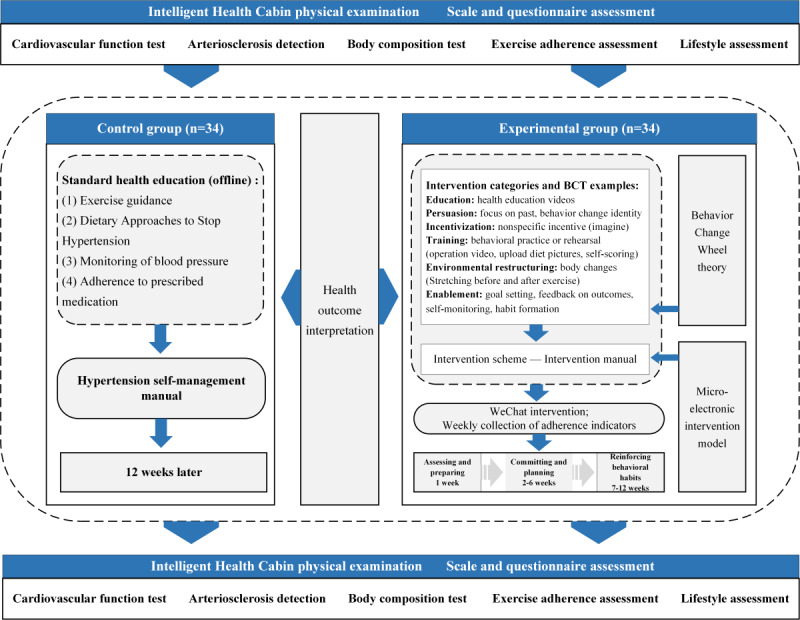
A 2-arm, randomized trial design was used. We randomly assigned 68 individuals aged >60 years with hypertension in a 1:1 ratio to either the control or experimental group. The digital intervention was established through the following steps: (1) developing digital health education materials focused on adherence to exercise prescriptions, Dietary Approaches to Stop Hypertension (DASH), prescribed medication, and monitoring of BP; (2) using the BCW theory to select behavior change techniques; (3) constructing the intervention's logic following the guidelines of the DMIC model; (4) creating an intervention manual including the aforementioned elements. Prior to the experiment, participants underwent physical examinations at the community health service center's intelligent health cabin and received intelligent personalized health recommendations. The experimental group underwent a 12-week behavior intervention via WeChat, while the control group received routine health education and a self-management manual. The primary outcomes included BP and adherence indicators. Data analysis was performed using SPSS, with independent sample t tests, chi-square tests, paired t tests, and McNemar tests. A P value <.05 was considered statistically significant.
The final analysis included 54 participants with a mean age of 67.24 (SD 4.19) years (n=23 experimental group, n=31 control group). The experimental group had improvements in systolic BP (-7.36 mm Hg, P=.002), exercise time (856.35 metabolic equivalent [MET]-min/week, P<.001), medication adherence (0.56, P=.001), BP monitoring frequency (P=.02), and learning performance (3.23, P<.001). Both groups experienced weight reduction (experimental: 1.2 kg, P=.002; control: 1.11 kg, P=.009) after the intervention. The diet types and quantities for both groups (P<.001) as well as the subendocardial viability ratio (0.16, P=.01) showed significant improvement. However, there were no statistically significant changes in other health outcomes.
The observations suggest our program may have enhanced specific health outcomes and adherence to health behaviors in older adults with hypertension. However, a longer-term, larger-scale trial is necessary to validate the effectiveness.
Chinese Clinical Trial Registry ChiCTR2200062643; https://www.chictr.org.cn/showprojEN.html?proj=172782.
INTERNATIONAL REGISTERED REPORT IDENTIFIER (IRRID): RR2-10.2196/46883.
大量文献支持及时用药、身体活动(PA)、健康饮食和血压(BP)监测对促进高血压患者健康结果和行为改变的有效性,“依从性”起着关键作用。然而,关于数字干预是否能改善高血压患者的健康行为依从性,缺乏一致的证据。
旨在基于智能健康促进系统和微信,根据行为变化轮(BCW)理论和数字微干预护理(DMIC)模型,为高血压患者制定健康行为数字干预(HBDIHP),评估其控制血压和提高健康行为依从性的效果。
采用 2 臂随机试验设计。我们将 68 名年龄大于 60 岁的高血压患者随机分为 1:1 比例的对照组和实验组。数字干预是通过以下步骤建立的:(1)制定以运动处方、DASH 饮食、规定药物和 BP 监测依从性为重点的数字健康教育材料;(2)使用 BCW 理论选择行为改变技术;(3)根据 DMIC 模型的指南构建干预的逻辑;(4)创建包括上述内容的干预手册。在实验前,参与者在社区卫生服务中心的智能健康舱进行体检,并获得智能个性化健康建议。实验组通过微信进行为期 12 周的行为干预,而对照组接受常规健康教育和自我管理手册。主要结局包括血压和依从性指标。使用 SPSS 进行数据分析,采用独立样本 t 检验、卡方检验、配对 t 检验和 McNemar 检验。P 值<.05 被认为具有统计学意义。
最终分析包括 54 名参与者,平均年龄 67.24(SD 4.19)岁(n=23 实验组,n=31 对照组)。实验组收缩压改善(-7.36mmHg,P=.002)、运动时间(856.35 代谢当量-min/周,P<.001)、药物依从性(0.56,P=.001)、BP 监测频率(P=.02)和学习表现(3.23,P<.001)。两组干预后体重均减轻(实验组:1.2kg,P=.002;对照组:1.11kg,P=.009)。两组的饮食类型和数量(P<.001)以及心内膜下活力比(0.16,P=.01)均有显著改善。然而,其他健康结果没有统计学上的显著变化。
研究结果表明,我们的方案可能改善了老年高血压患者的特定健康结果和健康行为依从性。然而,需要进行更长时间、更大规模的试验来验证其有效性。
中国临床试验注册中心 ChiCTR2200062643;https://www.chictr.org.cn/showprojEN.html?proj=172782。
国际注册报告标识符(IRRID):RR2-10.2196/46883。