SriBhashyam Sumitra, Marsh Kevin, Quartel Adrian, Weng Haoling H, Gershman Ari, Longo Nicola, Thomas Janet, Zori Roberto
Patient Centered Research, Evidera, The Ark, 201 Talgarth Road, Hammersmith, London W6 8BJ, UK.
BioMarin Pharmaceutical Inc., 105 Digital Drive, Novato, CA 94949, USA.
Mol Genet Metab Rep. 2019 Aug 30;21:100507. doi: 10.1016/j.ymgmr.2019.100507. eCollection 2019 Dec.
Phenylketonuria (PKU) leads to an accumulation of phenylalanine (Phe) in the blood and subsequent neurologic, cognitive, psychiatric, and behavioral dysfunction. Many patients report social isolation and decreased quality of life. Pegvaliase is an enzyme substitution therapy that reduces blood Phe levels in patients with PKU and is associated with a risk of hypersensitivity reactions.
To define the minimum acceptable benefit (MAB) of pegvaliase, i.e., the minimum probability of achieving a blood Phe level <360 μmol/L, which patients require to tolerate the risks of hypersensitivity associated with pegvaliase.
Adult, pegvaliase-naïve patients with blood Phe levels >600 μmol/L participated in a patient-preference web survey using two surveys: adapted swing-weighting and thresholding. Participants were asked to make ordinal choices between varying clinical benefit and severity levels for hypersensitivity. Disease effects and treatment satisfaction were also assessed.
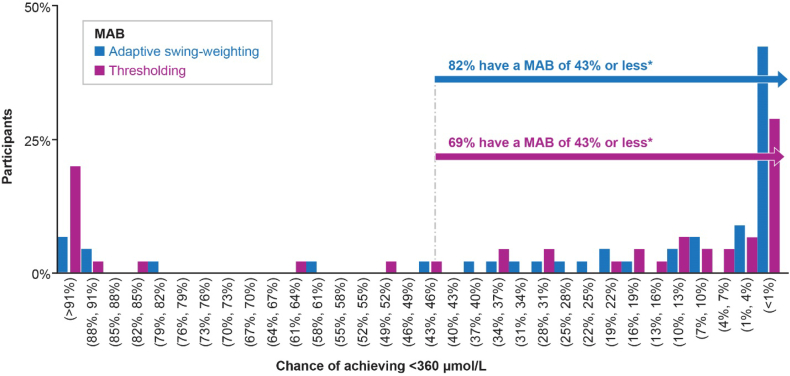
Among 45 participants, the mean (standard deviation) self-reported blood Phe level was 976.9 (429.9) μmol/L; only 28.8% reported satisfaction with their current treatment. Most (84.4%) indicated difficulty in following a PKU diet; 60% reported that the PKU diet was burdensome, and 58% reported feeling socially isolated. Most (≥69%) reported their MAB to be less than the expected clinical benefit provided by pegvaliase; the mean MAB was 22.7% and 34.4% in the swing-weighting and thresholding surveys, respectively.
Most participants felt the burden of PKU on their daily lives, were dissatisfied with current treatments, and were willing to accept the risks of hypersensitivity reactions to achieve recommended blood Phe levels with pegvaliase treatment.
苯丙酮尿症(PKU)会导致血液中苯丙氨酸(Phe)蓄积,进而引发神经、认知、精神和行为功能障碍。许多患者报告有社交隔离和生活质量下降的情况。培格瓦酶是一种酶替代疗法,可降低PKU患者的血液苯丙氨酸水平,但存在过敏反应风险。
确定培格瓦酶的最小可接受获益(MAB),即血液苯丙氨酸水平<360μmol/L的最小概率,这是患者耐受培格瓦酶相关过敏风险所需要的。
血液苯丙氨酸水平>600μmol/L且未使用过培格瓦酶的成年患者参与了一项患者偏好网络调查,该调查使用了两项调查:适应性摇摆加权法和阈值法。参与者被要求在不同的临床获益和过敏严重程度之间进行有序选择。还评估了疾病影响和治疗满意度。
45名参与者中,自我报告的血液苯丙氨酸水平平均(标准差)为976.9(429.9)μmol/L;只有28.8%的人对当前治疗表示满意。大多数(84.4%)表示遵循PKU饮食有困难;60%的人报告PKU饮食很繁重,58%的人报告感到社交隔离。大多数(≥69%)报告他们的MAB低于培格瓦酶预期的临床获益;在摇摆加权法和阈值法调查中,平均MAB分别为22.7%和34.4%。
大多数参与者感到PKU对他们日常生活造成负担,对当前治疗不满意,并愿意接受过敏反应风险,以通过培格瓦酶治疗达到推荐的血液苯丙氨酸水平。