Bell Sean M, Wendt Dan J, Zhang Yanhong, Taylor Timothy W, Long Shinong, Tsuruda Laurie, Zhao Bin, Laipis Phillip, Fitzpatrick Paul A
BioMarin Pharmaceutical, Novato, California, United States of America.
Department of Biochemistry and Molecular Biology, University of Florida, Gainesville, Florida, United States of America.
PLoS One. 2017 Mar 10;12(3):e0173269. doi: 10.1371/journal.pone.0173269. eCollection 2017.
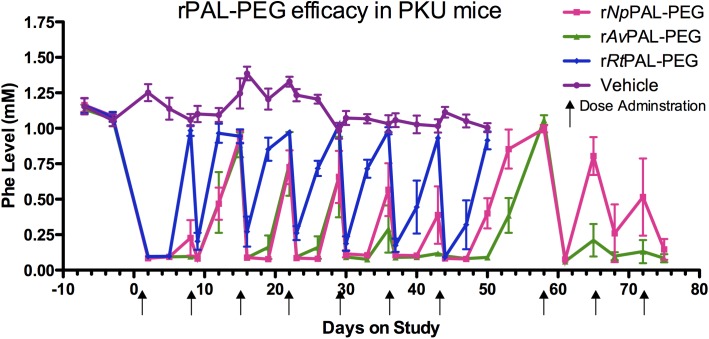
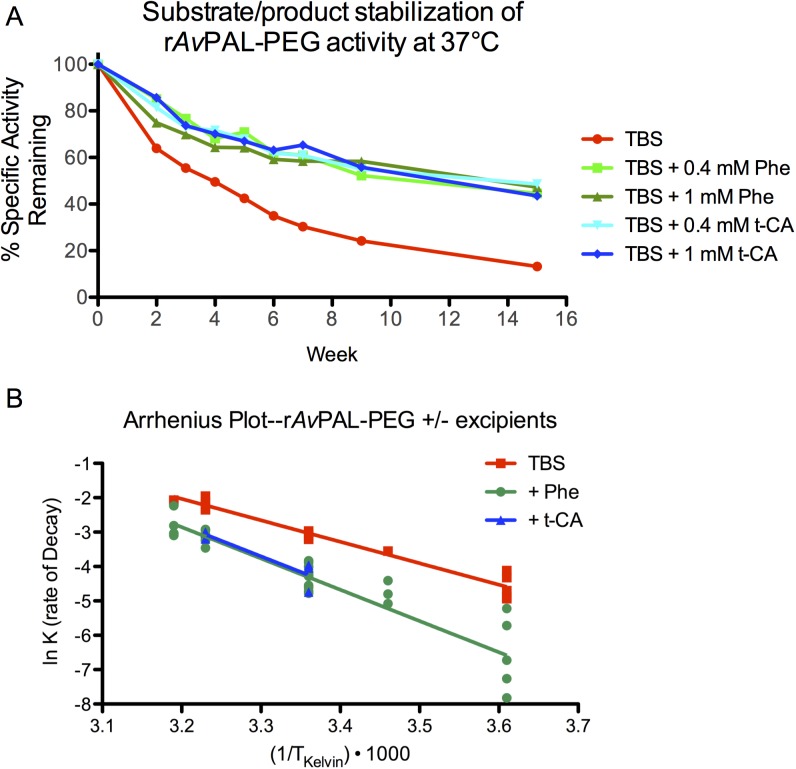
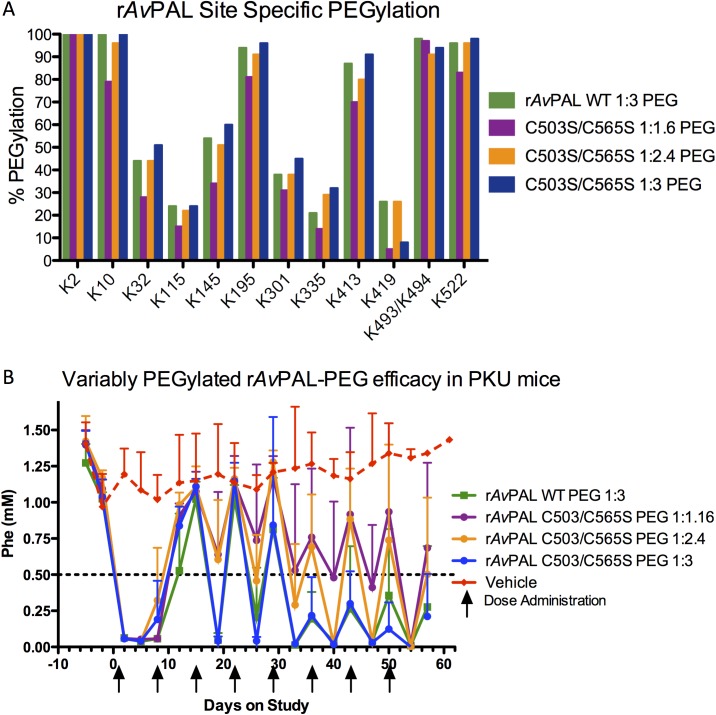
Phenylketonuria (PKU) is a genetic metabolic disease in which the decrease or loss of phenylalanine hydroxylase (PAH) activity results in elevated, neurotoxic levels of phenylalanine (Phe). Due to many obstacles, PAH enzyme replacement therapy is not currently an option. Treatment of PKU with an alternative enzyme, phenylalanine ammonia lyase (PAL), was first proposed in the 1970s. However, issues regarding immunogenicity, enzyme production and mode of delivery needed to be overcome. Through the evaluation of PAL enzymes from multiple species, three potential PAL enzymes from yeast and cyanobacteria were chosen for evaluation of their therapeutic potential. The addition of polyethylene glycol (PEG, MW = 20,000), at a particular ratio to modify the protein surface, attenuated immunogenicity in an animal model of PKU. All three PEGylated PAL candidates showed efficacy in a mouse model of PKU (BTBR Pahenu2) upon subcutaneous injection. However, only PEGylated Anabaena variabilis (Av) PAL-treated mice demonstrated sustained low Phe levels with weekly injection and was the only PAL evaluated that maintained full enzymatic activity upon PEGylation. A PEGylated recombinant double mutant version of AvPAL (Cys503Ser/Cys565Ser), rAvPAL-PEG, was selected for drug development based on its positive pharmacodynamic profile and favorable expression titers. PEGylation was shown to be critical for rAvPAL-PEG efficacy as under PEGylated rAvPAL had a lower pharmacodynamic effect. rAvPAL and rAvPAL-PEG had poor stability at 4°C. L-Phe and trans-cinnamate were identified as activity stabilizing excipients. rAvPAL-PEG is currently in Phase 3 clinical trials to assess efficacy in PKU patients.
苯丙酮尿症(PKU)是一种遗传性代谢疾病,其中苯丙氨酸羟化酶(PAH)活性的降低或丧失会导致苯丙氨酸(Phe)水平升高,达到具有神经毒性的程度。由于存在诸多障碍,目前PAH酶替代疗法并非一种可行的选择。20世纪70年代首次提出用替代酶苯丙氨酸解氨酶(PAL)治疗PKU。然而,免疫原性、酶生产和给药方式等问题仍需克服。通过对多种物种的PAL酶进行评估,选择了来自酵母和蓝细菌的三种潜在PAL酶来评估其治疗潜力。以特定比例添加聚乙二醇(PEG,分子量 = 20,000)来修饰蛋白质表面,可在PKU动物模型中减弱免疫原性。所有三种聚乙二醇化的PAL候选物在皮下注射后,在PKU小鼠模型(BTBR Pahenu2)中均显示出疗效。然而,只有经聚乙二醇化的多变鱼腥藻(Av)PAL治疗的小鼠在每周注射时表现出持续的低Phe水平,并且是唯一一种经聚乙二醇化后仍保持全部酶活性的被评估的PAL。基于其良好的药效学特征和有利的表达滴度,选择了聚乙二醇化的重组双突变体形式的AvPAL(Cys503Ser/Cys565Ser),即rAvPAL-PEG,用于药物开发。聚乙二醇化被证明对rAvPAL-PEG的疗效至关重要,因为未聚乙二醇化的rAvPAL具有较低的药效学效应。rAvPAL和rAvPAL-PEG在4°C时稳定性较差。L-苯丙氨酸和反式肉桂酸被确定为活性稳定辅料。rAvPAL-PEG目前正处于3期临床试验阶段,以评估其对PKU患者的疗效。