Debras E, Fernandez H, Neveu M-E, Deffieux X, Capmas P
AP-HP, Hôpital Bicêtre, GHU Sud, Department of Gynecology and Obstetrics, 94276 Le Kremlin-Bicêtre, France.
Inserm, Centre of Research in Epidemiology and Population Health (CESP), U1018, 94276 Le Kremlin-Bicêtre, France.
Eur J Obstet Gynecol Reprod Biol X. 2019 Aug 13;4:100093. doi: 10.1016/j.eurox.2019.100093. eCollection 2019 Oct.
To report long term pregnancy rate in polycystic ovary syndrome (PCOS) treated by ovarian drilling. To evaluate predictive factors of pregnancy and possibility of a second drilling.
Retrospective, observational, multicenter study.
Gynecologic departments of two teaching's hospitals.
All infertile women with PCOS who were treated by ovarian drilling from 2004 to 2013. The Rotterdam criteria were applied to define PCOS.
Surgical ovarian drilling by laparoscopy and trans vaginal hydro laparoscopy.
The primary endpoint was pregnancy rate after ovarian drilling. The secondary endpoints were the predictive factors of pregnancy and the possibility of a second ovarian drilling.
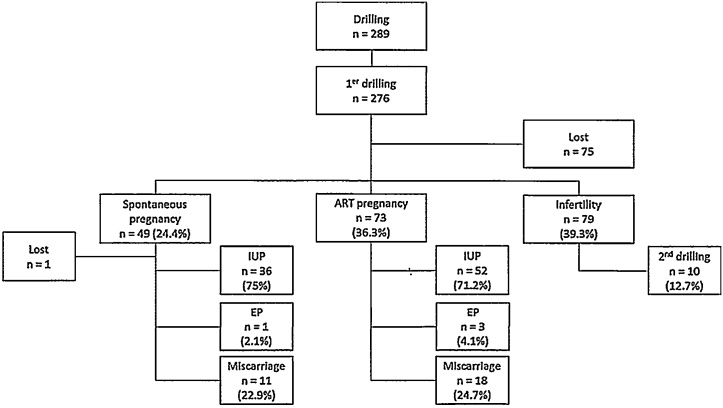
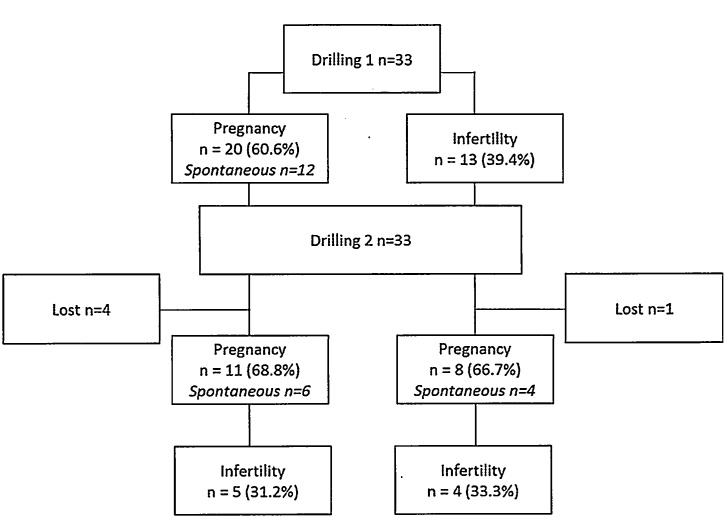
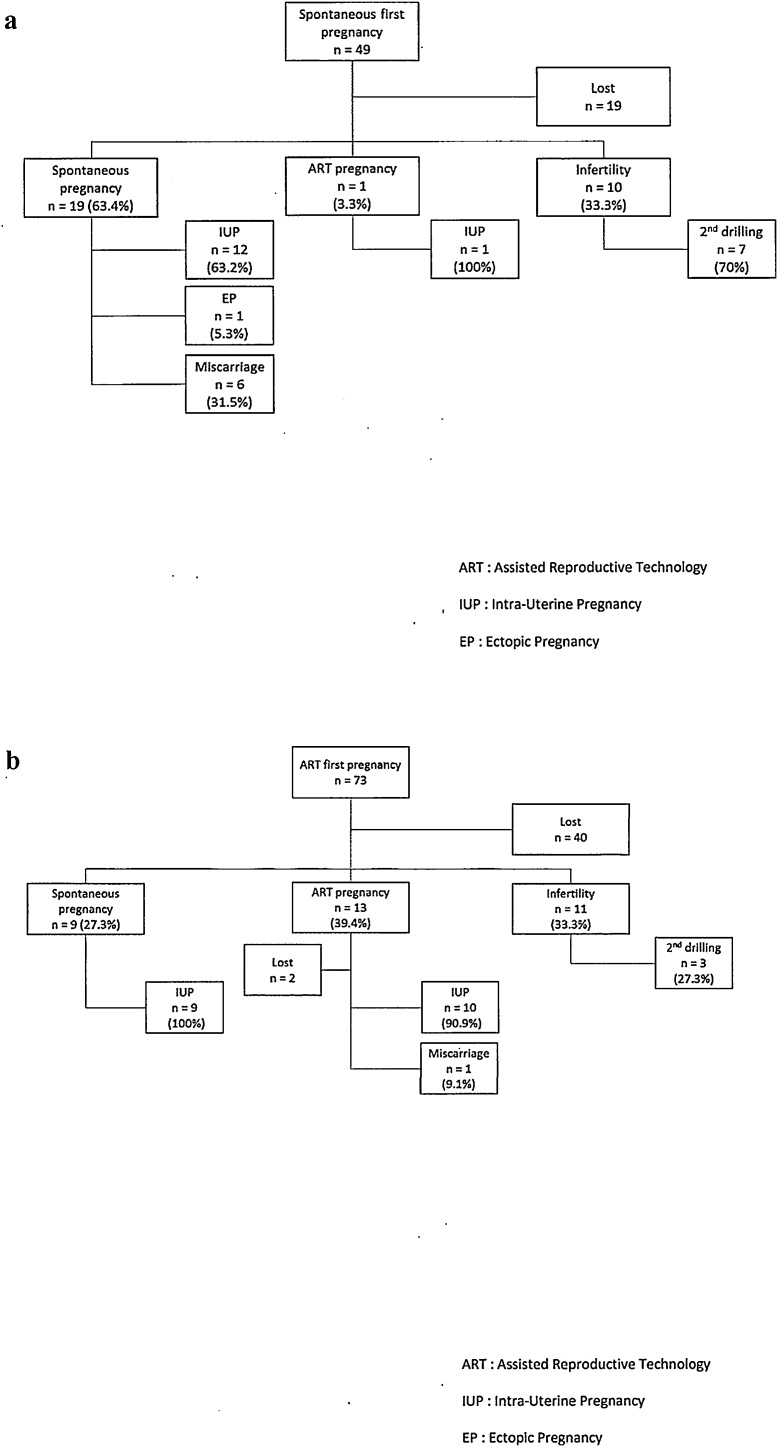
289 women were included in the study. The mean follow-up period was 28.4 months (25.3-31.5). A pregnancy was obtained in at least 137 (47.4%) women after a drilling, and 71 (51.8%) of these pregnancies were spontaneous, 48 (16.6%) women achieved at least two pregnancies after drilling, and 27 (56.3%) of these were spontaneous. The predictive factors for effectiveness were a normal body mass index (BMI), an infertility period of less than three years, an AFC of less than 50, and an age of less than 35. Second drillings were performed on 33 women. Among them, 19 (57.6%) achieved at least one pregnancy, and 10 (52.6%) of these were spontaneous. It appeared that a second drilling was effective either when the first drilling had been successful (pregnancy achieved after drilling) or when it had failed in cases of high AFC (greater than 55).
Ovarian drilling permitted to obtain spontaneous pregnancy for women with PCOS. This surgery could have durably effect permitted to obtain more than one pregnancy.
报告经卵巢打孔治疗的多囊卵巢综合征(PCOS)患者的长期妊娠率。评估妊娠的预测因素以及二次打孔的可能性。
回顾性、观察性、多中心研究。
两家教学医院的妇科。
2004年至2013年期间接受卵巢打孔治疗的所有PCOS不孕女性。采用鹿特丹标准定义PCOS。
通过腹腔镜和经阴道水腹腔镜进行手术卵巢打孔。
主要终点是卵巢打孔后的妊娠率。次要终点是妊娠的预测因素以及二次卵巢打孔的可能性。
289名女性纳入研究。平均随访期为28.4个月(25.3 - 31.5)。至少137名(47.4%)女性在打孔后妊娠,其中71名(51.8%)为自然妊娠,48名(16.6%)女性在打孔后至少有两次妊娠,其中27名(56.3%)为自然妊娠。有效性的预测因素为正常体重指数(BMI)、不孕年限少于3年、窦卵泡计数(AFC)少于50以及年龄小于35岁。对33名女性进行了二次打孔。其中,19名(57.6%)至少妊娠一次,其中10名(52.6%)为自然妊娠。似乎当首次打孔成功(打孔后妊娠)或在AFC高(大于55)的情况下首次打孔失败时,二次打孔是有效的。
卵巢打孔使PCOS女性能够自然妊娠。该手术可能具有持久效果,使患者能够获得不止一次妊娠。