Departamento de Farmacia, Facultad de Química y de Farmacia, Pontificia Universidad Católica de Chile, Santiago 7820436, Chile.
Departamento de Química Inorgánica, Facultad de Química y de Farmacia, Pontificia Universidad Católica de Chile, Santiago 7820436, Chile.
Molecules. 2019 Sep 7;24(18):3264. doi: 10.3390/molecules24183264.
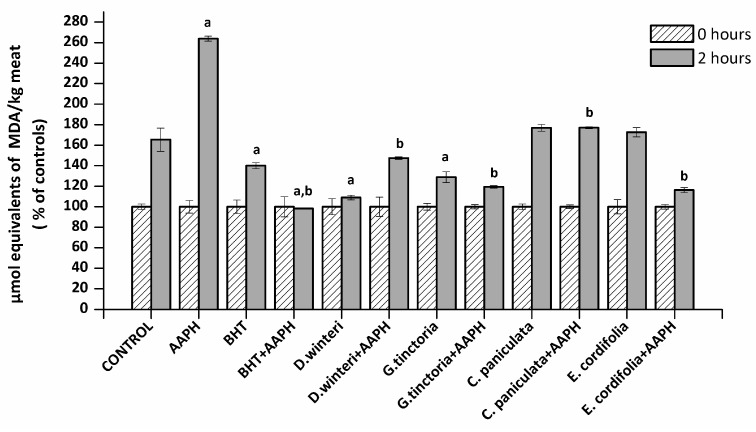
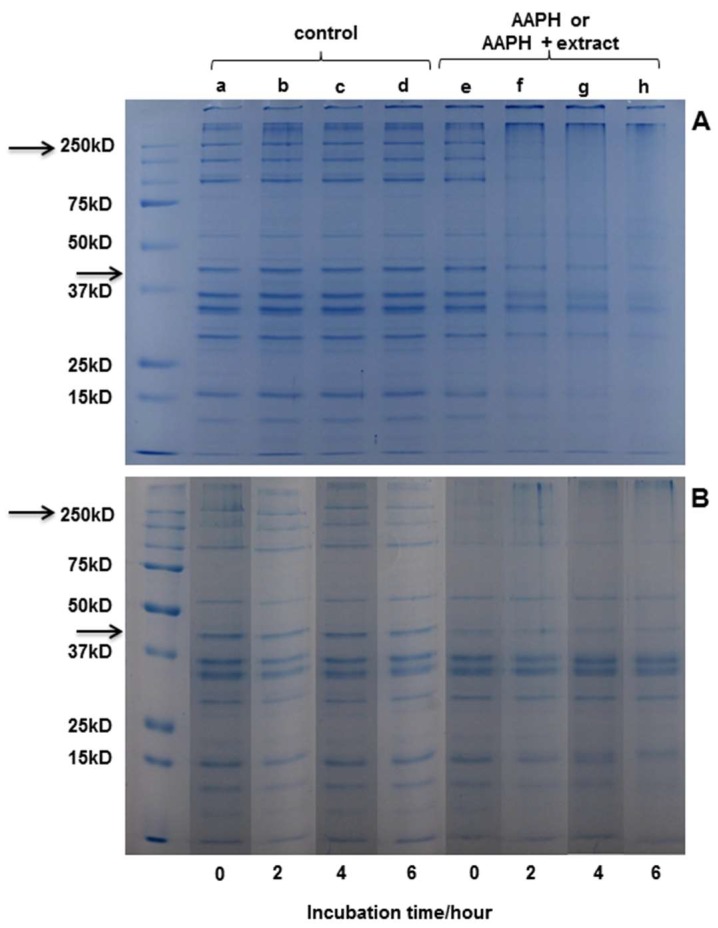
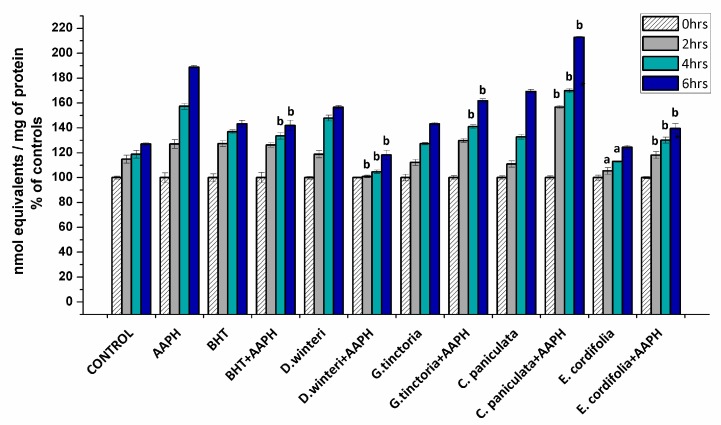
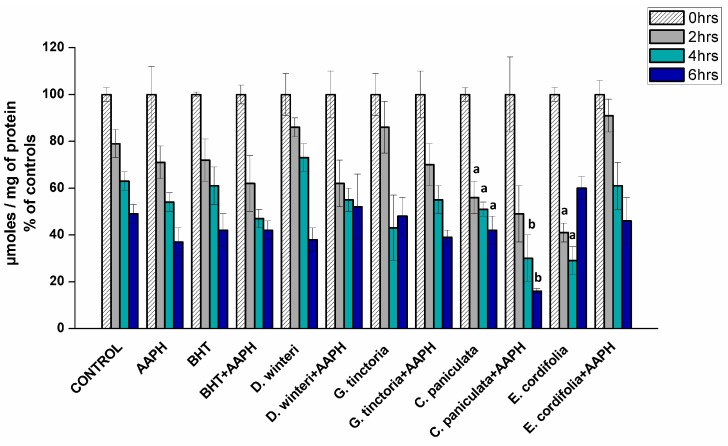
The present study investigated the antioxidant potential and the ability to inhibit lipid and protein oxidation in bovine meat of four native Chilean species: canelo (), nalca (), tiaca (), and ulmo (). Phenolic acids (gallic, chlorogenic, caffeic, and coumaric) and flavonoids (catechin, epicatechin, and rutin) were identified and quantified by HPLC-MS/MS. extract exhibited the highest antioxidant capacity evaluated by oxygen radical absorption capacity-red pyrogallol method (ORAC-PGR) and ferric ion reducing antioxidant power (FRAP) assays. All extracts decreased lipid oxidation induced by 2,2'-azo-bis(2-amidinopropane) dihydrochloride (AAPH) derived peroxyl radicals by anywhere between 30% and 50% the. In addition, canelo and nalca extracts decreased spontaneous oxidation by around 57% and 37% in relation to the control group, being even more efficient than butylated hydroxyanisole (BHT) a synthetic antioxidant. Protein oxidation in the myofibrillar proteins was evaluated by the formation of protein carbonyls and loss of protein thiols. The canelo, ulmo, and nalca extracts decreased the formation of carbonyls by around 30%. Plant extracts and BHT did not show an antioxidant effect on protein thiol loss. However, tiaca and ulmo extracts exerted a pro-oxidant effect, favoring the oxidation of sulfhydryl groups. The oxidizing system induced structural changes in myofibrillar protein (SDS-PAGE). A protective effect on protein structure from the canelo extract can be observed during the incubation when compared to samples incubated with AAPH.
本研究调查了四种智利本土物种(Canelo ()、Nalca ()、Tiaca () 和 Ulmo ())牛肉的抗氧化潜力和抑制脂质及蛋白质氧化的能力。采用高效液相色谱-质谱联用法(HPLC-MS/MS)对酚酸(没食子酸、绿原酸、咖啡酸和香豆酸)和类黄酮(儿茶素、表儿茶素和芦丁)进行了鉴定和定量。 提取物的抗氧化能力通过氧自由基吸收能力-红没食子酸丙酯法(ORAC-PGR)和铁还原抗氧化能力(FRAP)测定评价最高。所有提取物均降低了 2,2'-偶氮双(2-脒基丙烷)二盐酸盐(AAPH)衍生过氧自由基诱导的脂质氧化,抑制率在 30%至 50%之间。此外,与对照组相比,Canelo 和 Nalca 提取物分别使自发氧化降低了约 57%和 37%,甚至比合成抗氧化剂丁基羟基茴香醚(BHT)更有效。肌原纤维蛋白的蛋白质氧化通过蛋白质羰基的形成和巯基的损失来评估。Canelo、Ulmo 和 Nalca 提取物使羰基的形成减少了约 30%。植物提取物和 BHT 对蛋白质巯基损失没有抗氧化作用。然而,Tiaca 和 Ulmo 提取物表现出促氧化作用,有利于巯基的氧化。氧化体系诱导肌原纤维蛋白的结构变化(SDS-PAGE)。与用 AAPH 孵育的样品相比,Canelo 提取物在孵育期间对蛋白质结构具有保护作用。