Doctors with Africa CUAMM, Aber Hospital, Lira, Uganda.
Maternal and Child Wellbeing Unit, African Population and Health Research Center, Nairobi, Kenya
BMJ Open. 2019 Sep 8;9(9):e026851. doi: 10.1136/bmjopen-2018-026851.
To examine the perceptions of community members and other stakeholders on the use of baby kits and transport vouchers to improve the utilisation of childbirth services.
A qualitative study.
Oyam district, Uganda.
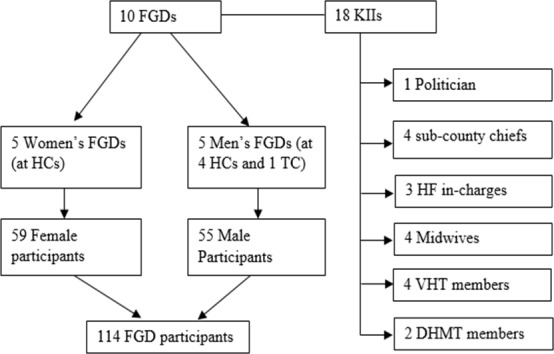
We conducted 10 focus group discussions with 59 women and 55 men, and 18 key informant interviews with local leaders, village health team members, health facility staff and district health management team members. We analysed the data using qualitative content analysis.
Five broad themes emerged: (1) context, (2) community support for the interventions, (3) health-seeking behaviours postintervention, (4) undesirable effects of the interventions and (5) implementation issues and lessons learnt. Context regarded perceived long distances to health facilities and high transport costs. Regarding community support for the interventions, the schemes were perceived to be acceptable and helpful particularly to the most vulnerable. Transport vouchers were preferred over baby kits, although both interventions were perceived to be necessary. Health-seeking behaviours entailed perceived increased utilisation of maternal health services and 'bypassing', promotion of collaboration between traditional birth attendants and formal health workers, stimulation of men's involvement in maternal health, and increased community awareness of maternal health. Undesirable effects of the interventions included increased workload for health workers, sustainability concerns and perceived encouragement to reproduce and dependency. Implementation issues included information gaps leading to confusion, mistrust and discontent, transport voucher scheme design; implementation; and payment problems, poor attitude of some health workers and poor quality of care, insecurity, and a shortage of baby kits. Community involvement was key to solving the challenges.
The study provides further insights into the implementation of incentive schemes to improve maternal health services utilisation. The findings are relevant for planning and implementing similar schemes in low-income countries.
探讨社区成员和其他利益攸关方对使用婴儿套装和交通券以提高分娩服务利用度的看法。
定性研究。
乌干达 Oyam 区。
我们与 59 名妇女和 55 名男子进行了 10 次焦点小组讨论,并与当地领导、村卫生团队成员、卫生机构工作人员和区卫生管理团队成员进行了 18 次关键人物访谈。我们使用定性内容分析对数据进行了分析。
出现了五个广泛的主题:(1)背景,(2)社区对干预措施的支持,(3)干预措施后的寻医行为,(4)干预措施的不良影响,(5)实施问题和经验教训。背景涉及到对卫生机构的距离远和交通费用高的看法。关于社区对干预措施的支持,这些方案被认为是可以接受的,特别是对最脆弱的人群有帮助。交通券比婴儿套装更受欢迎,尽管两者都被认为是必要的。寻医行为包括对产妇保健服务利用率的增加和“绕过”、促进传统助产妇与正规卫生工作者之间的合作、刺激男性参与产妇保健、以及提高社区对产妇保健的认识。干预措施的不良影响包括卫生工作者的工作量增加、可持续性问题以及对生育和依赖的看法的鼓励。实施问题包括信息差距导致的困惑、不信任和不满、交通券计划的设计、实施和支付问题、一些卫生工作者的不良态度和护理质量差、不安全以及婴儿套装短缺。社区参与是解决这些挑战的关键。
该研究进一步深入了解了实施激励措施以提高产妇保健服务利用率的情况。这些发现对于在低收入国家规划和实施类似计划具有相关性。