
癌症相关基因变体Rs3903072调节肿瘤微环境中的免疫细胞。
The Cancer-Associated Genetic Variant Rs3903072 Modulates Immune Cells in the Tumor Microenvironment.
作者信息
Zhang Yi, Manjunath Mohith, Yan Jialu, Baur Brittany A, Zhang Shilu, Roy Sushmita, Song Jun S
机构信息
Department of Bioengineering, University of Illinois at Urbana-Champaign, Urbana, IL, United States.
Carl R. Woese Institute for Genomic Biology, University of Illinois at Urbana-Champaign, Urbana, IL, United States.
出版信息
Front Genet. 2019 Aug 23;10:754. doi: 10.3389/fgene.2019.00754. eCollection 2019.
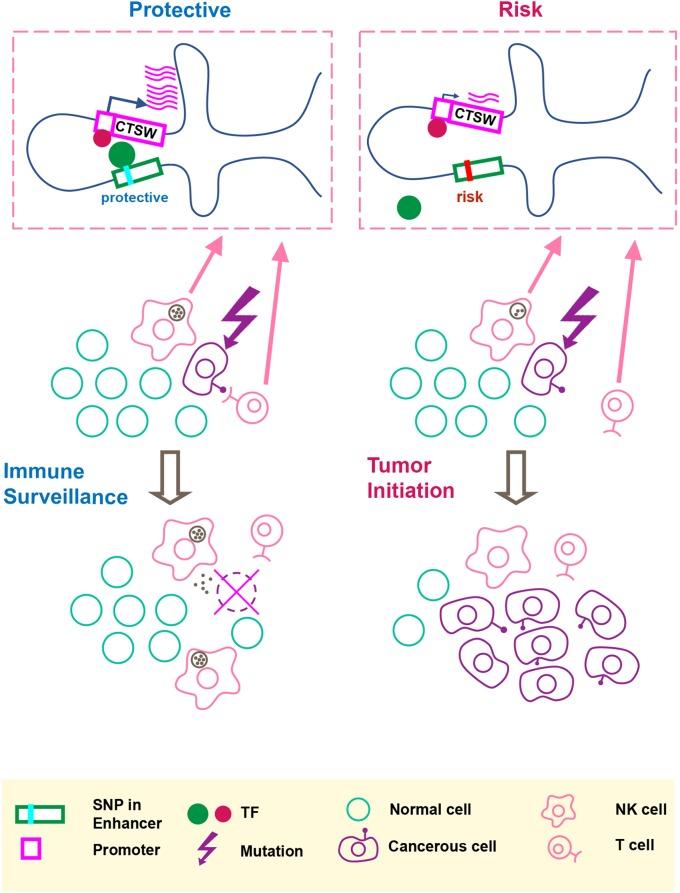
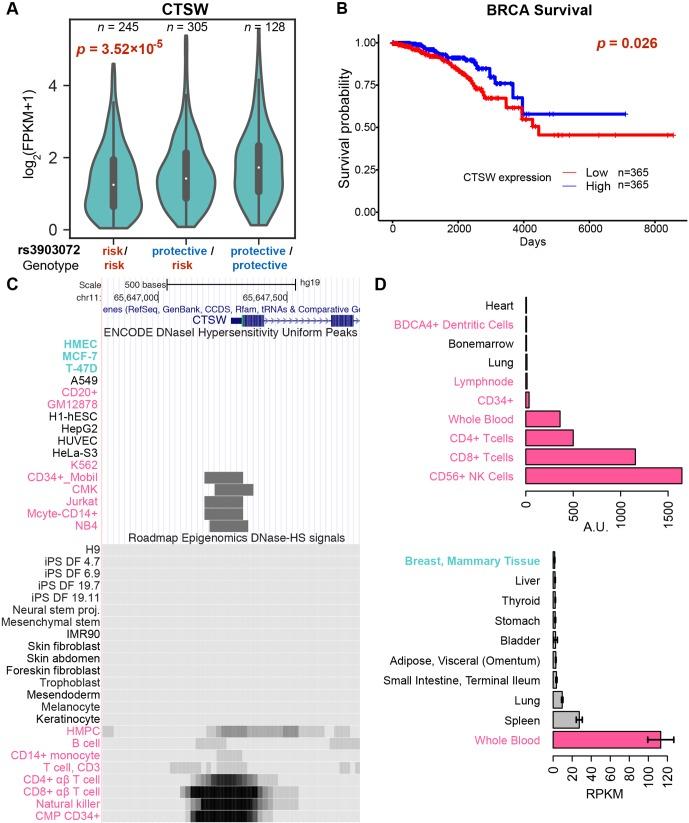
Genome-wide association studies (GWAS) have hitherto identified several germline variants associated with cancer susceptibility, but the molecular functions of these risk modulators remain largely uncharacterized. Recent studies have begun to uncover the regulatory potential of noncoding GWAS SNPs using epigenetic information in corresponding cancer cell types and matched normal tissues. However, this approach does not explore the potential effect of risk germline variants on other important cell types that constitute the microenvironment of tumor or its precursor. This paper presents evidence that the breast-cancer-associated variant rs3903072 may regulate the expression of in tumor-infiltrating lymphocytes. is a candidate tumor-suppressor gene, with expression highly specific to immune cells and also positively correlated with breast cancer patient survival. Integrative analyses suggest a putative causative variant in a GWAS-linked enhancer in lymphocytes that loops to the 3' end of through three-dimensional chromatin interaction. Our work thus poses the possibility that a cancer-associated genetic variant could regulate a gene not only in the cell of cancer origin but also in immune cells in the microenvironment, thereby modulating the immune surveillance by T lymphocytes and natural killer cells and affecting the clearing of early cancer initiating cells.
全基因组关联研究(GWAS)迄今已鉴定出几种与癌症易感性相关的种系变体,但这些风险调节因子的分子功能在很大程度上仍未明确。最近的研究已开始利用相应癌细胞类型和匹配正常组织中的表观遗传信息来揭示非编码GWAS单核苷酸多态性(SNP)的调控潜力。然而,这种方法并未探究风险种系变体对构成肿瘤或其前体微环境的其他重要细胞类型的潜在影响。本文提供的证据表明,与乳腺癌相关的变体rs3903072可能调控肿瘤浸润淋巴细胞中[基因名称未给出]的表达。[基因名称未给出]是一个候选肿瘤抑制基因,其表达对免疫细胞具有高度特异性,并且也与乳腺癌患者的生存率呈正相关。综合分析表明,淋巴细胞中一个与GWAS相关的增强子中存在一个推定的致病变体,该增强子通过三维染色质相互作用环化至[基因名称未给出]的3'端。因此,我们的研究提出了一种可能性,即癌症相关的遗传变体不仅可以在癌症起源细胞中调控基因,还可以在微环境中的免疫细胞中调控基因,从而调节T淋巴细胞和自然杀伤细胞的免疫监视,并影响早期癌症起始细胞的清除。


 Zotero 插件