Department of Physiotherapy and Occupational Therapy, Holstebro Regional Hospital, Hospital Unit West, Holstebro, Denmark.
Department of Clinical Medicine, Aarhus University, Aarhus, Denmark.
BMC Musculoskelet Disord. 2019 Sep 12;20(1):421. doi: 10.1186/s12891-019-2787-6.
Pain catastrophizing contributes to acute and long-term pain after knee arthroplasty (KA), but the association between pain catastrophizing and physical function is not clear. We examined the association between preoperative pain catastrophizing and physical function one year after surgery, as well as differences in physical function, pain and general health in two groups of patients with high and low preoperative pain catastrophizing score.
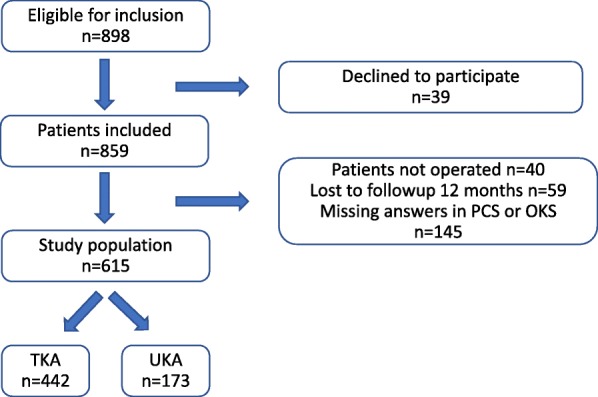
We included 615 patients scheduled for KA between March 2011 and December 2013. Patients completed The Pain Catastrophizing Scale (PCS) prior to surgery. The Oxford Knee Score (OKS), Short Form-36 (SF-36) and the EuroQol-5D (EQ-5D) were completed prior to surgery, and 4 and 12 months after the surgery.
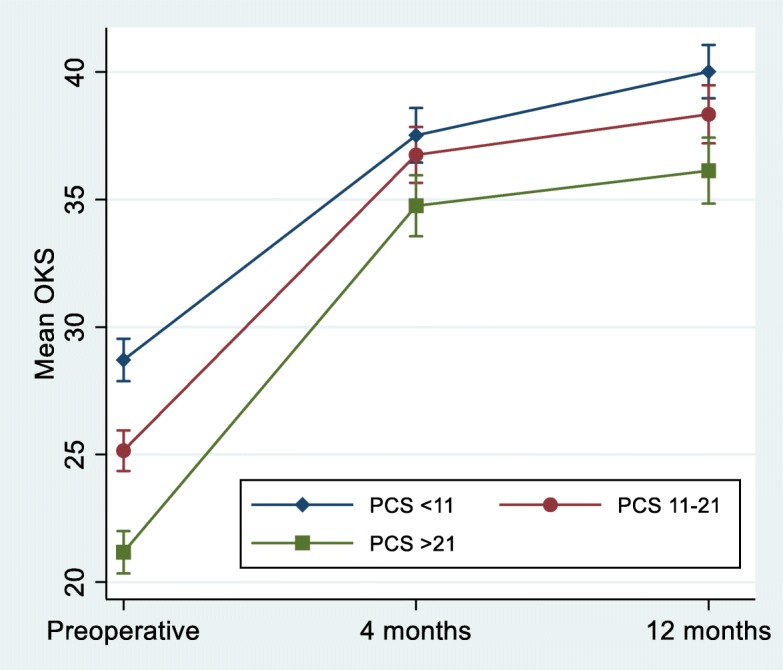
Of the 615 patients, 442 underwent total knee arthroplasty (TKA) and 173 unicompartmental knee arthroplasty (UKA). Mean age was 67.3 (SD: 9.7) and 53.2% were females. Patients with PCS > 21 had statistically significantly larger improvement in mean OKS for both TKA and UKA than patients with PCS < 11; 3.2 (95% CI: 1.0, 5.4) and 5.4 (95% CI: 2.2, 8.6), respectively. Furthermore, patients with preoperative PCS > 21 had statistically significantly lower OKS, SF-36 and EQ-5D and higher pain score than patients with PCS < 11 both preoperatively and 4 and 12 months postoperatively.
Patients with high levels of preoperative pain catastrophizing have lower physical function, more pain and poorer general health both before and after KA than patients without elevated pain catastrophizing.
疼痛灾难化是膝关节置换术后急性和长期疼痛的一个重要因素,但疼痛灾难化与身体功能之间的关系尚不清楚。我们研究了术前疼痛灾难化与术后一年手术身体功能之间的关系,以及术前疼痛灾难化得分高、得分低的两组患者在身体功能、疼痛和一般健康方面的差异。
我们纳入了 2011 年 3 月至 2013 年 12 月间拟行膝关节置换术的 615 例患者。患者术前完成疼痛灾难化量表(PCS)。术前、术后 4 个月和 12 个月时,患者完成牛津膝关节评分(OKS)、健康调查简表 36 项(SF-36)和 EuroQol-5D(EQ-5D)。
615 例患者中,442 例行全膝关节置换术(TKA),173 例行单髁膝关节置换术(UKA)。平均年龄为 67.3(标准差:9.7),女性占 53.2%。PCS>21 的患者与 PCS<11 的患者相比,TKA 和 UKA 的 OKS 平均改善程度均有统计学意义;分别为 3.2(95%可信区间:1.0,5.4)和 5.4(95%可信区间:2.2,8.6)。此外,术前 PCS>21 的患者在术前、术后 4 个月和 12 个月时的 OKS、SF-36 和 EQ-5D 评分均明显低于 PCS<11 的患者,疼痛评分也明显高于 PCS<11 的患者。
与无疼痛灾难化的患者相比,术前疼痛灾难化水平较高的患者在膝关节置换术前、后身体功能较差,疼痛更明显,一般健康状况更差。