Fondazione Istituto Italiano di Tecnologia, Genova, Italy.
MySpace Lab, Department of Clinical Neuroscience, Centre Hospitalier Universitaire Vaudois (CHUV), University of Lausanne, Lausanne, Switzerland.
Sci Rep. 2019 Sep 13;9(1):13191. doi: 10.1038/s41598-019-49500-7.
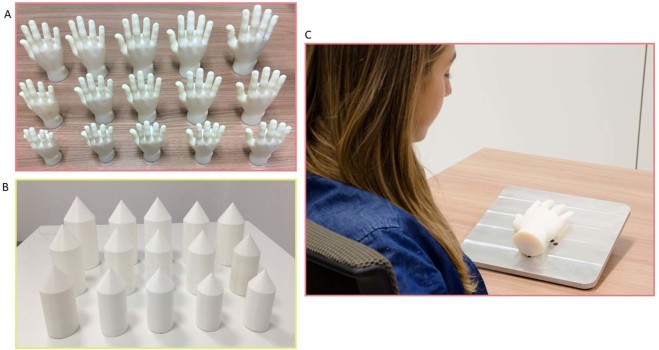
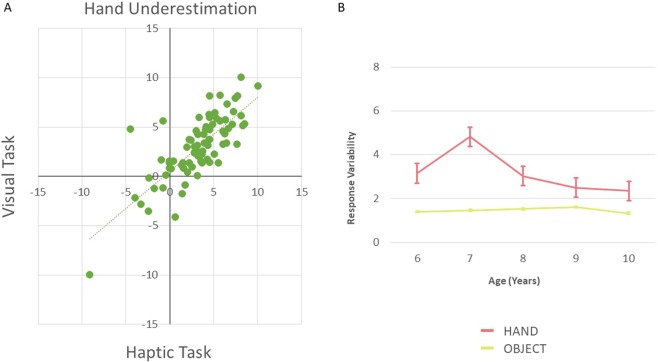
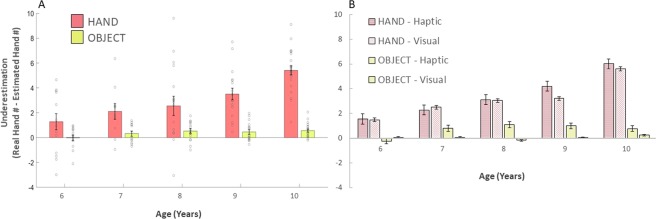
Cortical body size representations are distorted in the adult, from low-level motor and sensory maps to higher levels multisensory and cognitive representations. Little is known about how such representations are built and evolve during infancy and childhood. Here we investigated how hand size is represented in typically developing children aged 6 to 10. Participants were asked to estimate their hand size using two different sensory modalities (visual or haptic). We found a distortion (underestimation) already present in the youngest children. Crucially, such distortion increases with age and regardless of the sensory modality used to access the representation. Finally, underestimation is specific for the body as no bias was found for object estimation. This study suggests that the brain does not keep up with the natural body growth. However, since motor behavior nor perception were impaired, the distortion seems functional and/or compensated for, for proper interaction with the external environment.
皮质身体大小的表示在成年人中是扭曲的,从低级别的运动和感觉图到更高层次的多感觉和认知表示。关于这些表示是如何在婴儿期和儿童期建立和发展的,我们知之甚少。在这里,我们研究了正常发育的 6 至 10 岁儿童的手大小是如何被表示的。参与者被要求使用两种不同的感觉模式(视觉或触觉)来估计他们的手的大小。我们发现,在最小的孩子中已经存在一种扭曲(低估)。至关重要的是,这种扭曲会随着年龄的增长而增加,而与用于访问表示的感觉模式无关。最后,低估是针对身体的,因为在估计物体时没有发现偏差。这项研究表明,大脑没有跟上身体的自然生长。然而,由于运动行为和感知都没有受到损害,这种扭曲似乎是功能性的,或者是为了与外部环境进行适当的互动而得到补偿的。