Lim Ilhan, Lindenberg Maria Liza, Mena Esther, Verdini Nicholas, Shih Joanna H, Mayfield Christian, Thompson Ryan, Lin Jeffrey, Vega Andy, Mallek Marissa, Cadena Jacqueline, Diaz Carlos, Mortazavi Amir, Knopp Michael, Wright Chadwick, Stein Mark, Pal Sumanta, Choyke Peter L, Apolo Andrea B
Molecular Imaging Program, Center for Cancer Research, National Cancer Institute, National Institutes of Health, 10 Center Drive, B3B403, Bethesda, MD, 20892, USA.
Department of Nuclear Medicine, Korea Cancer Center Hospital, Korea Institute of Radiological and Medical Sciences (KIRAMS), Seoul, South Korea.
Eur J Nucl Med Mol Imaging. 2020 Jan;47(1):178-184. doi: 10.1007/s00259-019-04483-5. Epub 2019 Sep 14.
We evaluated the prognostic value of F-sodium fluoride (NaF) PET/CT in patients with urological malignancies treated with cabozantinib and nivolumab with or without ipilimumab.
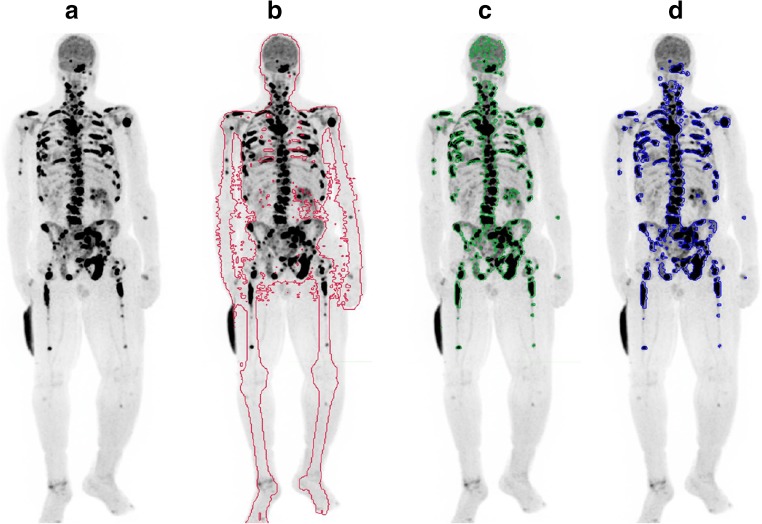
We prospectively recruited patients with advanced urological malignancies into a phase I trial of cabozantinib plus nivolumab with or without ipilimumab. NaF PET/CT scans were performed pre- and 8 weeks post-treatment. We measured the total volume of fluoride avid bone (FTV) using a standardized uptake value (SUV) threshold of 10. We used Kaplan-Meier analysis to predict the overall survival (OS) of patients in terms of SUVmax, FTV, total lesion fluoride (TLF) uptake at baseline and 8 weeks post-treatment, and percent change in FTV and TLF.
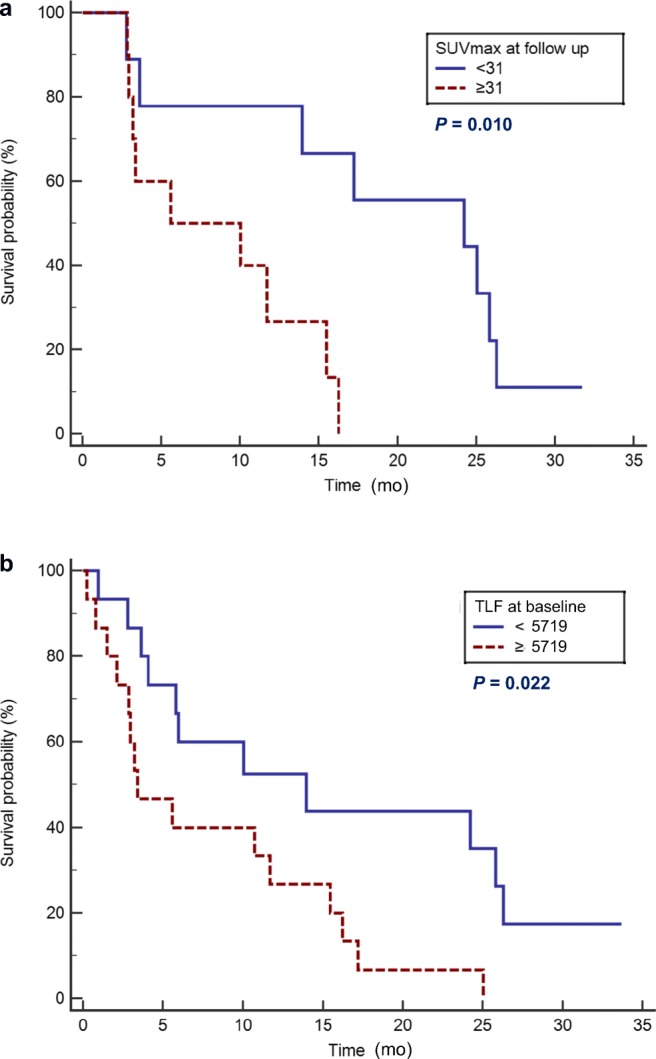
Of 111 patients who underwent NaF PET/CT, 30 had bone metastases at baseline. Four of the 30 patients survived for the duration of the study period. OS ranged from 0.23 to 34 months (m) (median 6.0 m). The baseline FTV of all 30 patients ranged from 9.6 to 1570 ml (median 439 ml). The FTV 8 weeks post-treatment was 56-6296 ml (median 448 ml) from 19 available patients. Patients with higher TLF at baseline had shorter OS than patients with lower TLF (3.4 vs 14 m; p = 0.022). Patients with higher SUVmax at follow-up had shorter OS than patients with lower SUVmax (5.6 vs 24 m; p = 0.010). However, FTV and TLF 8 weeks post-treatment did not show a significant difference between groups (5.6 vs 17 m; p = 0.49), and the percent changes in FTV (12 vs 14 m; p = 0.49) and TLF (5.6 vs 17 m; p = 0.54) also were not significant.
Higher TLF at baseline and higher SUVmax at follow-up NaF PET/CT corresponded with shorter survival in patients with bone metastases from urological malignancies who underwent treatment. NaF PET/CT may be a useful predictor of OS in this population.
我们评估了氟代氟化钠(NaF)PET/CT在接受卡博替尼和纳武单抗治疗、联合或不联合伊匹单抗的泌尿生殖系统恶性肿瘤患者中的预后价值。
我们前瞻性招募晚期泌尿生殖系统恶性肿瘤患者,纳入卡博替尼加纳武单抗联合或不联合伊匹单抗的I期试验。在治疗前和治疗后8周进行NaF PET/CT扫描。我们使用标准化摄取值(SUV)阈值为10来测量氟摄取性骨的总体积(FTV)。我们使用Kaplan-Meier分析,根据SUVmax、FTV、基线和治疗后8周的总病灶氟摄取量(TLF)以及FTV和TLF的变化百分比来预测患者的总生存期(OS)。
在接受NaF PET/CT检查的111例患者中,30例在基线时有骨转移。30例患者中有4例在研究期间存活。OS为0.23至34个月(m)(中位数6.0 m)。所有30例患者的基线FTV为9.6至1570毫升(中位数439毫升)。19例可用患者治疗后8周的FTV为56至6296毫升(中位数448毫升)。基线时TLF较高的患者的OS短于TLF较低的患者(3.4对14 m;p = 0.022)。随访时SUVmax较高的患者的OS短于SUVmax较低的患者(5.6对24 m;p = 0.010)。然而,治疗后8周的FTV和TLF在组间未显示出显著差异(5.6对17 m;p = 0.49),FTV(12对14 m;p = 0.49)和TLF(5.6对17 m;p = 0.54)的变化百分比也不显著。
基线时较高的TLF和随访时较高的NaF PET/CT SUVmax与接受治疗的泌尿生殖系统恶性肿瘤骨转移患者的较短生存期相关。NaF PET/CT可能是该人群OS的有用预测指标。