Division of Nuclear Medicine, Department of Translational Medicine, Lund University, Malmö, Sweden.
Department of Surgery, Skåne University Hospital, Malmö, Sweden.
Eur J Nucl Med Mol Imaging. 2023 Apr;50(5):1510-1520. doi: 10.1007/s00259-023-06108-4. Epub 2023 Jan 18.
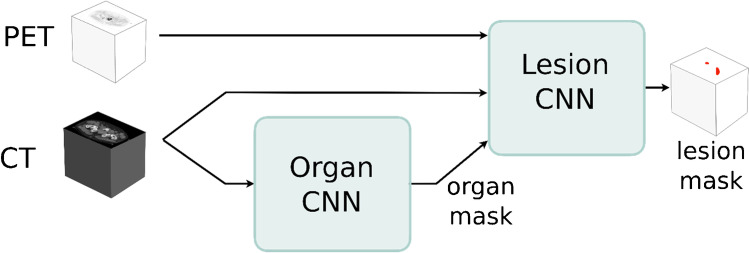
Consistent assessment of bone metastases is crucial for patient management and clinical trials in prostate cancer (PCa). We aimed to develop a fully automated convolutional neural network (CNN)-based model for calculating PET/CT skeletal tumor burden in patients with PCa.
A total of 168 patients from three centers were divided into training, validation, and test groups. Manual annotations of skeletal lesions in [F]fluoride PET/CT scans were used to train a CNN. The AI model was evaluated in 26 patients and compared to segmentations by physicians and to a SUV 15 threshold. PET index representing the percentage of skeletal volume taken up by lesions was estimated.
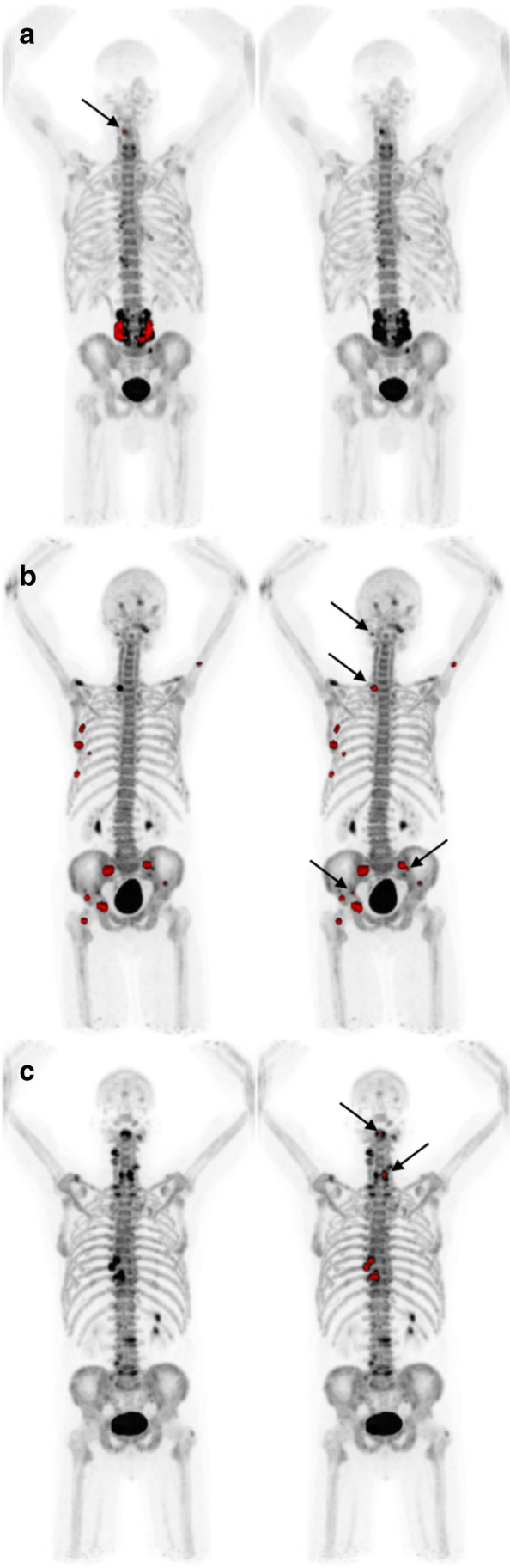
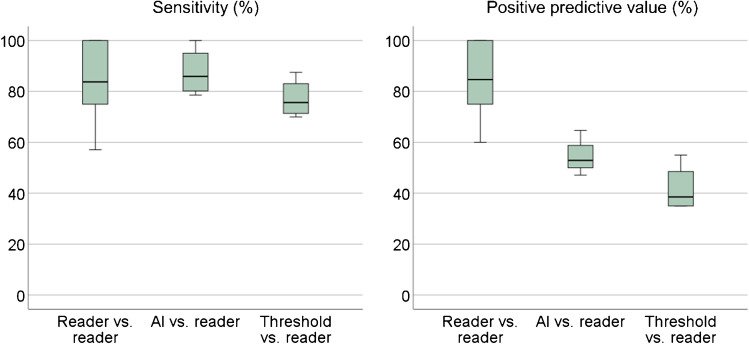
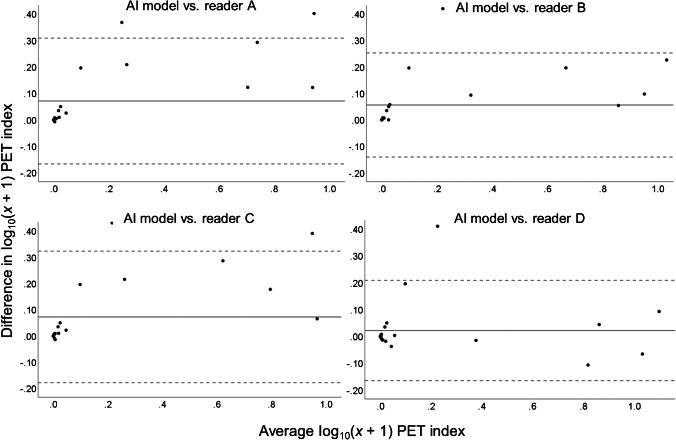
There was no case in which all readers agreed on prevalence of lesions that the AI model failed to detect. PET index by the AI model correlated moderately strong to physician PET index (mean r = 0.69). Threshold PET index correlated fairly with physician PET index (mean r = 0.49). The sensitivity for lesion detection was 65-76% for AI, 68-91% for physicians, and 44-51% for threshold depending on which physician was considered reference.
It was possible to develop an AI-based model for automated assessment of PET/CT skeletal tumor burden. The model's performance was superior to using a threshold and provides fully automated calculation of whole-body skeletal tumor burden. It could be further developed to apply to different radiotracers. Objective scan evaluation is a first step toward developing a PET/CT imaging biomarker for PCa skeletal metastases.
对前列腺癌(PCa)患者的骨转移进行一致的评估对于患者管理和临床试验至关重要。我们旨在开发一种基于完全自动化卷积神经网络(CNN)的模型,用于计算 PCa 患者的 PET/CT 骨骼肿瘤负担。
来自三个中心的 168 名患者被分为训练组、验证组和测试组。使用 [F]氟化物 PET/CT 扫描中的骨骼病变的手动注释来训练 CNN。该 AI 模型在 26 名患者中进行了评估,并与医生的分割以及 SUV15 阈值进行了比较。估计代表病变占据骨骼体积百分比的 PET 指数。
没有一个病例是所有读者都同意 AI 模型未能检测到的病变的患病率。AI 模型的 PET 指数与医生的 PET 指数中度相关(平均 r=0.69)。阈值 PET 指数与医生的 PET 指数相当相关(平均 r=0.49)。对于 AI,对于医生,对于阈值,病变检测的敏感性分别为 65-76%、68-91%和 44-51%,具体取决于哪个医生被认为是参考。
可以开发一种基于 AI 的模型,用于自动评估 PET/CT 骨骼肿瘤负担。该模型的性能优于使用阈值,并且可以提供全身骨骼肿瘤负担的全自动计算。它可以进一步开发以应用于不同的放射性示踪剂。客观扫描评估是开发用于 PCa 骨骼转移的 PET/CT 成像生物标志物的第一步。